Property of a Lady
Dame Laura Knight, R.A., R.W.S.
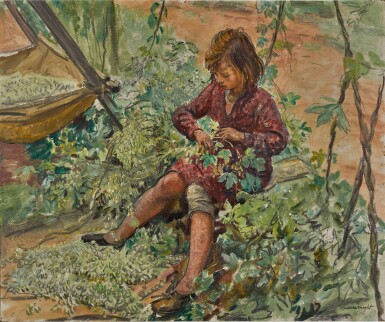
Among the Hop Vines
Auction Closed
December 7, 01:32 PM GMT
Estimate
30,000 - 50,000 GBP
Lot Details
Description
Property of a Lady
Dame Laura Knight, R.A., R.W.S.
British
1877 - 1972
Among the Hop Vines
signed Laura Knight lower right
oil on canvas over black chalk
Unframed: 64 by 76cm., 25 by 30in.
Framed: 86 by 98cm., 34 by 38.5in.
Purchased by Mr D.A. Solomon before 1967 and thence by descent to the present owner
London, Royal Academy, 1946, no. 35
Southport, Atkinson Art Gallery, Festival Exhibition of Local Art Treasures, 1951, no. 65
Southport, Atkinson Art Gallery, Centenary Exhibition, 1967, as The Hop Picker
In 1946 Laura Knight was invited by the National War Records to go to Germany to witness and record the Nuremberg Trials as an official war artist. Understandably, the destruction that she saw in the scarred city and the testimonies against the men on trial, moved her deeply. The descriptions of the atrocities were difficult to comprehend and although she managed to complete the studies for her remarkable painting, The Dock, Nuremberg 1946 (Imperial War Museum) she could not bear to stay any longer than necessary and she had to return home as her sister was unwell. She left before hearing the sentencing. Flying back to Britain, she was invited by the pilot to sit in the co-pilot’s seat so that she could see the terrible sight of the bomb-crater pitted beach at Dunkirk. The war was over but a dark pall had fallen upon Knight and she desperately needed solace. There was only one place she wanted to be – among the hop fields of Malvern, with sunlight dancing through the verdant leaves and the air filled with birdsong and the chatter and laughter of the gypsies and their children. She wrote; ‘How lush and green is our meadowland, how dazzling the pear orchards, then white roofed with blossom, how haphazard is our agriculture – oddly shaped, hedged in, dotted with church, cottage, pig-pen and haystack – all calm and sweet as if war had never been and sorrow never was.’ (Laura Knight, The Magic of Line, 1965, p. 302). Just as Nuremberg would be rebuilt from the rubble and ash, the hop-fields of Malvern would be lush with new growth and the children who harvested the hops would live with a renewed hope for the future. Knight wrote; 'Haunting still is the nightmare of Nuremberg. I nudge my mind and tell myself, 'Forget'. So it comes about that horror is again effaced - nature herself blots it out.' (ibid, Knight p.309).
Knight had painted her first depictions of the hop pickers of Malvern just after the outbreak of WWII. The Knights' staff had abandoned the house at Langford Place without any notice - leaving so hastily that they did not even remove the sheets from their beds - and a well-meaning neighbour had turned off the water-supply causing the pipes to burst. Harold Knight went to Scotland to undertake a commission to paint one of the few portraits that was not cancelled when war was announced and Laura decided to travel to Malvern to escape the domestic troubles. 'I stayed in Malvern, where to keep myself from going crackers, I painted the nearest thing to hand: the old back garden gate belonging to the hotel, and almost the last rose of summer, anything... no matter what... so long as I didn't stop to think.' (ibid Knight, p. 273). One of the reasons for Laura's trip to Malvern was that she had wanted to paint hop-pickers for some time and close to the town she found Callow Farm where gypsies were employed to harvest the hops. 'At the door of the taxi which I hired daily to take me to Callow End, I always found an elderly man, named Godfrey, who was ready and waiting to go with me, despite my wish for his absence. He knew all about hops. He knew all about everything in this world as well as in the world to come... he knew all about art and artists, and what would make the best picture in a hop field... Like painting anything on the move, such as race-meeting crowds, the constant change taking place during the stripping of the hop-vines is nervy work. An artist has to finish as he goes; you cannot reckon on seeing the same thing twice.' (Ibid, Knight, pp. 273-74).
Among the pictures of hop-pickers painted by Knight at the beginning of the war are The Hop Pickers, Malvern (sold in these rooms 13 December 2005, lot 77), At the Hop-Bin (Christie's, London, 6 March 1992, lot 4) and Young Gypsies (Worthing Museum and Art Gallery). But Knight was not done with the subject and found it endlessly fascinating. In 1946, almost a decade after she had first painted the hop harvest, she painted Hop Picking No 1 (Canterbury Art Gallery) and the present picture, Among the Hop Vines of a young girl separating the hops from the leaves to be loaded into canvas bins to dry in the sunshine.
Among the Hop Vines was exhibited at the Royal Academy in 1946 with two of Knight's depictions of munitions workers In a Bearing Factory: Steel and Oil and In a Bearing Factory: Visual Inspection and The Dock, Nuremberg 1946. Knight’s importance as a modern artist painting highly significant subjects of contemporary life should not be underestimated. It may seem that Among the Hop Vines depicts an insignificant subject compared to Knights other paintings exhibited that year but this is not the case – it depicts the renewed hope that she found in Malvern, amongst the children and the vines.
This picture will be included in the Catalogue Raisonné of the artist's works, currently being compiled by Mr R. John Croft FCA, the artist's great nephew.
You May Also Like