
Property of a Lady
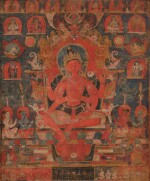
A paubha depicting Avalokiteshvara, Nepal, circa 1300
Auction Closed
September 18, 04:57 PM GMT
Estimate
80,000 - 120,000 USD
Lot Details
Description
A paubha depicting Avalokiteshvara
Nepal, circa 1300
尼泊爾 約1300年 觀音唐卡
distemper on cloth
Himalayan Art Resources item no. 13919.
HAR編號13919
Height 25⅝ in., 65 cm; Width 21⅛ in., 54 cm
Collection of Ulrich von Schroeder
Collection of Lionel (1943-2017) and Danielle Fournier.
Christie's Paris, 12th December 2018, lot 36.
Ulrich von Schroeder 收藏
Lionel (1943-2017) 及 Danielle Fournier 伉儷收藏
巴黎佳士得2018年12月12日,編號36
Art ésotérique de l'Himâlaya: Catalogue de la donation Lionel Fournier, Musée Guimet, Paris, 1990, cat. no. D.
Helmut Uhlig, Tantrische Kunst des Buddhismus, Verlag Ullstein GmbH Berlin, 1981, pp 156-57, cat. no. 52
The red six-armed Avalokiteshvara with his principal hands before his chest in the teaching gesture (dharmachakra mudra), a rosary (mala) and manuscript (pustaka) in his upper left and right hands, the lowered right displaying the boon-granting gesture (varada mudra) and the lower left hand in the lap holding the stem of a lotus flowering at the shoulder, the bodhisattva seated at ease (lalitasana) on a tiered lotus throne draped with a floral patterned cloth, with peacocks and recumbent deer either side of a white lotus in the lower tier, serpent kings (nagaraja) in obeisance at either side, an arch (torana) behind with snow lions, semi-avian creatures (kinnara) and hybrid lions (vyala) at each side, adorsed crocodilian creatures (makara) on the crossbar and Garuda above clutching serpent deities (naga) in his talons, the throne flanked by palm trees and the goddesses Tara, Bhrikuti, Vilokini and Bhurini, red Macchendranath and white eight-armed Amoghapasha to the left and right above with sun, moon and celestial beings (vidyadhara), Avalokiteshvara Sadaksari upper left with a red six-armed form of Avalokiteshvara and two unidentified deities upper right, the topmost register with the five dhyani Buddhas and two bodhisattva, and scenes in the lower register of an officiant (vajracharya) presiding over a fire ceremony (homa), ritual offerings on tall stands, and a family of donors.
Close stylistic parallels are seen in the renowned set of three Tathagata paintings in American museum collections that are attributed to a Nepalese artist commissioned by a Tibetan patron, see Steven M. Kossak and Jane Casey Singer, Sacred Visions: Early Paintings from Central Tibet, New York, 1998, pp. 138-43, cat. nos. 36 a, b, c. Similarities include the elegant, uncrowded composition, the large scale of the principal figure, the delicate armbands, pearl necklaces and triple bracelets, the patterned dhoti, the design of the tiered throne and lotus petal seat, the folds of the throne cloth, the format of the torana, and the detail in the lower tier of the throne in which a diminutive pair of recumbent deer flank the emblem of each deity: the white lotus of Avalokiteshvara in this painting, and the Tathagatas’ triratna, visvavajra and patra. The donor family and ritual scenes on the Avalokiteshvara indicate it was painted by a Newar artist for a local Nepalese patron. Such similarities in style would suggest the set of three paintings and the Avalokiteshvara were painted in the same general time period, perhaps within a few generations of artists in the Newar community. The Tathagatas have been attributed to the twelfth century in John C. Huntington and Dina Bangdel, The Circle of Bliss: Buddhist Meditational Art, Columbus, 2003, pp. 95-97, cat. no. 13, and thirteenth century in Kossak and Casey Singer, op. cit, pp. 138-43. The Avalokiteshvara is ascribed a date of thirteenth century in Helmut Uhlig, Tantrische Kunst des Buddhismus, Verlag Ullstein GmbH Berlin, 1981, pp. 156-7, and circa 1300 in Béguin, op. cit. A circa 1300 date would make the Avalokiteshvara one of the earliest known paintings on cloth from Nepal.