
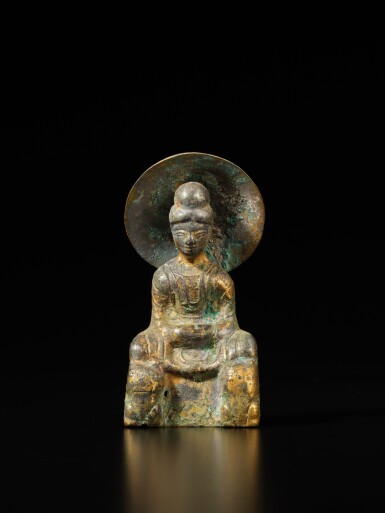
A gilt-bronze seated figure of Shakyamuni Buddha, Sixteen Kingdoms Period
Auction Closed
September 18, 04:57 PM GMT
Estimate
20,000 - 30,000 USD
Lot Details
Description
A gilt-bronze seated figure of Shakyamuni Buddha
Sixteen Kingdoms Period
銅鎏金釋迦牟尼佛坐像
Japanese wood box (3)
Height overall 3⅜ in., 8.6 cm.
Japanese Private Collection.
This finely cast small figure of Shakyamuni Buddha represents one of the classic images of early Chinese Buddhist sculpture, where the 'Awakened One' is depicted seated on a throne flanked by lions, the hands held in the dhyanamudra, the gesture of meditation, wearing a monastic robe that falls gently over the lap and with a facial expression of complete calmness and confidence. The strong influence of the art of Gandhara and somewhat that of Mathura from northern India, is evident, although the iconography of the throne is Chinese. The formal position and simple, almost abstract rendering of the folds make this early highly stylised sculpture particularly powerful. Compare an Indian green schist figure of similar proportions, but much larger in size, carved in the Gandharan tradition and attributed to the 3rd/4th century, and believed to have come from Barikot, now in the collection of the Matsuoka Museum of Art, illustrated in Ancient Asian Sculptures from the Matsuoka Collection, Tokyo, 1994, cat. no. 8.
The present figure is therefore among the finest examples of a small series of early Chinese Buddhist bronzes that incorporate the new iconography borrowed from votive images in India executed in the Gandharan and Guptan style. Among the largest and most impressive of these figures is the famous Buddha from the Avery Brundage Collection, illustrated in The Asian Art Museum of San Francisco. Selected Works, San Francisco, 1994, p. 91. This large figure, which measures 39.5 cm high, bears a fragmentary inscription dated 338. This was during the Jianwu reign of Emperor Shi Hu of the later Zhao dynasty, which only briefly controlled a large portion of north China from 329–350, and which was of a non-Chinese tribe, the Jie from the northern Steppes. Unlike the more languid and staple political structure of south China, which bred a version of Buddhism more favoured towards political discourse, the numerous political upheavals and rapidly changing social structure in northern China nurtured fervent religiosity and an adherence to source Indian texts, a desire to return to fundamental principles both in doctrine and in iconography; hence the rapid absorption of Indian sculptural models, as expressed on the present sculpture in the geometricised drapery inspired by Guptan figures, and in the squared features with large eyes and wavy hair, which hint at Central Asian facial proportions.
This correlation is even more pronounced in the second famous image, from the Grenville Winthrop Collection, now in the Arthur M. Sackler Museum, Harvard University, Cambridge, illustrated in Hugo Munsterberg, Chinese Buddhist Bronzes, Tokyo, 1967, fig. 3, which has Indian facial features and Gandharan sculptural influences, yet already bears the flanking lions and central pot of lotus with flaring stems as found on the present example. The image of closest relevance to the present piece, with identical proportions and iconography, is the famous small gilt-bronze sculpture in the Nelson Atkins Museum of Art, Kansas City, with two additional worshippers flanking the lotus between the lions, illustrated ibid., fig. 2. and in the Handbook of the Collections, vol. II, Kansas City, 1973, p. 30.
As for the geographic origins of the present figure, an attribution to Hebei province is likely. Compare a votive image of identical central section, but bearing attendants and flying apsaras in relief, below an umbrella canopy and the separate four-footed pedestal base, excavated from Shijiazhuang, Hebei province in 1955, and recently exhibited in China. Dawn of A Golden Age (200 - 750AD), The Metropolitan Museum of Art, New York, 2004, cat. no. 45. Compare several other figures with more distantly related mandorla, op. cit., fig. 4, from the Hart and later the Minkenhof Collections, exhibited at Eskenazi, London, 1977, and illustrated on the catalogue cover; and another in the Nelson Atkins Gallery, also with worshippers but without mandorla published in Hai-wai yi-chen. Chinese Art in Overseas Collections. Buddhist Sculpture, Taipei, 1986, pl. 3.
See also several closely related small figures, in the Sumitomo Collection, included in the exhibition Kondobutsu, Sen-oku Hakkokan, Kyoto, 2004, cat. nos. 3 and 5; and another of slightly larger size included in the exhibition Three Thousand Years of China: The Beauty of Beauty, Mitsukoshi, Tokyo, 1973, cat. no. 29; one included in the Special Exhibition of Recently Acquired Gilt-Bronze Buddhist Images, National Palace Museum, Taipei, 1996, cat. no. 1; and another in a Japanese collection illustrated in Saburo Matsubara, Chugoku Bukkyo Choukoku Shi Ron, vol. 1, 1995, pl. 13a-c.
For an early gilt-bronze figure of Sakyamuni sold at auction, see an example of similar size, form and iconography, formerly in the collection of Muneichi Nitta, sold in our New York rooms, 21st September, 2006, lot 111; and a larger one, measuring 13 cm, sold in our New York rooms, 22nd September 2005, lot 8, and again at Christie's New York, 20th March 2014, lot 1601. See also two closely related examples (without mandorlas) from the collections of Sato Gengen and Goro Sakamoto, sold in our Hong Kong rooms, 5th October 2016, lots 3201 and 3202.