George Condo
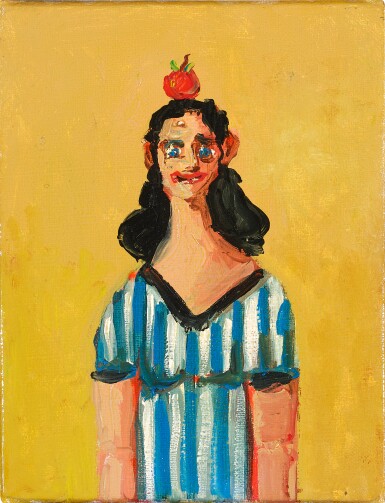
Girl in Striped Dress
Lot Closed
July 19, 02:01 PM GMT
Estimate
60,000 - 80,000 USD
Lot Details
Description
George Condo
b. 1957
Girl in Striped Dress
signed, titled and dated 2001 May N.Y.C (on the reverse)
oil on canvas
7⅛ by 5½ in.
18.1 by 14 cm.
Executed in 2001.
Galerie Andrea Caratsch, St. Moritz
Private Collection (acquired from the above)
Sotheby's London, 24 November 2020, lot 81 (consigned by the above)
Acquired from the above by the present owner
St. Moritz, Galerie Andrea Caratsch, The Art of Condognato, December 2014 - April 2015
Throughout George Condo’s practice, the subject of the woman assumes a special presence. When asked about his prolific use of women as an artistic subject in a 2004 interview, Condo remarked that “for many personal, objective reasons, I thought it was a subject that could be approached with a number of ideas” (Kellein 32).
Indeed, his Girl in Striped Dress expresses a multiplicity of thought. Alluding to his self-titled style of “physiological cubism,” Girl in Striped Dress explores the simulacra of personality elemental to Condo’s portraiture. Animated, piercingly blue eyes are suffused with undeniable, though indistinguishable, emotions; a clown-like smile, both joyous and sorrowful, further magnifies the dimensionality of the figure. She is at once cartoonish and realistic, naive and mature.
In creating this multi-dimensioned Girl in Striped Dress, Condo appears to have been inspired by Édouard Manet’s Woman in Striped Dress (ca. 1877-80). Condo is known to draw stimulus from other great artists, ranging from Goya to Warhol, especially their portraits of women—“the most impressive works by the masters were these kind of portraits or women subjects" (Kellein 34). In Woman in Striped Dress, Manet creates a portrait which is modern both in subject and style, epitomized by the fashionable Parisian bourgeois women's striped dress. With effortless, dominating strokes, Manet constructs a striped dress which unabashedly defines the woman wearing it.
In Girl in Striped Dress, Condo renews this striped dress motif for a contemporary expression of portraiture. Rather than focusing on the artistic performance of the striped dress, Condo fixates on the face. Employing simple, thick brushstrokes, Condo brilliantly conveys a multiplicity of emotions in a single look. Manet’s striped dress personifies his subject; but for Condo, the striped dress is the least interesting thing about his subject. Condo balances the subject with his imagination, composing a fresh, playful conception of a woman portrait.
Thomas Kellein, “Interview with George Condo, New York, 15 April 2004,” George Condo: One Hundred Women, Hatje Cantz Publishers, 2005, pp. 29-39.
You May Also Like