
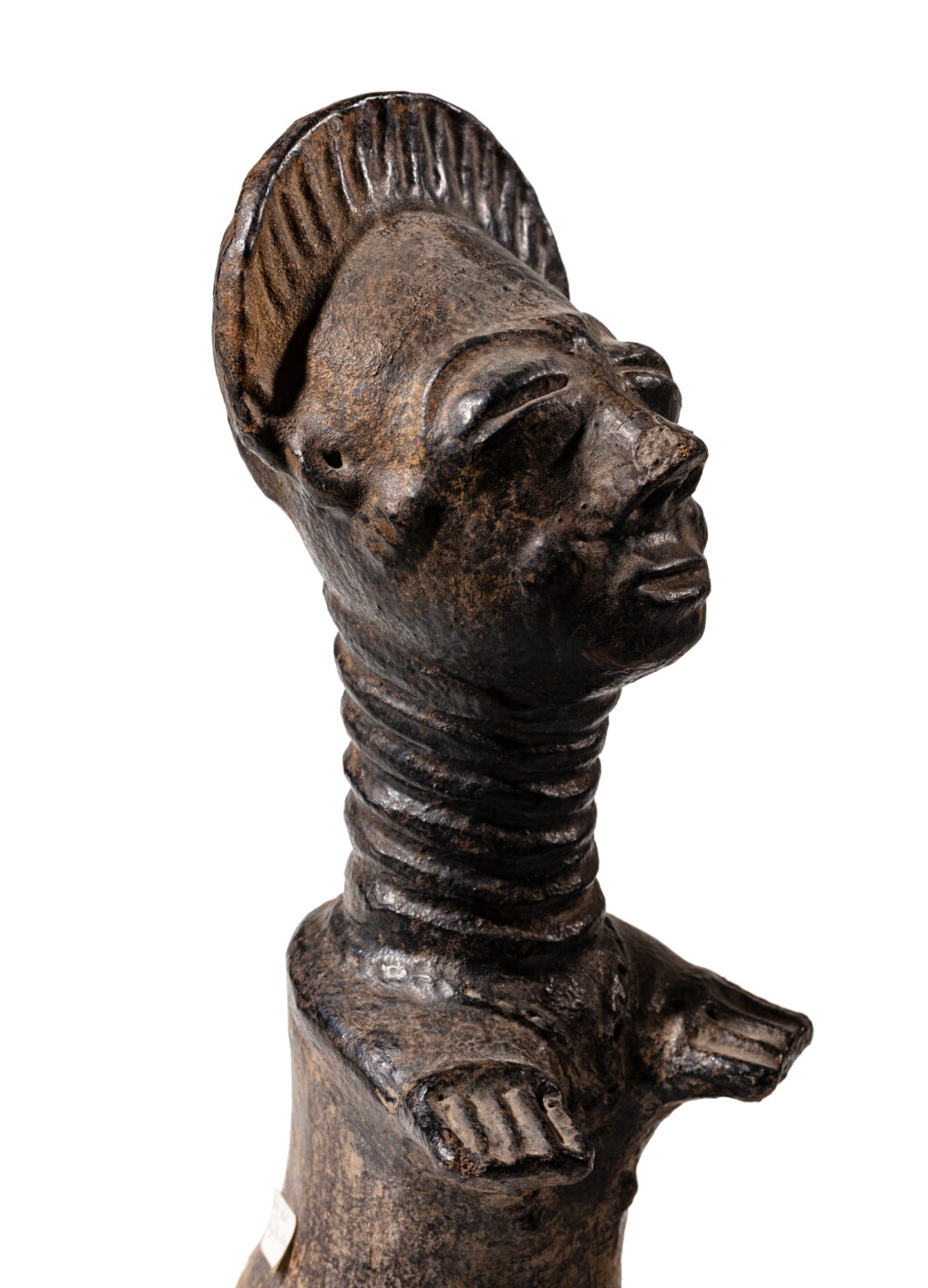
Buste funéraire Anyi, Région de Krinjabo, Côte d'Ivoire
Anyi Funerary Figure, Krinjabo region, Côte d'Ivoire
Auction Closed
June 21, 04:43 PM GMT
Estimate
4,000 - 6,000 EUR
Lot Details
Description
Buste funéraire Anyi, Région de Krinjabo, Côte d'Ivoire
haut. 26 cm ; 10¼ in
---------------------------------------------------------------------------
Anyi Funerary Figure, Krinjabo region, Côte d'Ivoire
Height. 26 cm ; 10¼ in
Collection Dr Marcel Lheureux, France
Collection Hélène Leloup, Paris
---------------------------------------------------------------------------
Dr Marcel Lheureux collection, France
Hélène Leloup collection, Paris
Paris, Galerie Pigalle, Exposition d'art africain et d'art océanien, 1930
---------------------------------------------------------------------------
Paris, Galerie Pigalle, Exposition d'art africain et d'art océanien, 1930
Galerie Pigalle, Exposition d'art africain et d'art océanien, 1930, p. 8, n° 31
---------------------------------------------------------------------------
Galerie Pigalle, Exposition d'art africain et d'art océanien, 1930, p. 8, n° 31
Figure commémorative mma, Anyi, Côte d’Ivoire
Par Jacques Germain
Selon la tradition orale, c’est au XVIIème siècle que la reine Akou Aman fonde le royaume anyi au pourtour d’une lagune sise au sud-est de la Côte d’Ivoire. La production de statuettes anthropomorphes de terre cuite a su conférer à l’art anyi ses lettres de noblesse et ces représentations de défunts, façonnées à même l’argile, ont ainsi servi pendant plus de deux siècles d‘éléments sémiotiques propres aux exigences du culte des ancêtres. Leur production cesse vers 1914, et ce, suite à l’implantation d’un mouvement syncrétique qui tolérait mal de telles manifestations du vécu animiste.
Ces objets, connus sous l’appellation de mma, étaient chargés de recueillir l’âme des morts, sans pour autant qu’il ne s’agisse de portraits dans le sens de l’acceptation occidentale du terme. On reconnaîtra l’identité du disparu grâce à une série d’indices, dont la présence de barbe, de scarifications, d’un certain type de coiffure, d’un instrument de musique ou de bijoux. Si à l’origine, les mma commémoraient les hommes et les femmes les plus en vue de la société anyi, la pratique s’est graduellement étendue vers les autres classes de la société sans que les enfants (donc ceux qui n’ont jamais eu de descendance) n’aient eu droit à un tel privilège.
Outre son utilisation dans un contexte funéraire, mention doit être faite du rôle des mma pendant les rites de purification collective à l’aube du nouvel an, événement correspondant à la fête des prémices de l’igname, tubercule à la base de l’alimentation. Des offrandes faites en cette période de communion avec les ancêtres aidaient souvent les femmes infertiles à connaître la grossesse tant espérée.
Le mma proposé de la collection Leloup semble être de toute évidence celui d’un chef, compte tenu que le personnage est notamment doté d’une coiffure au rendu expansif. La teinture noire matte de l’artefact met en évidence les composantes classiques du visage, soit les yeux mi-clos et la grande intériorité du regard.
Le cou annelé témoigne du prestige social de l’individu : plusieurs sociétés habitant un axe presqu’ininterrompu de la zone ouest africaine ont recours à cet élément stylistique. Dans la majorité des cas, cette particularité, considérée comme une stylisation reste associée à un idéal de beauté.
---------------------------------------------------------------------------
A mma Commemorative Figure, Anyi, Ivory Coast
By Jacques Germain
According to oral tradition, it was in the 17th century that Queen Akou Aman founded the Anyi kingdom around a lagoon located in the southeast of Ivory Coast. The production of anthropomorphic terracotta statues gave the Anyi art its prestige. These representations of the deceased, shaped from clay, served for over two centuries as semiotic elements specific to the requirements of ancestor worship. Their production ceased around 1914 due to the establishment of a syncretic movement that did not tolerate such manifestations of animistic experiences.
These objects, known as "mma", were responsible for capturing the souls of the dead, although they were not portraits in the Western sense of the term. The identity of the deceased could be recognized through a series of clues, such as the presence of a beard, scarifications, a certain type of hairstyle, a musical instrument, or jewelry. While initially mma commemorated the most prominent men and women in Anyi society, the practice gradually extended to other social classes, excluding children (those who never had offspring) from such privileges.
In addition to their use in a funerary context, mma also played an important role during collective purification rites at the dawn of the new year, corresponding to the festival of the first yam harvest, a staple food. Offerings made during this period of communion with the ancestors often helped infertile women achieve the long-awaited pregnancy.
The mma proposed from the Leloup Collection is clearly a representation of a chief, considering that the character is notably adorned with an expansive hairstyle. The matte black dye on the surface of the terracotta highlights the classic facial features, such as the half-closed eyes and the deep inward gaze.
The ringed neck testifies to the individual's social prestige: many societies inhabiting an almost uninterrupted axis in the West African region make use of this stylistic element. In most cases, this characteristic, considered a stylization, remains associated with an ideal of beauty.
You May Also Like


