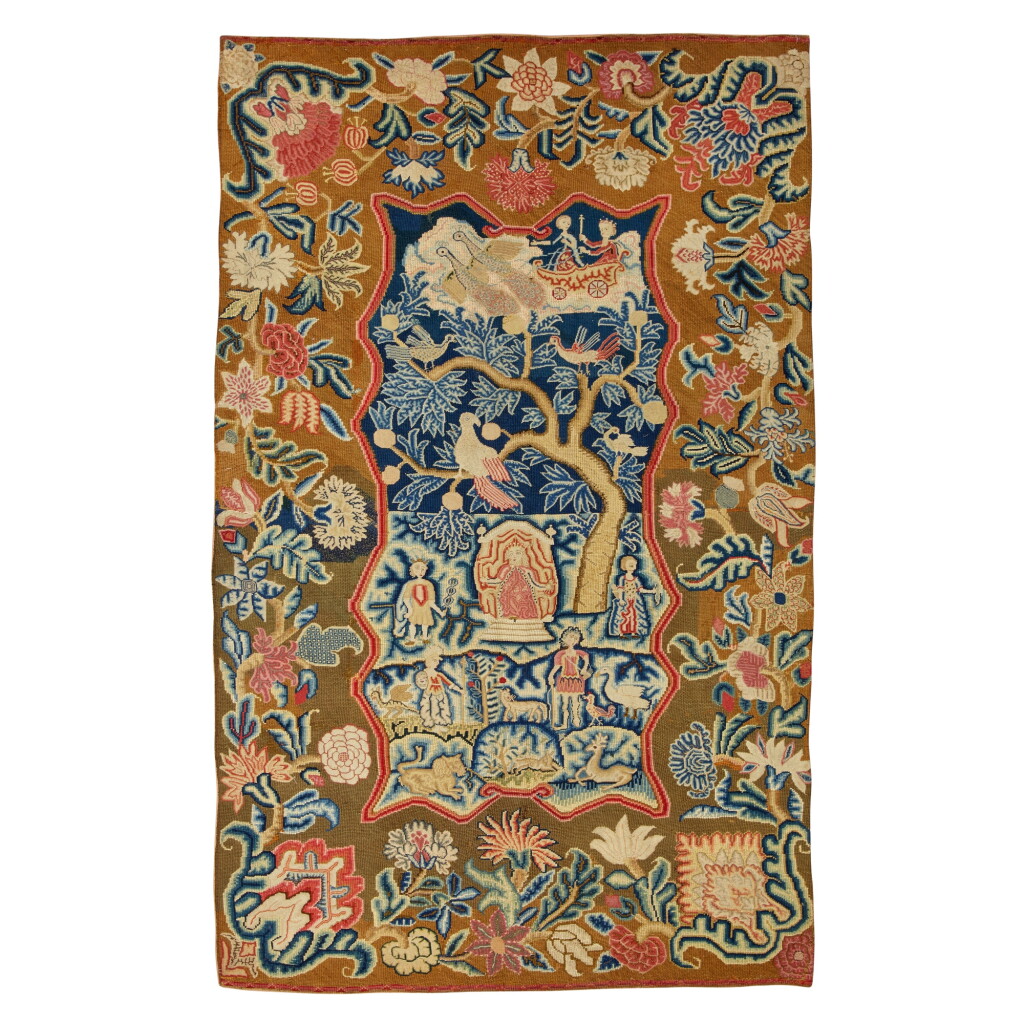
An English mythological and floral needlework carpet, Queen Anne, circa 1705
Lot Closed
May 23, 01:32 PM GMT
Estimate
10,000 - 15,000 GBP
Lot Details
Description
An English mythological and floral needlework carpet, Queen Anne, circa 1705
worked in wool and silk on a linen canvas, in gros and petit point, the carpet is centred with an irregularly outlined rectangular cartouche enclosing various charmingly naive classical figures in stylised surroundings, the cartouche is divided into three sections, with an exuberantly leaved tree with various birds extending through the middle and top section, the top section being the largest (half of the cartouche) and depicts, a large cloud with Hera, wife and sister of Zeus, and Queen of the Gods, driving a chariot pulled by peacocks, which are her attribute, the middle section, depicts the trunk of the exuberant tree extending upwards towards the sky, and Zeus is portrayed seated on a dias under a canopy with his attribute of thunder/lightening bolts, with the figure on the left of Hermes, God of science and invention, and best know as messenger of the gods, and standing on the right is Artemis, twin sister of Apollo, and goddess of the hunt, holding her bow and arrow, below this scene the lower section depicts Athena, daughter of Zeus carrying her father's shield (the aegis) and the figure of Apollo, patron and defender of herds and flocks, with his gold bow and arrow, surrounded by exotic birds and the corners with the lion and hart of England, surrounded on four sides by exuberant flowering and foliate sprigs, and each corner with a large leaf clasped flowerhead orientated from the corner into the nearest top corner of the cartouche, against a warm dark almond coloured ground
Approximately 256cm. long, 160cm. wide; 8ft. 4in., 5ft. 2in.
Lord Ivor Spencer Churchill (1898-1956)
Arditti & Mayorcas, London
Messrs. Phillips of Hitchin Ltd
S.W.Wolsey, London
Lady Eileen Joseph wife of Sir Maxwell Joseph
Private Collection
Mayorcas, M,J, English Needlework Carpets - 16th to 19th centuries, F.Lewis Publishers, 1963, p.35, & black and white plate 19. It was catalogued as English with the comment that ‘the very fine tent stitch centre is very reminiscent of Dutch needlework which was made in Delft and Leyden in the late 1680’s. The outer border still retains a strong influence of Jacobean crewel woolwork.’ The writer attributes the style to Dutch embroidery in Delft and Leiden of 15-20 years earlier, which was erroneously referred to in this country as being English. Mayorcas dates the carpet to c. 1705, ‘when the Dutch style was still used in England’, and he couldn’t put it any earlier than this as there are the beginnings of motifs seen in later examples. The image used is cited as being courtesy of Messrs. Phillips of Hitchin Ltd.
Mayorcas, M,J, English Needlework Carpets - 16th to 19th centuries, F. Lewis Publishers, 1963, p.35, & black and white plate 19.
Synge, Lanto, Art of Embroidery – History, Style and Technique, Antique Collectors Club, 2001, Chp. 7, The eighteenth century, pp.170-225, Carpets, pp.198-203, pl.188-190, for discussion of carpets and illustrations of slightly later variations of comparable foliate design motifs and colouration, albeit it with fields with baskets of flowers and no figures or animals. The English flower style and the Indian inspired exuberant plants are present on furniture covers on earlier English chairs, of 1720 and 1710 respectively, again on the almond ground which became so distinctly English in the first half of the eighteenth century, op.cit, pp.234-235, pl.226 & 228. The figural types are reminiscent of those found in early eighteenth century narrative fire-screens and panels, although not with the charm and naivity, which is almost more of an echo of seventeenth century English figural types found on caskets and pillows, of which there are notable examples in both the Victoria and Albert Museum, London, and the Metropolitan Museum of Art, New York.
It really is charming and is a rare example of an early 18th century English carpet. Small carpets, originally used as table carpets were highly prized textiles, and the Dutch examples of the 17th century, with their fascination and creative depiction of flowers, along with cartouches enclosing either biblical or mythological scenes, were influential. Especially when we consider that William of Orange/William III of England had been brought up in Holland before coming to England as King from 1689-1702. The design and figural groups of the present carpet recall Indian chintz designs, Japanese lacquer, Italian scagliola, English 17th century embroidery and European folk art, and highlight the extent of the influences of designs. It is a very decorative textile.
Lord Ivor Spencer Churchill (1898-1956)
Lord Ivor Spencer Churchill (1898-1956) who was younger son of the 9th Duke of Marlborough, is the earliest known owner that can be traced. His mother was Consuelo Vanderbilt (1877-1964), the American heiress who married the 9th Duke of Marlborough and inherited Blenheim Palace. Winston Churchill was Consuelo's cousin. She was a great collector so it is more than likely that the son Ivor inherited the carpet from his mother and later sold it.
The carpet then appears to have been bought by dealers Arditti & Mayorcas. They were established, renowned and knowledgeable London antique dealers, and Mayorcas were particularly known for their textile stock.
Phillips of Hitchin
Phillips of Hitchin, a family firm which were one of the leading provincial dealers in the country. Jerome Phillips joined the company in 1961 but did not recall the carpet. It was considered possible that Phillips and Mayorcas had joint interest in the carpet at the time. The Phillips firm closed in 2014 with the archive going to the University of Leeds in the newly formed Antique Trades department, where it was to be catalogued.
Samuel Wolsey (1895-1980)
Samuel Wolsey (1895-1980) was a leading London dealer, trading with his brother from Buckingham Gate, specialising in antique oak furniture(1924-69). Wolsey assembled a large collection of photographs of the stock that he traded in over the course of 50 years (location of archive unknown); many of his photographs (although none of carpets) were used as illustrations for his publication on early furniture - Wolsey and Luff, Furniture in England, the Age of the Joiner, (1969).
The antiques dealer Samuel Wolsey was the main source for the collection of Lady Eileen Joseph, wife of Sir Maxwell Joseph, founder of Grand Metropolitan hotels in the 1960’s. They lived in a house between Pelham Street and Onslow Square, London, SW7. It is probable that Wolsey supplied this needlework carpet to Lady Joseph, although there are no formal family records to this effect. The Lady Joseph Charitable Trust was formed in 2009.
You May Also Like