
Property from the Henry Lawrence Collection
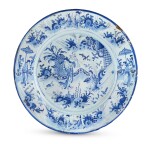
An English delftware initialed and dated large Chinoiserie dish, 1698, attributed to Brislington
Lot Closed
November 8, 12:37 PM GMT
Estimate
10,000 - 15,000 GBP
Lot Details
Description
Property from the Henry Lawrence Collection
An English delftware initialed and dated large Chinoiserie dish, 1698, attributed to Brislington
painted in shades of blue with a figure of a lady holding a fan beside an attendant on a terrace below the ownership initials .G./.T,S. above the date 1698, within concentric circles to the well, the border with further vignettes of figures with parasols and figures seating among rockwork below a thick blue rim, the underside boldly painted with a star below crosses and circles
50cm. diameter
Anonymous, sale Phillips, London, 4th December 1985, lot 117;
Henry Lawrence (1925-2016)
On loan to the Bristol Museum & Art Gallery, 2001-2023.
Michael Archer, “Delftware Chinoiserie at Brislington in the late Seventeenth and early Eighteenth Centuries”, Transactions of the English Ceramic Circle, vol. 19, no. 3, pp. 518-9, fig. 24.
In his paper read to the English Ceramic Circle in November 2005, Michael Archer examines the case for the attribution of certain delftware chinoiserie designs to the Brislington works near Bristol, see Michael Archer, “Delftware Chinoiserie at Brislington in the late Seventeenth and early Eighteenth Centuries”, Transactions, Vol. 19, no. 3, pp. 509-526. The Brislington works were likely set up by John Brissicke from the Montague Close pottery in Southwark, perhaps in collaboration with Robert Bennett, also thought to be from London. The works were founded in about 1642 and operated form just over a century. The author bases his attributions on the similarities between the decoration on excavated sherds unearthed in Brislington and around Bristol in 1914-15 and surviving intact examples in Museum and private collections. He suggests groupings of pieces which share similar decoration, notably with royal portrait subjects. The decoration of distinctive L-shaped figures which imitates Chinese porcelain of the late Ming Dynasty (which also inspired Japanese porcelain decorators) is used on large delftware dishes, elaborate posset-pots and punch bowls of the late Stuart period.
The present large dish is the earliest of six dated examples in a group distinguished by their unusually large size, the elaborate cross and circle decoration to the back of the dishes, the use of ownership initials and a close range of dates from 1698 to 1703. Four of this group are recorded in Lipski & Archer, Dated English Delftware, London, 1984, nos. 234-7, the present example which came to light following publication of the work on dated delftware and the sixth painted with a vase issuing flowers among birds and foliage sold Sotheby’s, London, 2nd June 2005, lot 78.
You May Also Like