
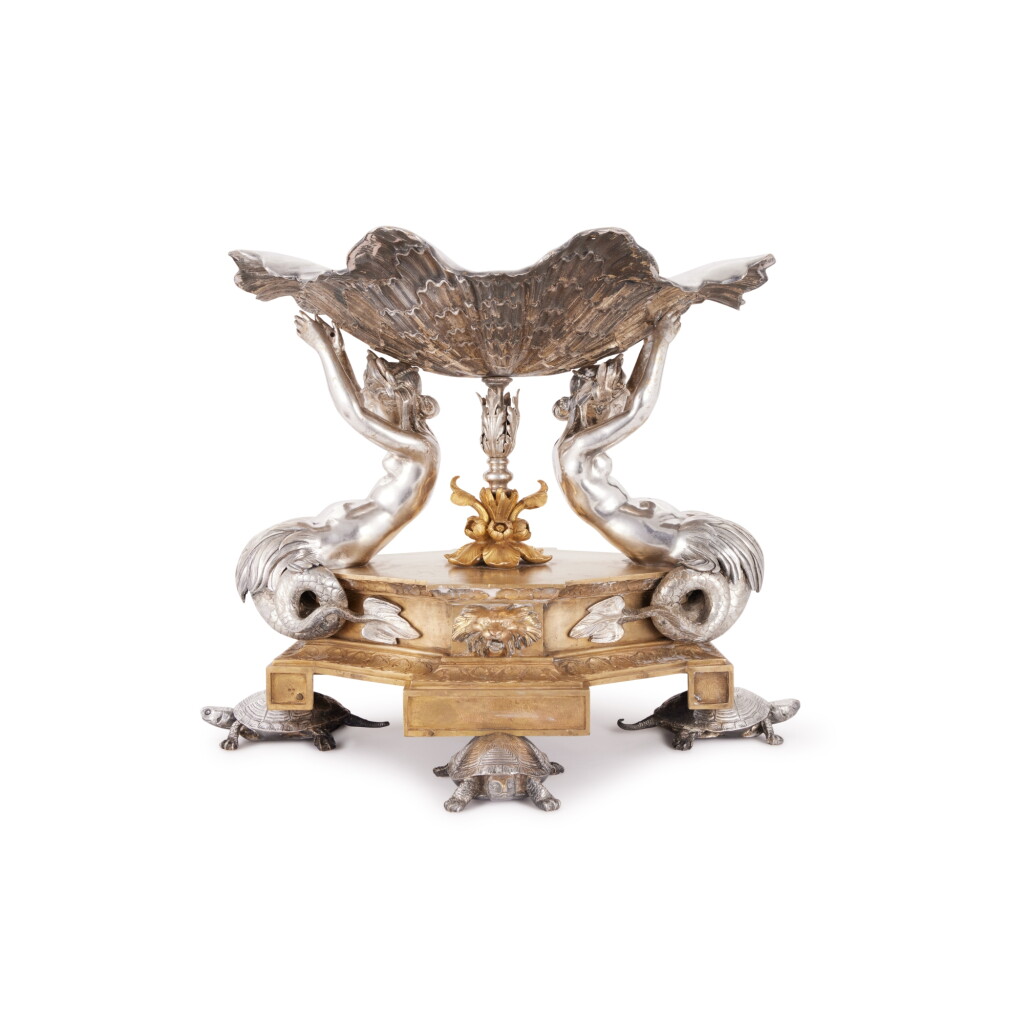
Attributed to François Désiré Froment-Meurice, (1802-1855) A Silvered and Gilt-Bronze Surtout, Probably After a Design by Jean-Baptiste Klagman, Circa 1844
Lot Closed
October 17, 06:35 PM GMT
Estimate
6,000 - 9,000 USD
Lot Details
Description
Attributed to François Désiré Froment-Meurice, (1802-1855)
A Silvered and Gilt-Bronze Surtout, Probably After a Design by Jean-Baptiste Klagman, Circa 1844
lacking elements
Height 17 3/4 in.; Width 23 in.
depth 19 3/4 in.
45 cm.; 58.5 cm.; 50 cm.
Exposition des produits de l'industrie française 1849, Paris
(Exhibition of Products of French Industry) was a public trade fair organized in Paris, France, from 1798 to 1849.
Illustrated in: Un âge d'or des Arts Decoratifs 1814-1848, Paris 1991, ill. 241b, p. 429, see last image in black and white.
Related Literature:
Reinier Baarsen, Paris 1650-1900, Decorative Arts in the Rijksmuseum, Yale University Press, New Haven and London. in association with the Rijksmuseum, Amsterdam 2013, p.521, ill 127 for a discussion and an illustration of a Silver-Gilt Cup by
François Désiré Froment-Meurice executed by Jules Wiese.
The renowned nineteenth-century jeweler and goldsmithing firm, Froment-Meurice, was founded by François Désiré Froment-Meurice (1802-55) and continued by his son Émile (1837-1913).
Froment-Meurice was qualified as the ‘Cellini of his time’ by Victor Hugo, and rapidly developed a most influential worldwide clientele, including the Shah of Iran, the Pope, the Tsar of Russia, the Bonaparte family, the Royal Orleans family and Queen Victoria.
The son and stepson of goldsmiths, he took over a modest family firm in 1832, and registered his own mark the year after. He first came to public notice at the exhibition of products of the French industries of 1839, and with his display at the next held five years later, he emerged as a triumphantly artist. He was awarded a gold medal, and this was repeated in 1849. At the Great Exhibition in London Froment-Meurice's leading international position was definitely affirmed, and honors were showered on him on both sides of the Channel.
In 1855, a few weeks before the opening in Paris of the next Universal Exhibition, he died unexpectedly, aged 54. His widow continued the business until it was taken over by their son in 1859.
The sculptor Jean-Baptiste Klagmann (1810-1867) was the pupil of Jean-Jacques Feuchère (1807-1852). Both Feuchère and Klagmann were seen as some of the leading sculptors of small scale works. Klagmann was renowned for the designs and models he produced for the Parisian goldsmiths of the mid 19th century, including Froment-Meurice and François Durand. He produced many of the designs for the magnificent silver-gilt dessert service commissioned by the Duke of Orléans which is now in the collection of the Musée des Arts Décoratifs, Paris.
You May Also Like


