Attributed to Piguet & Meylan
A magnificent, rare and large gold, enamel and pearl-set quarter repeating watch with case by Frères Oltramere and movement attributed to Piguet & Meylan, made for the Chinese market Circa 1815, no. 4404 "Château de Chillon"
Auction Closed
May 14, 02:23 PM GMT
Estimate
40,000 - 60,000 CHF
Lot Details
Description
Attributed to Piguet & Meylan
A magnificent, rare and large gold, enamel and pearl-set quarter repeating watch with case by Frères Oltramere and movement attributed to Piguet & Meylan, made for the Chinese market
Circa 1815, no. 4404 "Château de Chillon"
• Movement: gilded full plate, highly decoratively engraved 'Chinese' calibre with flowers and foliage, cylinder escapement, repeating on coiled gongs, plain three-arm balance
• Dial: gold, matt stippled chapter ring with polished Roman numerals, engine-turned dial centre, blued steel serpentine hands, pearled outer minute ring
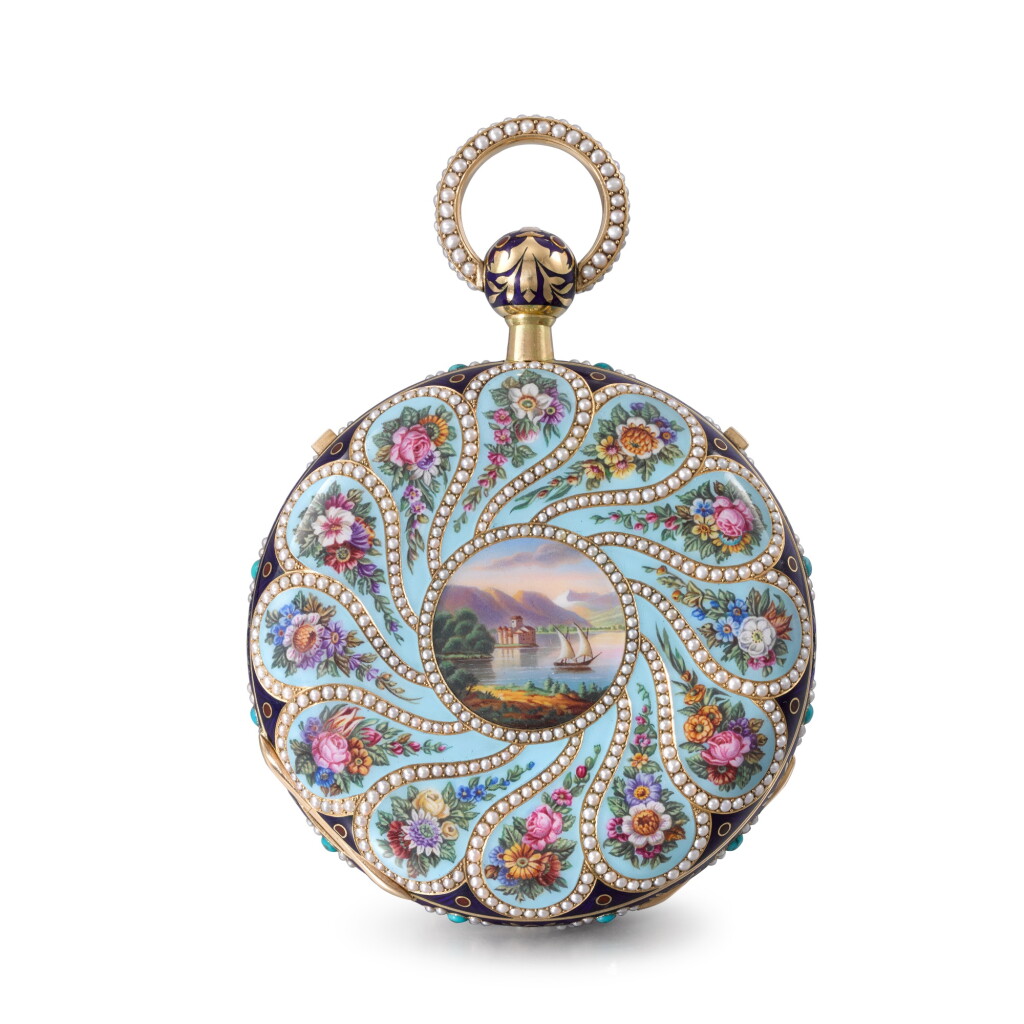
• Case: gold, the back polychrome enamel painted to the centre with the Château de Chillon upon Lake Geneva framed by seed pearls and bordered by radiating swirling turquoise enamel panels each bordered with seed pearls and polychrome enamel painted with flowers, dark blue translucent enamel at the intersections each with a red enamel roundel, the band with stylised gold foliage and set with seed pearls, turquoises and red enamel roundels, bezel decorated with semi-circular turquoise enamel panels painted with flowers bordered by seed pearls and separated by dark blue translucent enamel and red roundels, plunge repeat pendant further decorated with enamel, pearl-set bow, pushers to the band between 10 and 11 and 1 and 2 for opening case back and front bezel, case back signed FO within lozenge-shaped cartouche for Frères Oltramere, numbered 440.4
diameter 59mm
Brothers Louis-David-Benjamin Oltramare, born 30 August 1781 and Jean-Hugues Oltramare, born 2 February 1786, were both trained as 'monteurs de boîtes en or' (makers of gold boxes/cases). Coming from a family of artisans with a horological background, they worked together in an informal association and entered a maker's mark as the Frères Oltramare in 1810/11. When Geneva was liberated from French occupation and they re-registered the same mark on 4 November 1815, their workshop was in Geneva at rue de Coutance, 82. The association was dissolved on 31 March 1826.
Specializing in opulent cases for the Chinese market, Frères Oltramare produced some of the finest enamel decorated watches of the period. The firm worked closely with Piguet & Meylan whose movements can frequently be found in Oltramare cases. Frères Oltramare also collaborated with some of the greatest enamel miniaturists of their day, including Jean-Louis Richter and Jean-François Victor Dupont. Frères Oltramare cases incorporated a range of decorative enamel techniques, the most elaborate of which were often heightened with pearls. Case back decoration could vary greatly and might include large polychrome enamel painted panels depicting still lives, classical scenes, landscapes and, occasionally, religious scenes.
The arrangement of the case back's decoration is especially notable for the highly unusual arrangement of twelve, radiating, swirling panels, each of which are decorated with a unique floral bouquet polychrome enamel painted against a pale blue background. While other cases of comparable opulence are known with decorative case backs formed of 12 panels, these are usually of straight sided segmented form (for examples see: I. White, The Majesty of the Chinese-Market Watch, 2019, cover illustration & pp. 128-129 and a pair in the Patek Philippe museum, inv. S124A & S124B illustrated in P. Friess, The Emergence of the Portable Watch, Patek Philippe Museum, 2015, vol. III, pp. 568-569), the swirling panels of the present watch's case back are exceptionally rare. The style of painting of the case back's scene can be closely compared with the aforementioned pair of watches in the Patek Philippe Museum.