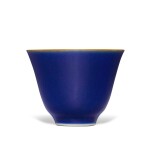

A blue-glazed cup, Qing dynasty, 18th century | 清十八世紀 藍釉盃 《敬畏堂製》款
Auction Closed
March 21, 02:11 PM GMT
Estimate
6,000 - 8,000 USD
Lot Details
Description
A blue-glazed cup
Qing dynasty, 18th century
清十八世紀 藍釉盃 《敬畏堂製》款
the base with a Jingweitang zhi hall mark in underglaze blue within a double square
Diameter 2⅜ in., 6 cm
Spink & Son Ltd., London, 1987.
Spink & Son Ltd.,倫敦,1987年
According to Yinliuzhai shuoci [Commentary on Porcelain from the Studio of Drinking Streams], composed by Xu Zhiheng, the Jingweitang hall mark was used by princes of the royal family during the Yongzheng and Qianlong periods. The hall name, translating to 'Made for the Hall of Veneration of Respect,' may have been used for several generations as pieces bearing this hall mark were not only produced during the Yongzheng and Qianlong periods, but also during the reigns of the Jiaqing and Daoguang Emperors. In the exhibition catalogue Rare Marks on Chinese Ceramics, Victoria and Albert Museum, London, 1998, Ming Wilson quotes Wang Qingzheng to suggest that the Jingweitang mark may have belonged to the Manchu high official Agedunbu at one point (see p. 114), while the British Museum attributes the hall mark to Li Hu (alias Duanren, style name Zhucun), a native of Cixi, a city within the sub-provincial city of Ningbo, Zhejiang province.
See a blue-glazed cup and saucer bearing the same hall mark, previously in the E.T. Hall Collection, sold at Christie's London, 6th June 2004, lot 161; and a blue-glazed bowl, sold in our Hong Kong rooms, 1st December 2016, lot 831. Vessels with the same mark, but with a celadon glaze and brown rim include a bowl and a dish, attributed to the 18th century, in the Sir Percival David Collection, now in the British Museum, London (accession nos PDF.532 and PDF,A.568); a bowl included in the Victoria and Albert Museum exhibition, op. cit., cat. no. 47; a dish published in Margaret Medley, Illustrated Catalogue of Ming and Qing Monochrome Wares, London, 1989, cat. no. A568; and a pair of ogee-form dishes sold in our Hong Kong rooms, 8th October 2019, lot 109, from the collection of Sir Quo-Wei Lee II.
You May Also Like


