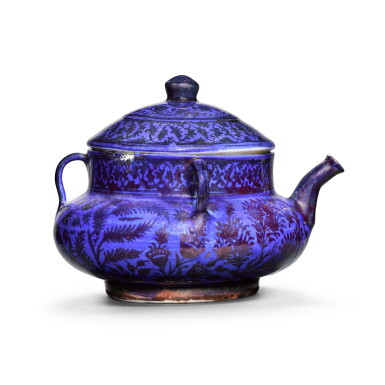
A Safavid three-handled lustre posset cup, Persia, late 17th century
Auction Closed
October 25, 04:59 PM GMT
Estimate
8,000 - 12,000 GBP
Lot Details
Description
of compressed globular form with large cylindrical neck, applied with three handles and a curved spout, the domed lid with rounded finial, the exterior covered in a cobalt blue slip and decorated with floral patterns and arabesques in lustre, the interior with a lustre landscape composed of a central cypress surrounded with stylised foliate designs
15.5cm. height
16cm. approx. diam.
inscriptions:
[k]hatim
A comparable posset cup in the British Museum (inv. no.1891,0617.5, published in Rogers 1983, cat. no.187, p.139 & O. Watson, Persian Lustre Ware, London, 1985, p.170, cat. no.140) bears the signature 'Khatim', likely reproduced on the present cup albeit faded. The name is recorded on a number of pieces of Safavid lustre (see Watson 1985, p.182).
Another Safavid three-handled spouted vessel in the Victoria and Albert Museum (inv. no.514-1878) is believed to derive from contemporary English posset cups, a type of ware created to serve a foamy milk beverage curdled with wine. The foam was eaten from the top and the liquid drunk from the spout. Safavid prototypes like the present one could have therefore been produced for export or for local English tradesmen working for the East India or The Levant Company. The shape could also be a revival of comparable Seljuk ceramics from the twelfth century (see online catalogue entry in V&A collections website).
You May Also Like