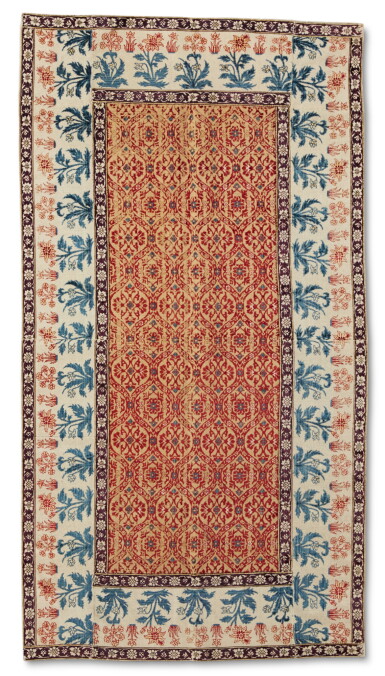
A silk velvet panel, India, 17th century or later
Auction Closed
October 25, 04:59 PM GMT
Estimate
10,000 - 15,000 GBP
Lot Details
Description
the central field with a lattice of ogival medallions each enclosing a floral spray, within ivory borders with large floral sprays alternating with smaller flowers, within aubergine-purple floral meander guard stripes
193 by 103cm.
Colnaghi, circa 1970s.
Michael Goedhuis, London.
Typical of the decorative Mughal style of the seventeenth century, this elegant velvet displays borders comprising rows of naturalistic floral sprays. Floral blossoms feature in Mughal arts during the reigns of Akbar and Jahangir, but the distinctive flower style comprising formally arranged sprays against a plain background became fully developed under Shah Jahan (r.1628-58) (see Walker 1997, pp.86-88).
In the present velvet, which was likely used as a floor spread, the border alternates two large-scale sprays of different types flanked by a minor row of smaller sprays. The flowers are naturistically rendered with curved stems, giving the impression that the flowers are gently swaying in the breeze. This effect is highlighted by the natural lustre of the silk which shimmers and transforms with variations in the light.
Similarly drawn stems are found in contemporaneous botanical drawings such as an iris plant in the Dara Shikoh album in the British Library (inv. no.Add. Or. 3129 f.41v, Walker 1997, p.87, see also f.67v from the album). A mid-seventeenth century velvet fragment in the Metropolitan Musuem of Art, New York, is also woven with comparable, gently curved sprays (acc. no.30.18), as well as the border of a pashmina carpet in the Frick collection, New York (acc. no.16.10.8, Walker 1997, p.99, fig.96) which also displays similarly serrated leaves in one of the floral sprays in the field.
The artist has played with colour to add a sense of depth to the overall design. The larger flowerheads are outlined in red while the smaller flowerheads set within the leaves are outlined in green. This similar colour play is also present in the Metropolitan example mentioned above. These subtle shifts allow the weaver to create range to the colour while only requiring a small number of dyes. The palette is closely reflected in the lattice field with shades of red, turquoise and ivory set against a golden yellow ground which emulates the warm ivory flowerheads.
A similar combination of a lattice field with borders of sprays is found on a plain red velvet tent ceiling panel decorated in gold powder paint in the collection of H. Peter Stern, New York (Mackie 2015, pp.424-5, fig.10.15). The arrangement of the field possibly reflects the contemporaneous textile traditions of the Safavids with a similar arrangement found on a silk lampas in the Cleveland Museum of Art (inv. no.1915.666) and a velvet in the Metropolitan Museum of Art (acc. no.52.20.13).
You May Also Like