Property from a Private Collection, New York
Tall Maya Polychrome Vessel
Late Classic, circa AD 550 - 950
Lot Closed
May 23, 03:01 PM GMT
Estimate
30,000 - 50,000 USD
Lot Details
Description
Property from a Private Collection, New York
Tall Maya Polychrome Vessel
Late Classic, circa AD 550 - 950
Height: 10 ¾ in (27.4 cm)
Stendahl Gallery, Los Angeles
Private Collection, New York, acquired from the above in 1977
Sotheby’s, New York, May 15, 2009, lot 135, consigned by the above
American Private Collection, acquired at the above auction
Francis Robicsek, The Smoking Gods, Tobacco in Maya Art, History and Religion, Norman, 1978, pp. 152-153, pls. 175-178, and fig. 166.
Nicholas Hellmuth, F.L.A.A.R., 1975
Nicholas Hellmuth, Archaeology, 1976, p. 4 (advertisement)
George E. Stuart and Gene S. Stuart, The Mysterious Maya, National Geographic, 1977, p. 39
Persis Clarkson, “Classic Maya Pictorial Ceramics: A Survey of Content and Theme”, Institute of Archaeology VIII, 1978, p. 105, fig. 2
Jacinto Quirarte, “The Representation of Underworld Processions in Maya Vase Painting: An Iconographic Study”, Maya Archaeology and Ethnohistory, 1979, p. 130, figs. 8-10
Francis Robicsek and Donald M. Hales, The Maya Book of the Dead, The Ceramic Codex, Charlottesville, 1981, p. 33 (vessel 54)
www.mayavase.com, K 1256
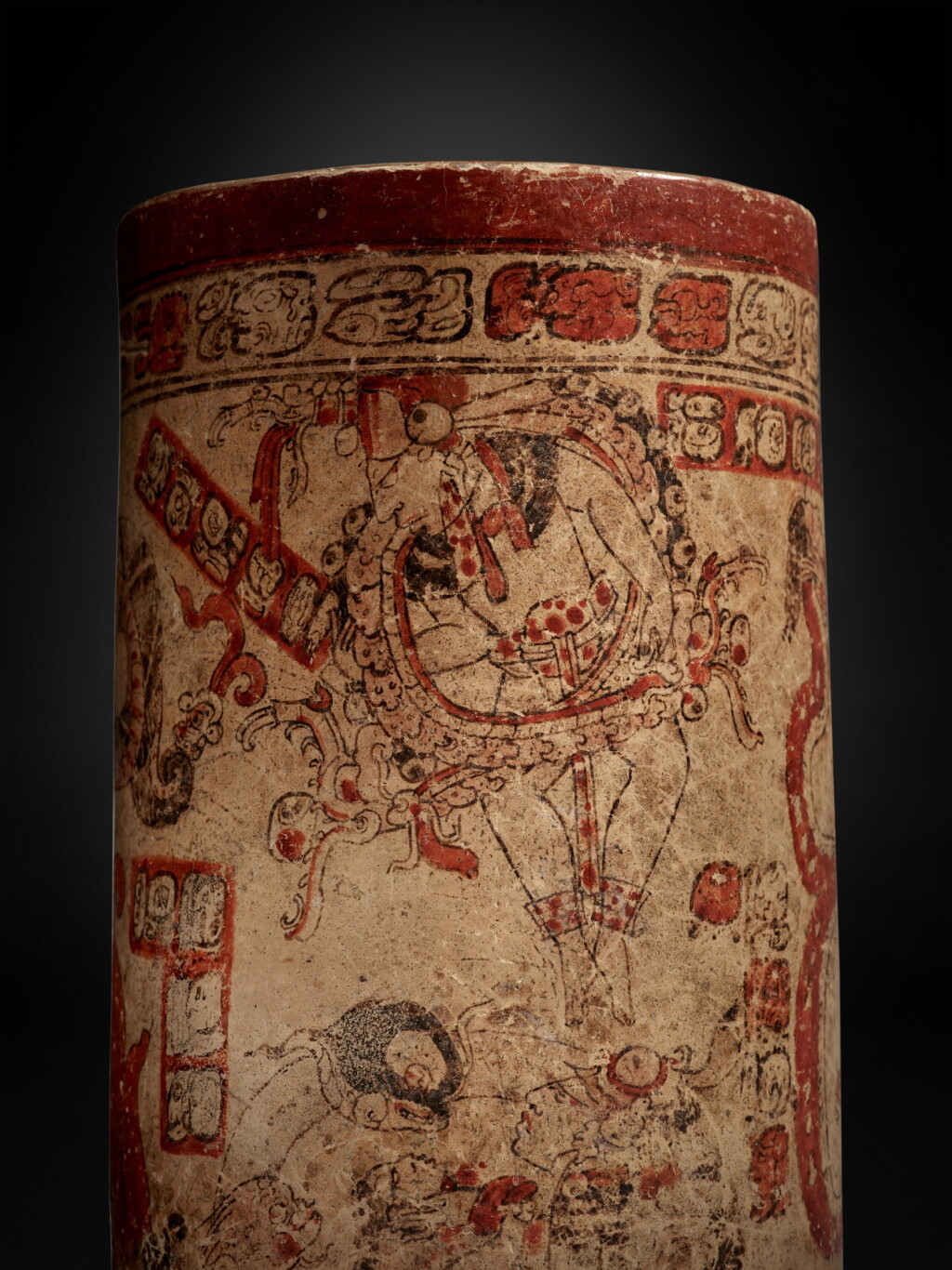
The supernatural encounters and trials of Maya deities, spirit beings and human lords, was an important subject celebrated on a series of codex-style and polychrome vessels. The pageantry of this vessel includes seven way figures, the companion spirit or alter-egos of royal clans. Way figures are major actors in these ritual scenes, they are “fantastical fusions of gods, humans and beasts […] that roam the dream world of sleep” (Mary Miller and Simon Martin, Courtly Art of the Ancient Maya, San Francisco, 2004, p. 157). The dense narrative takes place in the Underworld, showing the death, sacrifice and redemption for a young lord. The scene is best read left to right (in accordance with the night sun moving through the Underworld), with standing God A shown as the primary deity, his skeletal form in a dancing posture as the decapitator holding a head, his backrack decorated with stacked death eyes, behind him a Hero Twin seated in a darkened cartouche wearing a headband and tie-dyed scarf, below is a Jaguar Lord of the Underworld inching toward the God A and enveloped by a rattlesnake emitting his forked tongue, behind and above is the coiled Och Chan the bearded dragon with a large deer’s ear curling from his head, and whose gaping jaw holds a human head.
“The parade of eerie characters continues […] the most unusual, and therefore the most interesting character in the scene […] is the young lord who is reclining on his back, one of his legs upright, and the other bent both at the hip and the knee […]” (Francis Robicsek and Donald M. Hales, The Maya Book of the Dead, The Ceramic Codex, Charlottesville, 1981, p. 123). The young lord is engulfed in the fiery flames of the Underworld while gracefully holding a stylus or implement. The last two figures are versions of the young lord, floating above in a pseudo dancing posture and enveloped in a double- headed sinuous body of a chapaht, a centipede (identified by the 3rd glyph in the diagonal band adjacent), and below a reclining figure holding a sacrificed head and surrounded by a water wave of fish. The rim is encircled by the Primary Standard sequence glyph band including reference to the person the vase for, the drinking of chocolate.
It is suggested this vase is one of a series that commemorated the meeting of rival and allied powers and the subsequent conflict, sacrifice and tribute associated with major kingdoms.
Cf. See mayavase.com, K791, K3831, and K3395 for related vessels.