Provenant d'une collection privée nord américaine
Plaque, Maya, Classique ancien, ca. 700 - 800 ap. J-C. | Rare Mayan Jade Pectoral Plaque, Late Classic, ca. AD 700 - 800
Auction Closed
November 28, 03:48 PM GMT
Estimate
50,000 - 60,000 EUR
Lot Details
Description
Plaque, Maya, Classique ancien, ca. 700 - 800 ap. J-C.
Haut. 10,8 cm , Larg. 9,8 cm
________________________________________
Rare Mayan Jade Pectoral Plaque, Late Classic, ca. AD 700 - 800
Height 4 ¼ in, Width 3 ⅞ in
Fine Art of Ancient Lands, NY, ca.1970
Collection, John Platt, University of Virginia, acquis au précédent en 1981
Sotheby’s, New York, 15 mai 2003, lot 252
Collection Gary Hendershott, USA, acquis lors de cette vente
Heritage Auction, Dallas, 29 septembre 2006, lot 47017
Collection privée nord américaine, acquis lors de cette vente
Denver, Denver Art Museum, Chalchihuitls : Pre-Columbian Jades and Other Sacred Stones, 15 août - 11 octobre 1987
Washington DC, National Museum of Women, Chalchihuitls : Pre-Columbian Jades and Other Sacred Stones, 27 octobre 1987 - 31 janvier 1988
Greenwich, CT, Bruce Museum of Art, A Cosmic View, Pre-Columbian Art from the John Platt Collection, 25 septembre 1994 - 8 janvier 1995
Von Winning, The John Platt Collection of Pre-Columbian Art, Charlottesville, University of Virginia Art Museum, 1986, fig. 172
Brinkerhoff, A Cosmic View, Pre-Columbian Art from the John Platt Collection, Bruce Museum of Art, Greenwich, CT, 1994, cat. no. 116
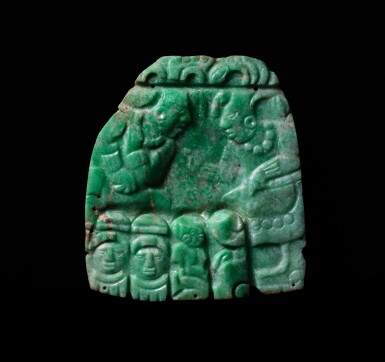
Cette plaque de faible épaisseur en jade vert pomme brillant,
sculptée en profondeur jusqu’à la transparence et percée sur les cotés pour être suspendue avec également huit autres encoches
destinées à d’autres moyens d’accroche, est décorée d’une superbe sculpture montrant deux divinités qui se font face, celle de gauche étant assise sur un trône sous lequel sont représentés
deux visages humains avec des colliers composés de bandes et qui représente le Dieu du Maïs identifiable à l’excroissance de feuillage qui émerge de son crâne alors qu’il place élégamment sa
main sur le devant de sa poitrine en signe de révérence et regarde
devant lui en direction du personnage de droite qui est placé les genoux croisés sur un trône représentant le montre witz et qui peut être identifié au Dieu du Chocolat en raison des fèves de
cacao qui sont accrochées dans ses mèches de cheveux. Le Dieu du Chocolat pour sa part laisse reposer sa main gauche le long de son corps tout en tendant sa main droite paume ouverte en direction du Dieu du Maïs dans une position qui peut signifier un geste de remerciement (Patricia Ancona-Ha, Jorge Pérez de Lara et Mark Van Stone, Some Observations and Hand Gestures in Maya Art, in The Maya Vase Book Vol. 6 pp. 1072-1089, ed. Barbara et Justin Kerr, New York, Kerr Associates 2000). Un nain à genoux regardant vers le ciel est assis entre eux et le revers de la plaque est incisé
d’une inscription composée de trois glyphes.
Par Stanley Paul Guenther
Notre connaissance du Dieu du Chocolat s’est considérablement enrichie au cours des dernières années et cette plaque en jade contribue de façon notoire à cet enrichissement. L’iconographie des Dieux du Maïs et du Chocolat est assez semblable en raison des gousses de cacao et des épis de maïs qui éclosent directement à partir d’une tige ou d’un tronc, comme pour la plupart des végétaux. Les grains de maïs et de cacao poussent dans des rangées disposées de façon très proche et le chercheur Simon Martin a mis en évidence la grande similitude entre ces plantes et les Dieux qui leur sont associés. Cette analyse a conduit Simon Martin aux côtés de Mary Miller (Mary Miller et Simon Martin, p. 63, Courtly Art of the Ancient Maya, New York, Thames and Hudson 2004) a suggérer que le Dieu du Chocolat pourrait avoir été une autre incarnation du Dieu du Maïs ou éventuellement son frère, bien qu’il n’y ait aucune possibilité pour affirmer l’une ou l’autre hypothèse. Cette plaque de jade qui montre les deux divinités ensembles sur une même représentation nous conduit cependant à penser avec conviction que les Dieux du Maïs et du Chocolat sont bien deux entités séparées, et donc probablement des frères comme le suggèrent Miller et Martin, et non pas simplement deux
représentations d’une même divinité.
L’arrière de la plaque est orné d’une courte inscription constituée de trois glyphes qui a été étudiée pour la première fois par Dieter Dutting (Hasso Von Winning, The John-Platt Collection of Precolombian Art, Charlottesville : The University of Virginia Art Museum, 1986, cat. 166) mais qui doit être désormais étudiée de nouveau en raison des progrès faits depuis en matière de traduction des anciens textes mayas. Dans l’analyse initiale de Dutting, ces glyphes sont dénommés A, B et C et dans le tableau ci-après la première colonne reprend la « catégorisation T » utilisée pour identifier les hiéroglyphes mayas qui a été proposée initialement par J. Eric Thompson (J. Eric Thompson, A catalogue of Maya Hieroglyphs, Norman : University of Oklahoma Press, 1982) tandis que la seconde colonne propose une transcription phonétique de chacun des glyphes, et ces colonnes sont ensuite
suivies d’une translittération puis d’une traduction.
Glyphe Classification T Transcription phonétique
A : 61.534.2 yu-la-li
B : 204.102.1000b u-ki-na
C : 12.99.502.142 AJ-o-ma-ma
Translittération : y-ulaal ukiin aj-omam
Traduction : « Uluaal de Uklin, Celui de Omam »
Cette courte citation, similaires à de nombreuses autres chez les Mayas, est la dénomination de l’objet sur lequel elle est inscrite ainsi que l’identification de son propriétaire. La lettre initiale y- est une marque d’appartenance dans la langue maya et l’objet possédé est ici dénommé ulaal, un mot jusque là inconnu dans les citations mayas de la Période Classique. Ce mot est absent du dictionnaire des mots mayas et a aujourd’hui disparu dans la langue maya moderne. On peut cependant penser en comparant avec d’autres inscriptions dénominatives mayas que le mot
ulaal fait référence à cette plaque de jade ou à la catégorie d’objets (un pectoral, un bijou, du jade, un objet …) à laquelle elle appartient. Cet ulaal appartient à une personne dont le nom et le titre apparaissent dans les deux caractères suivant sa dénomination, les glyphes B et C. Le nom du propriétaire est inscrit dans le glyphe B et peut s’épeler phonétiquement Ukiin tandis que son titre suit dans le glyphe C et peut se lire Aj Omam ou « Celui de Omam » - Omam étant probablement un nom de lieu ou le nom d’un ancien site maya d’où était originaire Ukiim.
C’est malheureusement la seule mention du mot Omam dans le corpus des inscriptions hiéroglyphiques mayas et la localisation précise du site reste à ce jour inconnue. Le style des glyphes
et de leur gravure indique cependant une zone géographique qui peut être située dans les Basses Terres mayas du sud et correspond au pays actuel du Belize, au district guatémaltèque de Peten, et
pour le Mexique à la partie est des états du Tabasco et du Chiapas et à la partie sud des états du Campèche et du Quintana Roo.
On peut donc voir sur cette plaque en jade une importante représentation iconographique accompagnée d’une inscription notoire qui atteste de l’interconnexion entre deux divinités mayas de première importance tout en citant pour la première et unique fois un type d’objet non encore recensé (Ulaal) ainsi qu’un personnage (Ukiin) et un ancien site maya (Omam) eux aussi inconnus jusque là.
________________________________________
The plaque of thin section and finely carved with two deities facing each other, the left hand figure seated on a throne upon which are carved two heads with pendant celt necklaces, actually this is a depiction of the Maize God, identified by the corn foliage that sprouts from his head, he holds his left hand elegantly over his chest in a reverent gesture, he leans over toward the crosslegged figure to the right who sits on a witz monster throne, who can be identified as the Chocolate God as cacao pods hang from strands of his hair. The Chocolate God rests his left hand on his own thug while raising his right hand, palm outstretched towards the Maize God in a gesture which has been interpreted as a greeting ((Patricia Ancona-Ha, Jorge Pérez de Lara, and Mark Van Stone, "Some Observations on Hand Gestures in Maya Art" in The Maya Vase Book Volume 6, pp. 1072-1089, edited by Barbara and Justin Kerr. New York: Kerr Associates, 2000); between them a kneeling dwarf looking upward, the reverse incised with a three hieroglyph inscription; in bright apple green jade carved to highly translucent thinness, pierced with a lateral perforation for suspension and eight sets of tiny perforations around the perimeter possibly for further attachments.
Stanley Paul Guenther
Our knowledge of the Chocolate God has increased considerably over the last few years and this jade plaque adds to that knowledge in a significant way. The iconography of the Maize and Chocolate Gods overlaps considerably, which is understandable in that cacao pods and maize cobs, unlike most vegetables, grow directly off the plant stalk or tree trunk. Corn kernels and cacao beans grow in rows very similar to each other and, as scholar Simon Martin has noted, these plants and their associated gods are intimately related. This led Martin and associate Mary Miller (Mary Miller and Simon Martin, p.63, Courtly Art of the Ancient Maya. New York: Thames and Hudson, 2004) to propose that the Chocolate God could have either been an aspect of the Maize God or possibly his brother, not enough evidence existing to favor one or the other of these possibilities. This jade plaque, portraying both of these gods interacting, thus provides unique and strong evidence suggesting that the Maize and Chocolate Gods were separate entities, possibly brothers as Miller and Martin have suggested, and not merely aspects of the same deity.
The back of this jade plaque carries a short three hieroglyph inscription. This inscription was first analyzed by Dieter Dütting (Hasso von Winning, The John-Platt Collection of Pre-Columbian Art, Charlottesville: University of Virginia Art Museum, 1986, catalogue no. 166), but advances in the decipherment of ancient Maya texts which have occurred since then make a reanalysis necessary. These hieroglyphs, following Dütting's original analysis, will be designated A, B, and C. In the following table the first column provides the "T numbers" for identifying Maya hieroglyphs first proposed by J. Eric S. Thompson (J. Eric S.Thompson. A Catalog of Maya Hieroglyphs. Norman: University of Oklahoma Press, 1962). The second column provides a phonetic transcription of each of these signs.
Transcription and transliteration of the text:
Table 1
Hieroglyph T# Phonetic Value
A: 61.534.2 yu-la-li
B: 204.102.1000b u-ki-na
C: 12.99.502, 142 AJ-o-ma-ma
Transliteration: y-ulaal ukiin aj-omam
Translation: "the ulaal of Ukiin, He of Oman".
This short text, as with many similar Maya texts, appears to be a "nametag", identifying the object upon which it was inscribed as belonging to a specific individual, The initial y- is the ergative possessive in Maya language, and the possessed object is said to be an ulaal, a word that is otherwise unattested in Classic Maya inscriptions. This word cannot be identified in Maya dictionaries and appears to have disappeared from modern Maya languages. However, by way of comparison with similar nametag texts the ulaal should refer to this jade plaque or the category of object (e.g.: pectoral, jewel, jade object, etc.) to which it belongs. This ulaal belonged to an individual whose name and title appear in the next two hieroglyphs, Glyphs B and C. The personal name of the individual appears in Glyph B, which is phonetically spelled out as Ukiin. His title follows in Glyph C, and reads Aj Omam, or "He of Omam", where Omam is most likely a toponym, or name of the ancient Maya site where Ukiin came from. Unfortunately, this is the only reference to Omam in the corpus of Maya hieroglyphic inscriptions and so the whereabouts of this site remain unknown. The style of the hieroglyphs and carving suggest that wherever Omam was located, it was somewhere within the Southern Maya Lowlands, which cover the modern country of Belize, the Petén district of Guatemala, eastern Tabasco and Chiapas states and southern Campeche and Quintana Roo states in Mexico. It can thus be seen that this jade plaque bears an important image and text that help reveal the relationship of two primary Maya deities, as well as providing unique references to an otherwise unrecorded type of object (ulaal) and an otherwise unrecorded individual (Ukiin) from an otherwise unrecorded ancient Maya site (Omam).