
Provenant d'une collection privée américaine
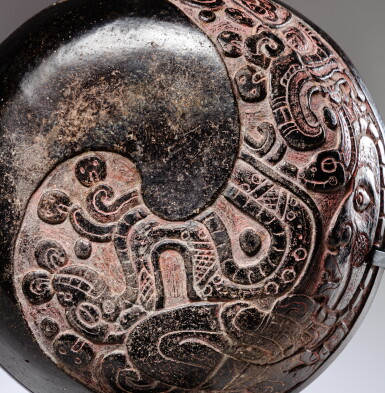
Coupe à relief de tête de divinité, Maya, Classique récent, 300 - 600 ap. J-C. | Maya Carved Bowl with the head of a deity, Early Classic, ca. AD 300 - 600
Auction Closed
November 28, 03:48 PM GMT
Estimate
25,000 - 35,000 EUR
Lot Details
Description
Coupe à relief de tête de divinité, Maya, Classique récent, 300 - 600 ap. J-C.
Haut. 8,3 cm, Diam. 22,9 cm
________________________________________
Maya Carved Bowl with the head of a deity, Early Classic, ca. AD 300 - 600
Height 3 ¼ in, Diam 9 in
Robert et Marianne Huber, Dixon
Dr. Victor Barcilon, University of Chicago, Chicago, acquis avant 1982
Sotheby's, New York, 21 novembre 1988, lot 99
Merrin Gallery, New York
Collection privée américaine, acquis au précédent en 1988
Chicago, The Arts Club of Chicago, High Culture in the Americas Before 1500. 15 novembre - 31 décembre 1982
McNear Everett, High Culture in the Americas Before 1500, The Arts Club of Chicago, Chicago, 1982, p. 23, fig. 47
Hellmuth Nicholas M., Monster und Menschen in der Maya Kunst, Graz, 1987, p. 264, fig. 566; drawing: p. 251, fig. 548
Ce bol à engobe noir richement décoré et agrémenté de cinabre comporte la rare représentation d'une scène se déroulant dans les deux sens du vase, avec une tête d'ancêtre regarde vers le bas tandis qu'un célébrant boit dans un bol au cours d'un rituel de commémoration. Le glyphe « hun » est inscrit sur la joue de la tête d'ancêtre, ce qui le désigne comme étant l'un des Héros Jumeaux, Hunahpu (Hun Ajaw) qui porte la coiffe de la Principale Divinité Oiseau (PDO) surmontée d'un félin.
Le serpent qui sort de la bouche de la PDO évoque le souffle tandis que le bras droit de l'ancêtre est placé sur sa poitrine avec une main exprimant une posture cérémonielle et un serpent émerge en arrière qui évoque peut-être le Monde Souterrain. De petits glyphes indiquant ajaw (seigneur) sont disposés en bordure de la partie où se trouvent l'ancêtre et le serpent.
Cette coupe à forte connotation mythologique représente Hunahpu, l'un des demi-dieux créateurs de la mythologie maya et est agrémentée d'une autre représentation symbolique sous la forme de la POD qui représente une incarnation animée du jade qui était l'une des matières les plus précieuses pour le Mayas.
Ce vase à boire a clairement été commandité pour un seigneur de haut rang qui est indiqué comme parent de l'un des Héros Jumeaux.
Pour ce rare motif tourbillonnant en deux parties, voir Dumbarton Oaks PC.B.554 (Hasso von Winning, Pre-Columbian Art of Mexico and Central America, 1968, pls. 410-413, p. 302)
________________________________________
In this rare use of a two-part swirling design, the head of an ancestor peers downward when the celebrant drank from the bowl in commemorative rituals. The ancestor’s cheek is marked by the “hun” glyph, designating him as one of the Hero Twins, Hunahpu (Hun Ajaw), he wears the headdress of the Principal Bird Deity (PBD) with a feline compound above it. The serpent that comes from the PBD’s mouth is a breath emanation. The ancestor’s right arm is held to the chest with the hand in the ceremonial bar position. A serpent issues forth from the black void, which perhaps represents the Underworld. Small ajaw (lord) glyphs are on the periphery of the section with the ancestor and serpent; in blackware richly embellished with cinnabar.
The mythically-charged vessel depicting Hunahpu, one of the foundational demi-gods in Mayan mythology, is replete with further symbolism with the inclusion of the Principal Bird Deity, representing the animate embodiment of jade, one of the most precious substances for the ancient Maya. The drinking bowl was clearly commissioned for a lord of high rank alluding to his parentage from one of the Hero Twins.
For the distinctive and rare, two part swirling motif see Dumbarton Oaks PC.B.554 (Hasso von Winning, Pre-Columbian Art of Mexico and Central America, 1968, pls. 410-413, p. 302)