Antoine-Louis Barye
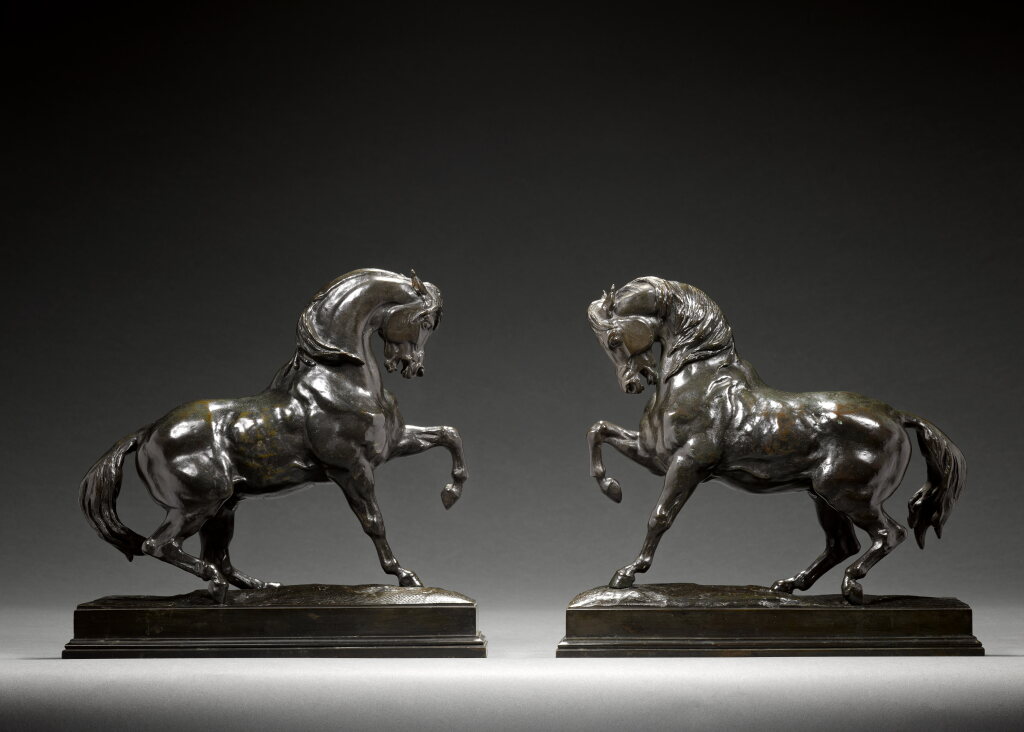
Pair of Chevaux Turcs No.2 (antérieur droit levé, antérieur gauche levé, terrasse carrée) (Turkish Horses No.2)
Lot Closed
December 13, 01:13 PM GMT
Estimate
40,000 - 60,000 GBP
Lot Details
Description
Antoine-Louis Barye
French
1795 - 1875
Pair of Chevaux Turcs No.2 (antérieur droit levé, antérieur gauche levé, terrasse carrée) (Turkish Horses No.2)
both signed: BARYE
bronze, with dark to mid brown and green patina
Cheval Turc (antérieur droit levé): 28.5 by 31.5cm., 11¼ by 12⅜ in.
Cheval Turc (antérieur gauche levé): 29.5 by 31.5cm., 11⅝ by 12⅜ in.
John Poynton Collection;
Sotheby's, London, 6 June 2007, The John Poynton Collection, lot 332;
private collection, United Kingdom
Imbued with dynamic power and strong silhouette, the Cheval Turc or Turkish Horse is an emblematic work of French artist and seminal animalier sculptor, Antoine-Louis Barye. Barye’s unique sculptural vision comes to life in the present pair of bronzes, which capture the essence and potent energy of the rearing horse. Due to the great success of the Cheval Turc No.2, Barye created four versions: the present two on square bases with opposite front legs lifted, and two on oval bases, also with the front right or left leg lifted. The Cheval Turc No.2 on a terrasse carrée was in fact the first version, dating to circa 1840, and described as Cheval marchant in the 1844 Besse catalogue.
In the Turkish Horse, Barye unites his interest in Orientalist art with his inspiration from Western classical antiquity. Comparison can be noted to the horse in the ancient Roman equestrian group of Marcus Aurelius, or to the horses on the pediment of the Parthenon, which Barye studied in his sketches that are in the Walters Art Gallery, Baltimore (inv. no. 37.2139).
In addition to being a sculptural genius, Barye was a master draughtsman. A watercolour in the Louvre Museum, Paris, relates closely to the present bronzes (inv. no. RF 4236) - the energetic anatomy with tensed musculature and raw expression is expertly transferred from his two-dimensional work to these powerful casts.
The fine quality of the bronzes with dark patina and nervous texture of the surface can be closely compared to the Cheval Turc No.2 in the Walters Art Gallery (inv. no. 27.67). It is a rare opportunity to acquire the famed Cheval Turc as a pair. The present bronzes make a natural and convincing pair, because they have rectangular bases with equal measurements and opposite front legs lifted. In addition, their patination and refined casting is very similar, which could suggest that the two bronzes were conceived as a pair.
RELATED LITERATURE
M. Poletti and A. Richarme, Barye, Catalogue raisonné des sculptures, Paris, 2000, pp. 263-271; W. R. Johnston and S. Kelly, Untamed: The Art of Antoine-Louis Barye, exh. cat. Walters Art Gallery, Baltimore, 2006, pp.158-159 and 235; S. Pivar, The Barye Bronzes: A Catalogue Raisonné, Suffolk, 1981, pp.205-206
You May Also Like