Scipione Tadolini
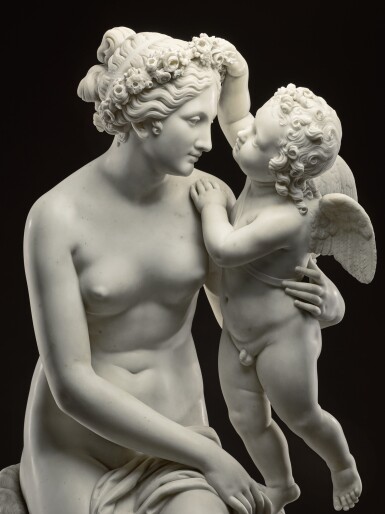
Ninfa inghirlandata da Amore (Nymph garlanded by Cupid)
Lot Closed
December 13, 01:04 PM GMT
Estimate
180,000 - 250,000 GBP
Lot Details
Description
Scipione Tadolini
Italian
1822 - 1892
Ninfa inghirlandata da Amore (Nymph garlanded by Cupid)
signed and dated: SCIPIO.TADOLINI / FECIT.ANNO.1845 / ROMAE
white marble
154cm., 60⅝in.
This exceptionally beautiful marble group is an early masterpiece by the Roman sculptor Scipione Tadolini. It is likely to be one of his seminal works, the Ninfa inghirlandata da Amore (Nymph garlanded by Cupid) described by Vicario in his Gli Scultori Italiani Dal Neoclassicismo Al Liberty (op. cit., p. 1018). Recently rediscovered, the sale of Tadolini’s Ninfa represents a unique opportunity for collectors to acquire a late neoclassical sculptural group of museum quality and in near-original condition which was carved by a sculptor operating within workshop with direct links to Antonio Canova.
Scipione Tadolini was the son of the celebrated sculptor Adamo Tadolini, who was one of Antonio Canova’s principal studio assistants, and the miniaturist Serafina Passamonti Tadolini. Scipione’s oeuvre marks a departure from his father’s strict neoclassical style in favour of a softer classicism imbued with the Romantic spirit. The present marble is, however, an early work by Scipione which strongly relates to his father's model Venere che scherza con Amore executed in 1816 for Prince Hercolani of Bologna (and subsequently acquired by Prince Esterhazy in 1818).
In carving the present group Scipione has sought to exhibit his virtuosic brilliance, which is particularly evident in the remarkable drilled face of the lionskin, and the drilling and undercutting of Venus' hair and the garland crowned by Cupid. These techniques, together with the neoclassical facial types indicate that Scipione probably executed the group under his father's supervision. Scipione's Ninfa can arguably be identified as one of the last major works of the Neoclassical movement, executed within the tradition of Canova's workshop practice and aesthetic.
Scipione’s most iconic work was conceived almost two decades later in the 1860s. The elegant Schiava Greca (Greek Slave) became so popular that the sculptor made several versions for important patrons. Other major works include the earlier Ninfa pescatrice (Fishing Nymph) of 1850 which was acquired by Count Anatolio Demidoff. Later in his career Scipione became overwhelmed with commissions, including a marble for the church of Gonfalone in Rome, an equestrian of Bolivar for Lima, a St. Michael for a wealthy Bostonian and the very important bust of King Vittorio Emanuele I. Pope Pius IX and the Queen of Italy were amongst the many notables to visit his studio.
The Tadolini dynasty continued to operate in Rome well into the 20th century. The family occupies a fascinating position in the history of sculpture in the Eternal City. Four generations of the family of stone carvers lived and worked in the same studio for some 150 years. The building still exists today, on the corner of the Via del Babuino over looked by the Greek Church of S. Anastasia. It is now the Canova-Tadolini Museum.
RELATED LITERATURE
V. Vicario, Gli Scultori Italiani Dal Neoclassicismo Al Liberty, Lodi, 1994, p.1018 ; A. Panzetta, Nuovo dizionario degli scultori Italiani dell'ottocento e del primo novecento, Turin, 2003, pp. 900-901 ; T. F. Hufschmidt, Tadolini, Adamo, Scipione, Giulio, Enrico, Quattro Generazioni di Scultori a Roma Nei Secoli XIX e XX, Rome, 1996, pp. 57-63
Sotheby's wishes to thank Professor Alfonso Panzetta, author of the Nuovo dizionario degli scultori Italiani dell'ottocento e del primo novecento for his kind assistance in the study of this lot.
You May Also Like