
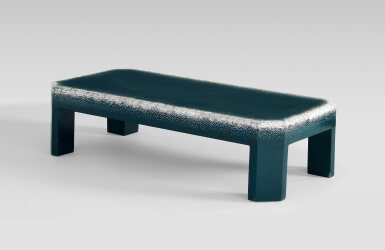
Jean Dunand
Low Table
Auction Closed
December 6, 07:17 PM GMT
Estimate
200,000 - 300,000 USD
Lot Details
Description
Jean Dunand
Low Table
circa 1925
lacquered wood, coquille d’oeuf, mother of pearl
signed JEAN/DUNAND/LAQUEUR
7⅛ x 27½ x 13⅜ inches (18.1 x 69.9 x 34 cm)
Baron La Caze
Sotheby's Monte Carlo, April 13, 1986, lot 309
DeLorenzo Gallery, New York
Acquired from the above by the present owner, 2001
Félix Marcilhac, Jean Dunand: His Life and Works, London, 1991, p. 251, cat. no. 471 (for the present lot illustrated)
Yvonne Brunhammer, Le Style 1925, Paris, 1975, p. 184 (for a period photograph of the model)
A magnificent example of Jean Dunand’s mastery in combining mediums and textures, this low table in rich blue-green lacquer, enhanced with eggshell and mother of pearl inlays, is a singular creation within the designer’s oeuvre. Rarely has Dunand used mother of pearl as part of his designs— a welcome and colorful addition to an otherwise stunning and beautifully proportioned piece. Slightly lower than most coffee tables attributed to the lacquerer, the work further distinguishes itself through the delicate placement of the eggshell around the tabletop edges which enhance its sculptural quality. The table was a focal point in Jean Dunand’s second exhibition at Galerie Georges Petit, which opened in December of 1923. Exhibited alongside works by Jean Lambert-Rucki, Jean Goulden and Paul Jouve, the present table was a key component of the show, as evidenced by the several period photographs available of this table. Generally speaking, the exhibition was received with praise and admiration by the critics and was well attended by the general public and art enthusiasts, their interest whetted by the success of the group exhibition a year prior. It was also a notable commercial success. The show coincided with a particularly successful and prolific time in Dunand’s career, during which the artist not only mastered and developed his well-known lacquer technique, but also showed remarkable inventiveness in decoration and artistry—as evidenced here through his exploration of mother of pearl details and geometric proportions. Recognized as an artist in undisputed command of every technique he employed, it was during that time that Dunand’s clientele grew to encompass increasingly influential circles of collectors which led to important commissions. This table strikingly exposes the versatility of Dunand’s practice while simultaneously presenting as a successful, incredibly exquisite work of art in and of itself.