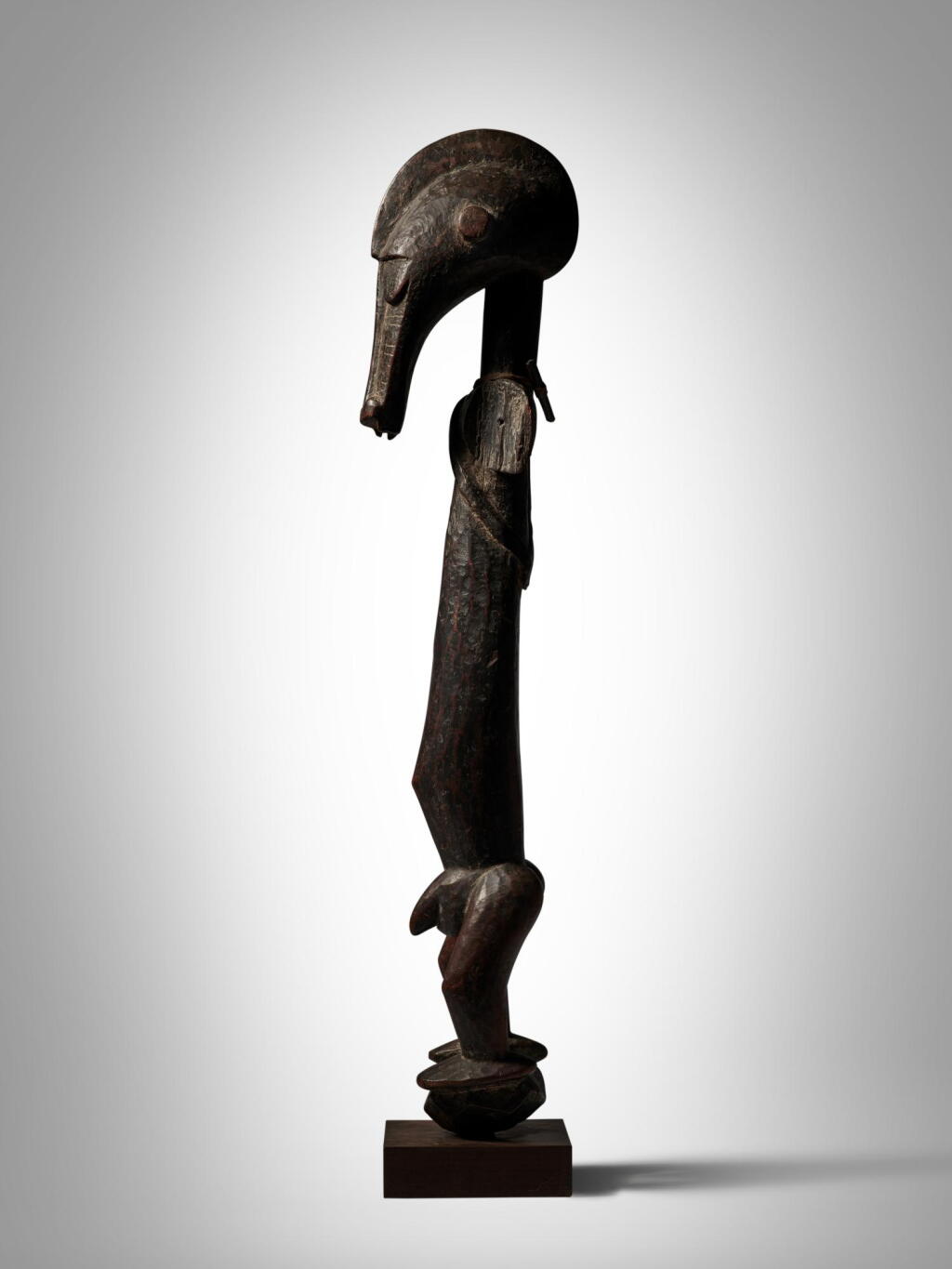
Senufo Male Figure, Côte d'Ivoire
Auction Closed
May 24, 03:58 PM GMT
Estimate
40,000 - 60,000 USD
Lot Details
Description
Senufo Male Figure, Côte d'Ivoire
Height: 25 1/4 in (64.1 cm)
Werner Muensterberger, London
Morris J. Pinto, Paris, acquired from the above
Sotheby's, London, African, Oceanic and Pre-Columbian Art from the Pinto Collection, May 9, 1977, lot 116
The British Rail Pension Fund, acquired at the above auction
Sotheby’s, London, July 3, 1989, lot 71, consigned by the above
American Private Collection, acquired at the above auction
Bonhams, New York, November 13, 2018, lot 72, consigned by the above
Acquired at the above auction
As enigmatic as this figure is, it is apparent at first glance that he has a place in the prolific imagination of the Senufo. These people, who live in northern Côte d’Ivoire, are the largest ethnic group in the country and their presence extends beyond the borders of Mali and Burkina Faso. Their richly diverse sculpture is part of a stylistic tradition specific to the savannah regions.
The powerful, spectacular deble ancestor statues once preserved in the sacred groves of the Poro initiatory society now appear in the world’s most prestigious museum institutions. Their great rarity and appeal have sparked epic bidding battles with each of their appearances on the market. At the other end of the spectrum are tugubele and other madebele, sculptures designed to embody or attract the good graces of more or less benevolent spirits. Those works come in a wide variety of shapes and, although smaller in size, often attain a level of sculptural quality that has nothing to envy among the “big pieces” of the group.
The intermediate size of the present sculpture excludes it from these two corpora, a circumstance that adds to its aura of mystery. The exaggeratedly stretched torso posed on short legs undoubtedly bears the signature of the Senufo, as does the hairstyle in the shape of a Mohawk crest; his face, on the other hand, is intriguing. The arrow of a humanoid nose with slightly flattened nostrils crosses its entire length through a slender snout borrowed from the animal world, at the top of which heavy eyelids in the shape of half-moons give the whole a benevolent expression. The object of great care on the part of its original owner, a beautiful shiny patina uniformly covers the head and body, while the faceted surface reveals the skilful and delicate strokes of the sculptor. Its general state of conservation makes it possible to rule out an extended station outside. One may suppose that it sat enthroned near an altar, erected out of sight and out of the weather, to be used in some exercise of divination.
While there is undeniably a Senufo sculptural identity, supported by shared practices of worship, it is not necessarily monolithic; the Senufo territory is wide-ranging, in close contact with other cultures, and the population is distributed among dozens of largely autonomous subgroups. A few regional styles have been conclusively identified based on old accounts and proven collection sites. The drawings made by Frobenius at the beginning of the 20th century in Pomporo, on the border of Mali and Côte d’Ivoire, or the impressive statues sold by Félix Lem, a collector in Sikasso in the 1930s, to Helena Rubinstein and the painter Boussard, make it possible to distinguish the Senufo sculpture of the north, which is very stylized in comparison with the more realistic works from the central region of the Savanes District, centred around its capital, Korhogo. Saved thanks to Fathers Convers and Clamens from the eradication ordered by the prophet Massa in the 1950s, the deble of a more naturalistic human appearance from the sacred grove of Lataha is a good example.
The slender morphology and the refined treatment of the statue described in the present text encourage us to link it to the sculpture created in the border region of Mali; its elongated face, embellished with a sagittal crest, bears a certain kinship with that of Helena Rubinstein’s deble, which reached a record price for the time when it was sold in 1995. The face of the present sculpture also irresistibly evokes that of certain bronzes cast in lost wax by the Lhoron, a talented caste of jewellers, who were the principal suppliers of amulets and other ornaments, and whose artistic practice spread throughout the region from the Gan kingdom in Burkina Faso to that of the Bono, or Abron, in eastern Côte d’Ivoire, passing through Korhogo and the legendary town of Kong.
This phantasmagorical being, a metaphor for an animist world where the human race and the animal kingdom are intimately intertwined, has captured the attention of amateurs of undoubted discernment, such as the great collector Morris Pinto, Alan Mann, the gentleman from Richmond, who was a great connoisseur of Fang reliquaries, or Werner Muensterberger, the psychoanalyst and art historian, who once owned a deble which, in 2014, sold for 12 million dollars at Sotheby’s New York, propelling African art into a new galaxy.
Bertrand Goy