
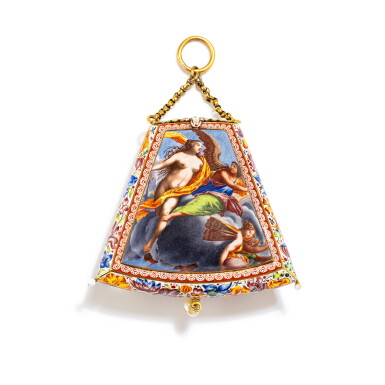
Boîte à sel en or et émail et perles figurant Junon et Iris, Aurore et Céphale d'après Simon Vouet gravé par J. Dosigny
A gold, enamel and pearl scent box featuring Juno and Iris, Aurora and Cephalus, unmarked, attributed to Robert Vauquer, Blois or Paris, probably between 1640 - 1660 | Boîte à sel en or et émail et perle figurant Junon et Iris, Aurore et Céphale, non poinçonné, attribué à Robert Vauquer, Paris ou Blois, probablement entre 1640 - 1660
Lot Closed
July 8, 03:40 PM GMT
Estimate
7,000 - 10,000 EUR
Lot Details
Description
Boîte à sel en or et émail et perles figurant Junon et Iris, Aurore et Céphale d'après Simon Vouet gravé par J. Dosigny
A gold, enamel and pearl scent box featuring Juno and Iris, Aurora and Cephalus, unmarked, attributed to Robert Vauquer, Blois or Paris, probably between 1640 - 1660
of trapezoidal shape, the decorations after Simon Vouet engraved by J. Dosigny, the edges with enamelled decorations of polychrome flowers set with a pearl and two enamelled pearls, the interior enamelled in turquoise blue, a chain and three rings to hang it, in a case with the shape probably dating from the end of the 18th century
________________________________________________________________________
Boîte à sel en or et émail et perles figurant Junon et Iris, Aurore et Céphale d'après Simon Vouet gravé par J. Dosigny
Boîte à sel en or et émail et perle figurant Junon et Iris, Aurore et Céphale, non poinçonné, attribué à Robert Vauquer, Paris ou Blois, probablement entre 1640 - 1660
de forme trapézoïdale, les décors d'après Simon Vouet gravé par J. Dosigny, les bords à décors émaillées de fleurs polychromes serties d'une perle et de deux perles en émail, l'intérieur émaillé bleu turquoise, une chaîtennet et trois anneaux à la suspendre, dans un écrin à la forme datant probablement de la fin du XVIIIème siècle
Haut. 5 cm ; 2in high
Voir montre attribué a Vauquier au MET de New York : https://www.metmuseum.org/art/collection/search/194150
Some specialists today attribute this kind of enamel, not to Blois or Paris but rather to Augsburg, around 1685. At the beginning of the 16th century, the French town of Blois was the hub of the French enamel box production. Around the middle of the century, production moved to Paris, along with its enamellers. These two French cities will remain the most famous ones creating the most beautiful gold boxes, like this one. Around 1630, the use of gold covered with a hard and opaque white enamel and very fine colored enamels became a trend. This know-how, invented in the workshops of Châteaudun and Blois, was used in the elaboration of this gold box. Enameled boxes from this period are rarely signed, and as the enamellers were skilled in reproducing the style of their models, it is difficult to identify the hand of the artist. Nevertheless, this box could be attributed to Robert Vauquer.
Robert Vauquer (1625-1670), a native of Blois, like many enamel painters, was initially trained in goldsmithing and jewelry. In 1660, he produced eighteen plaques of the life of Christ, which are in the Vatican. Among his most prestigious creations in enamel is a enamelled watch, signed by him, which would have belonged to Queen Anne of Austria, only known by the archives.
The cover of the one presented is decorated with a mythological scene representing Aurora and Cephalus, and the base Juno and Iris, after paintings from Simon Vouet (1590-1649). Aurora carries the hunter Cephalus on a cloud, both are accompanied by cupids. On the other side, Juno standing naked on a cloud, accompanied by two peacocks and Iris, the winged messenger.
Robert Vauquer is the brother of Jacques Vauquer, author of the Livres de fleurs propres pour orfèvres et graveurs. The floral border of the two mythological scenes can be compared to the drawings of his brother. This polychrome decoration, attests to the tulipomania in the seventeenth century.
It is difficult to know if Robert Vauquer was directly inspired by the paintings of Simon Vouet or the widely distributed engravings after Vouet by Michael Dorigny (1617-1665).
________________________________________________________________________
Certains spécialistes attribuent aujourd'hui ce genre d'émail, non pas à Blois mais à Augsbourg, vers 1685. Au début du XVIe siècle, la ville française de Blois est le berceau de la production de boîtes en émail. Vers le milieu du siècle, la production se déplace à Paris, accompagnée de ses émailleurs. Ces deux villes françaises resteront les plus réputées créant les plus belles boîtes en or, à l’instar de celle-ci. Vers 1630, l'utilisation de l'or recouvert d'un émail blanc dur et opaque, et d'émaux colorés très fins devient une mode. Ce savoir-faire, inventé dans les ateliers de Châteaudun et de Blois, a été utilisé dans la conception de cette boîte en or. Les boîtiers émaillés de cette période sont rarement signés, et comme les émailleurs étaient habiles en reproduisant le style de leurs modèles, il est difficile, d'identifier la main de l’artiste. Néanmoins, cette boîte pu être attribuée à Robert Vauquer.
Robert Vauquer (1625-1670), originaire de Blois, comme de nombreux peintres sur émail, avait au départ une formation en orfèvrerie et joaillerie. Il réalise en 1660 dix-huit plaques de la vie du Christ, qui se trouvent au Vatican. Parmi ses réalisations en émail les plus prestigieuses, se trouve une montre émaillée et signée par lui, qui aurait appartenu à la reine Anne d'Autriche, uniquement connu par les archives.
Le couvercle est orné d’une scène mythologique représentant, Aurore et Céphale, et la base Junon et Iris, d’après des tableaux de Simon Vouet (1590-1649). Aurore emporte le chasseur Céphale sur un nuage, tout les deux sont accompagnés par des cupidons. De l’autre côté, Junon nue debout sur un nuage, accompagnée de deux paons et d'Iris, la messagère ailée.
Robert Vauquer est le frère de Jacques Vauquer, auteur des Livres de fleurs propres pour orfèvres et graveurs. La bordure florale des deux scènes mythologiques peut être rapprochée aux dessins de son frère. Ce décor polychrome, atteste de la tulipomania au XVIIe siècle.
Il est difficile de savoir si Robert Vauquer s’est inspiré directement des peintures de Simon Vouet ou des gravures d’après Vouet largement diffusées de Michael Dorigny (1617-1665).
You May Also Like


