
Property from an Important English Private Collection
Italian, probably Padua, early 16th century
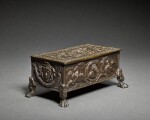
Writing casket
Lot Closed
July 5, 02:17 PM GMT
Estimate
12,000 - 18,000 GBP
Lot Details
Description
Property from an Important English Private Collection
Italian, probably Padua, early 16th century
Writing casket
bronze
9.5 by 22cm., 3¾ by 8⅝in.
Sotheby's, London, 13 July 1978, lot 167
The present writing casket design was highly popular in Renaissance Italy and over fifty examples have been recorded. It is likely that the design originated in the 1470s in Rome or Mantua, although many of the bronze versions are thought to have been cast in Padua in the early sixteenth century by various workshops.
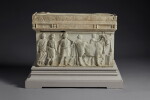
Several variations of the casket exist, as artists and workshops adapted the decorative motifs to their taste. The present casket is decorated with galloping centaurs, Medusa heads, putti, wreaths and ribbons. The border is adorned with palmettes and flower motifs, while the front of the casket shows bust of a young man surrounded by cornucopias.
Examples of this casket model are housed in important collections, including the Ashmolean Museum, Oxford (WA 1947.191.172), The Wallace Collection, London (S65), The Thyssen-Bornemisza collection, Madrid (K28E), and a more elaborate version is in the Frick Collection, New York (1916.2.32).
RELATED LITERATURE
Pope-Hennessy, Renaissance bronzes from the Samuel H. Kress collection, Washington, 1965, pp. 133-134, no. 491, figs. 478-480; Radcliffe et al., The Thyssen-Bornemisza collection. Renaissance and later sculpture, London, 1992, pp. 194-203, no. 31; J. Warren, Medieval and Renaissance Sculpture: A Catalogue of the Collection in the Ashmolean Museum, Vol. 1, Sculptures in Metal, Oxford, 2014, pp. 65-71, no. 16
Several variations of the casket exist, as artists and workshops adapted the decorative motifs to their taste. The present casket is decorated with galloping centaurs, Medusa heads, putti, wreaths and ribbons. The border is adorned with palmettes and flower motifs, while the front of the casket shows bust of a young man surrounded by cornucopias.
Examples of this casket model are housed in important collections, including the Ashmolean Museum, Oxford (WA 1947.191.172), The Wallace Collection, London (S65), The Thyssen-Bornemisza collection, Madrid (K28E), and a more elaborate version is in the Frick Collection, New York (1916.2.32).
RELATED LITERATURE
Pope-Hennessy, Renaissance bronzes from the Samuel H. Kress collection, Washington, 1965, pp. 133-134, no. 491, figs. 478-480; Radcliffe et al., The Thyssen-Bornemisza collection. Renaissance and later sculpture, London, 1992, pp. 194-203, no. 31; J. Warren, Medieval and Renaissance Sculpture: A Catalogue of the Collection in the Ashmolean Museum, Vol. 1, Sculptures in Metal, Oxford, 2014, pp. 65-71, no. 16
You May Also Like