Property from the Alexander Ginzburg Collection, Paris
Oskar Rabin
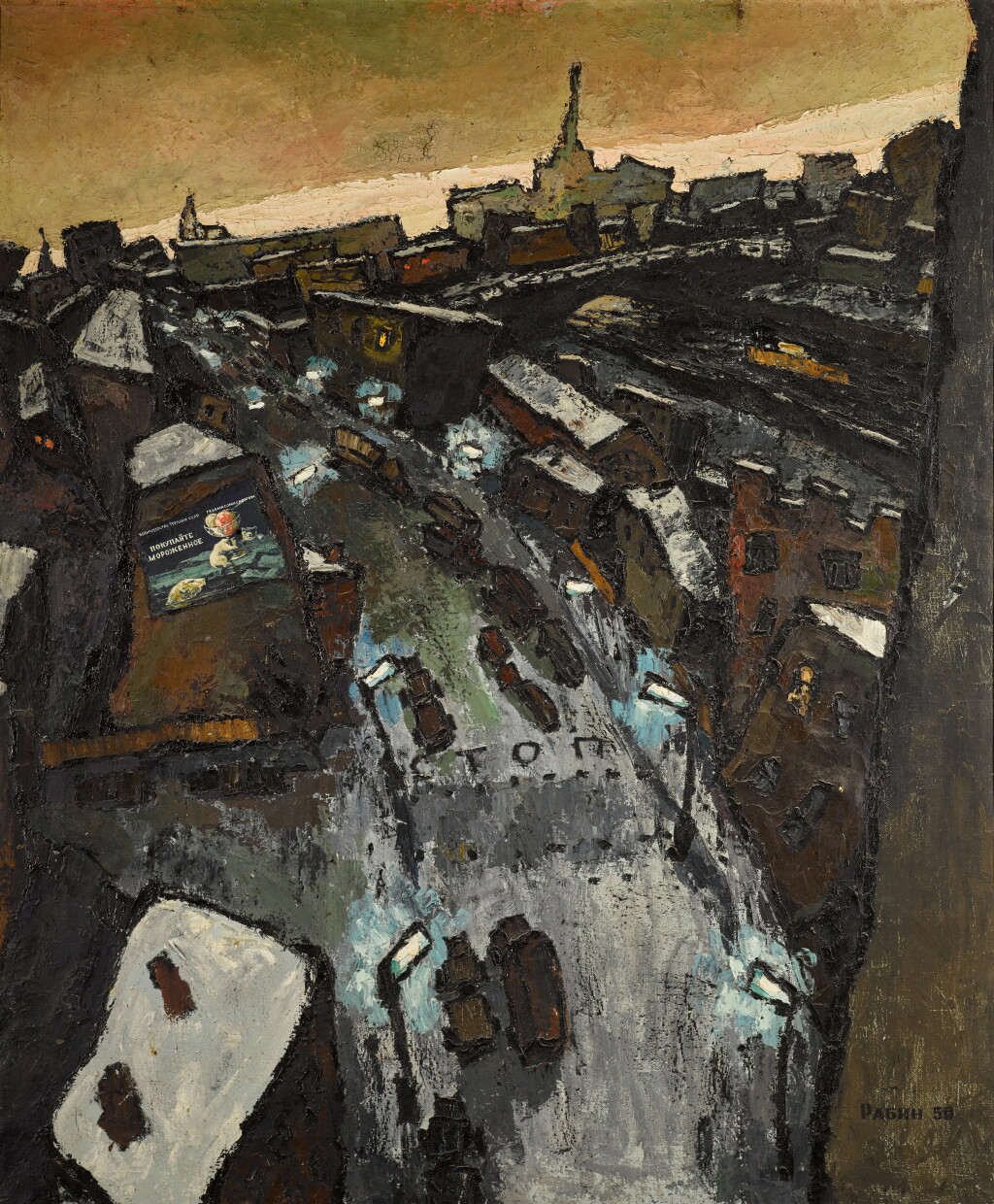
Stop! Moscow Street, 1959
Lot Closed
December 8, 02:28 PM GMT
Estimate
60,000 - 80,000 CHF
Lot Details
Description
Oskar Rabin
1928 - 2018
Stop! Moscow Street, 1959
Oil on canvas
Signed in Cyrillic and dated lower right
110 x 90 cm (unframed); 101,5 x 90,5 cm (framed)
Acquired directly from the artist by Alexander Ginzburg (1936 - 2002)
Thence by descent to the present owner
Oskar Rabin’s Stop! Moscow Street is an important example of early non-official Soviet art, which started to emerge following the death of Stalin in 1953 in the context of the Khrushchev Thaw. The first group to appear was the Lianozovo School, which existed from the late 1950s to the mid-1970s. Founded among others by Rabin, it consisted of underground poets and artists who would meet in the camp barracks near the Lianozovo railway station located in a village on the outskirts of Moscow. Artist such as Lydia Masterkova and Vladimir Nemukhin, influenced by the work of the long-suppressed avant-garde of the 1910s and 20s, worked in an abstract style, while Rabin developed his own formal language based on set of symbolically charged motifs he would repeat throughout his career.
The present work dates from the same year as City with Moon (sold Sotheby’s London on 1 December 2021). Both paintings prominently feature distorted tenement houses and rooftops, which would become a central motif in Rabin’s oeuvre. Behind the dark and dirty facades human life does exist but is only hinted at by the light emanating from some of the windows. While the houses depicted in City with Moon could be in any industrial town in the former Soviet Union, the present view is without doubt one of Moscow, with one of Stalin’s recently built Seven Sisters clearly visible in the distance. The painting is also unusually animated, with cars and trucks driving on a wide and busy street. The inclusion of an advertising poster, here one for ice cream, is another element that would feature in many of Rabin’s later paintings.
Rabin was one of the first non-official artists to gain attention in the West, and his first one-man show took place at Eric Estorick’s Grosvenor Gallery in London in 1965. In 1974, he was one of the organizers of the so-called Bulldozer exhibition, which took place outdoors in Moscow and was forcefully closed by the police using water cannons and bulldozers. The event was widely covered by the foreign press and was an embarrassment for the Soviet authorities. Rabin himself was put under house arrest in 1977 and subsequently offered a visa to leave the Soviet Union. Already in France, he was stripped of his Soviet citizenship.
Apart from its early date and rare subject, Stop! Moscow Street is further distinguished by its provenance. It comes from the collection of Alexander Ginzburg, another leading Soviet dissident. During the 1960s, Ginzburg was three times sentenced to forced labor for his involvement in samizdat publications. A friend of Alexander Solzhenitsyn, he oversaw the so-called Solzhenitsyn Aid Fund after the writer’s expulsion from the Soviet Union. Ginzburg became a founding member of the Moscow Helsinki Group in 1976 and was subsequently arrested and sentenced to another lengthy prison term. In 1979, he was stripped of his Soviet citizenship and sent to the United States as part of a prisoner exchange, together with four other dissidents who were swapped for two Soviet prisoners who had been jailed in the USA for espionage. Ginzburg went to live with the Solzhenitsyns family at their home in Cavendish, Vermont, and was joined by his family the following year. He eventually settled in Paris, where he worked as a journalist.
You May Also Like