El Anatsui
Wastepaper Basket
Lot Closed
March 22, 03:39 PM GMT
Estimate
100,000 - 150,000 GBP
Lot Details
Description
El Anatsui
Ghanaian
b. 1944
Wastepaper Basket
Executed 2003
aluminium and copperwire
243cm., 95¾in.
The October Gallery, London
Acquired directly from the above by the present owner in 2007
Bonhams, Post-War & Contemporary Art, London, 3 October 2019, Lot 32
Acquired from the above sale by the present owner
Washington D.C., National Museum of African Art, Smithsonian Institution, El Anatsui - Gawu, 2004 - 2008; traveling to Llandudno, Oriel Mostyn Gallery; Sligo, Model Arts and Niland Gallery; Oldham, Gallery Oldham; London, The October Gallery; Nottingham, Djanogly Art Gallery; Gainesville, Harn Museum of Art; Hanover, Hood Museum of Art, Dartmouth College; Los Angeles, Fowler Museum at UCLA; Tucson, The University of Arizona Museum of Art
Brussels, Villa Empain- Fondation Boghosssian, Melancholia, 2018
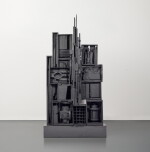
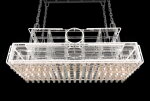
El Anatsui’s Wastepaper Basket is part of a limited series of large scale sculpture installations. Created using discarded printing plates for newspaper obituary pages, the flaking sheets of aluminium are patched and threaded into a towering wastepaper basket measuring over two meters tall. Scattered around the basket are loose pieces of crumpled sheets, piles of discarded memorials faintly shimmering in the periphery. Funerals are an important part of the cultural process in Ghana, and obituary notices are often printed in posters and dispersed throughout the area where the deceased lived. The discarded fragments of personal histories are stitched together into a vessel for waste, commenting on the triviality of death and the disposable nature of human life. Steeped in the cultural memory of the locale, Anatsui’s Wastepaper Basket is an anti-monument to global connectivity, oscillating between the local and universal. Individually humble and collectively monumental, the present work captures the essence of Anatsui’s practice.
“I have employed both materials and processes… literally and figuratively to demonstrate divisions - political, economic, social, cultural, psychological - and their erosion as part of the human experience. There is this obvious impermanence about the human body that eventually terminates in detritus, just as there is a certain impermanence about my work that enables me to reconfigure, redirect, and rehang it in various ways.”
El Anatsui cited in: Jessia Lanay, ‘Three Angles (or Sometimes You Catch a Crocodile): El Anatsui and Dee Briggs Interviewed by Jessica Lanay, BOMB Magazine, March 2019, online
Wastepaper Basket series addresses the issues of environmental sustainability with cultural specificity and poetic complexity. Born in Ghana in 1944, Anatsui’s work grapples with the development of post-colonial life and globalisation of Africa. The artist utilises found objects with materials inextricably bound to a global capitalist economy, highlighting the exchanges between the singular-self and group-other. One of many similar works produced by the artist between 2003 and 2004, the motif not only presents the universal issue of increased waste in global consumerist culture, but also the ways in which waste will accumulate disproportionately on developing nations as more developed countries sell large quantities of waste to countries with limited recycling and waste management capabilities. Referencing the complex colonial history of the African continent with the Western world, the present work is a reminder of the continued scourge of disease, crime and persecution in a region struggling with the long-term effects of post-colonialism and political instability.
Yet the work is also a hopeful message of the power of the collective experience, and the potential for mutual understanding and through the power of creative expression. As Anatsui said - “in reality, therefore, my work is no bridge that links any or all of these so-called labels. Art is the one language we all speak, and is infinite in power. Art is about the voyage of the human spirit and the commonality of all experiences.” (El Anatsui cited in: Jessia Lanay, ‘Three Angles (or Sometimes You Catch a Crocodile): El Anatsui and Dee Briggs Interviewed by Jessica Lanay, BOMB Magazine, March 2019, online)
You May Also Like