Property from a European Private Collection
Victor-Marie Hugo
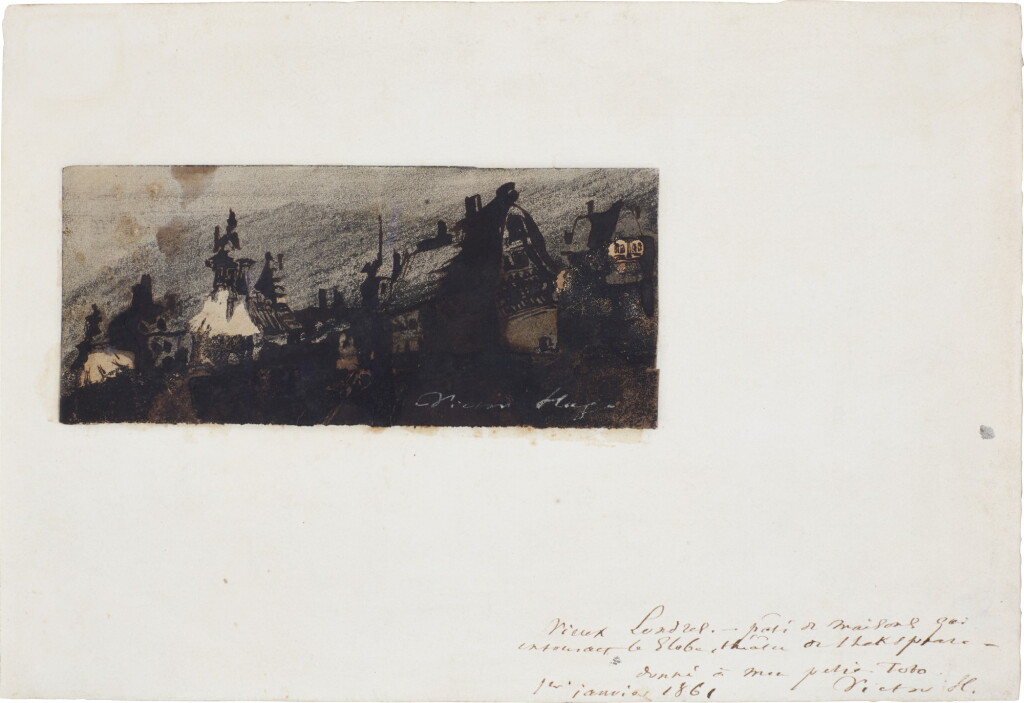
"Vieux Londres"
Auction Closed
July 6, 10:38 AM GMT
Estimate
35,000 - 45,000 GBP
Lot Details
Description
Property from a European Private Collection
Victor-Marie Hugo
Besançon 1802 - 1885 Paris
"Vieux Londres"
Pen and brown ink and wash and black chalk;
signed in white gouache, lower right: Victor Hugo
titled, dedicated and signed in brown ink on the original backing sheet, lower right: Vieux Londres - pâté de maisons qui / entourent le Globe, théâtre où Shakespeare - / donné à mon petit Toto / 1er janvier 1861 Victor H.
The drawing: 68 by 155 mm
The original backing sheet: 180 by 265 mm
As a staunch French Republican, London was not an obvious choice of city for the great French Romantic writer and artist, Victor Hugo, to depict. Indeed Hugo's own experiences of the city must have been extremely limited as, following his exile from France in 1851, he lived first in Brussels, followed by Jersey from 1852-55 before finally settling in Guernsey from 1855 to the fall of Napoleon III in 1870. Hugo is known to have passed through London in August 1852, en route from Antwerp to Jersey, but as with much of his graphic oeuvre, it is Hugo's mind and imagination that is responsible for most of what we see.
The subject of the present work is clearly noted by Hugo in his dedication on the backing sheet and it is through this that we perhaps get the clearest insight into what might have drawn him to this particular subject. Hugo, in his characteristic combination of pen and brown ink and wash, creates a highly atmospheric depiction of "old London" with the artist's interpretation of some of the buildings that once surrounded the Globe theatre, the historic Tudor venue synonymous with the work of Shakespeare. The original Globe theatre was built in 1599, destroyed by fire in 1613, rebuilt in 1614, and then demolished in 1644, further enforcing the imaginative quality of this work. The Romanticism and historical importance surrounding the Globe and Shakespeare would clearly not have been lost on Hugo, who was evidently able to put aside any national differences to celebrate the most important of all his literary forebears.
You May Also Like