
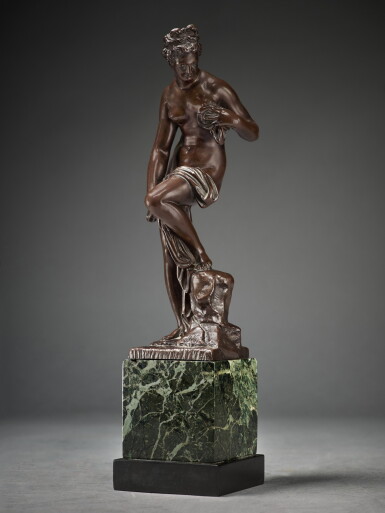
Italian, Florence, second half 17th century
Venus Drying Herself (the 'Cesarini Venus')
Lot Closed
January 28, 07:41 PM GMT
Estimate
8,000 - 12,000 USD
Lot Details
Description
After a Model by Giambologna (Douai 1529-1608 Florence)
Italian, Florence, second half 17th century
Venus Drying Herself (the 'Cesarini Venus')
bearing the inscription IOANNES BOLOGNA BELGA
bronze, on veined marble base
with remains of paper label on underside of base, inscribed Liste 2?, Nr. ?
height of bronze 10 in.; 25.4cm.
height of base 3 ⅞ in.; 9.8cm.
With Bachstitz Gallery 1920;
Fritz Thyssen, Mülheim, acquired before 1926 and confiscated from him by the National Socialist Authorities 1939;
In storage with the Folkwang Museum Essen from February 1940 (Inventory # FM3);
Removed to the Siegen copper mine for safe keeping (inventory # S P 1 94) until June 1945;
Marburg Central Collecting Point, after 1945 (inventory # 1390);
Restituted to the Thyssen family by the British administration after May 1949 and thence by descent to Federico Augusto Count Zichy-Thyssen de Zich et Vásonykeö;
Acquired from the family of the above.
A catalogue of the paintings, tapestries, and bronzes contained in the Bachstitz gallery, The Hague, 1920, pl. 6, no. 11-13 ;
Cicerone, notebook 3 February 1922;
L. Planiscig, Die Bronze-Plastiken des Kunsthistorischen Museums, Vienna, 1924, nos. 249, S. 147 and 255, S. 152;
O. von Falke, The Bachstitz Gallery Collection, 1924, no. 29, vol III, pl. 2;
International Studio, New York, May 1924, S. 92/94, fig. m;
Bulletin III/IV, Baschstitz Gallery, The Hague;
Haus [Fritz] Thyssen Die Sammlung, private printing, Berlin, 1926, no. 55 (illus.)
Giambologna's Cesarini Venus was the sculptor's final exploration of the single female nude in marble. Carved in 1583, it was commissioned by Giangiorgio II Cesarini, Marquis of Civitanova, and executed on the orders of Grand Duke Francesco I de' Medici (1541-1587) and it is housed today in Palazzo Margherita, the American embassy in Rome. The Cesarini Venus became one of Giambologna's most celebrated and highly praised models, with reductions cast by Antonio and Gianfrancesco Susini and later by other workshops.
The present bronze, bearing the signature of Giambologna inscribed in the same manner as his best known autograph bronze Venus in the Kunsthistorisches Museum, Vienna (inv. no. 5874), was cast with the figure resting her foot on a rocky outcropping instead of a pedestal (as seen in the Vienna bronze). The bronze figure is finished with a copper-colored patina, remains of a reddish translucent varnish and multiple square plugs on her legs and back, indicative of an early Italian cast. However, the facial type varies from those of Giambologna and Antonio Susini's small bronzes. While the cast appears to be Itailan, the terrasse base is typical of French bronzes from the second half of the 17th century and 18th century.
RELATED LITERATURE
C. Avery and A. Radcliffe (eds.), Giambologna 1529-1608. Sculptor to the Medici, exh. cat. Arts Council of Britain and Kunsthistorisches Museum Vienna, London, 1978, pp. 62-63;
C. Avery, Giambologna. The Complete Sculpture, London, 1993, no. 14, pp. 30, 107.
You May Also Like


