
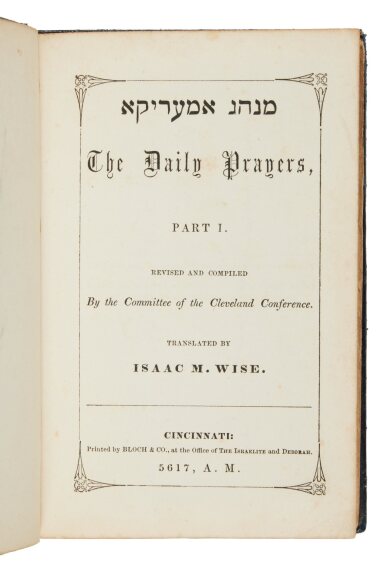
Minhag America: The Daily Prayers, Part I, Translated by Isaac M. Wise, Cincinnati: Bloch & Co., 1857
Lot Closed
June 16, 06:36 PM GMT
Estimate
10,000 - 15,000 USD
Lot Details
Description
The first edition of “a revolutionary prayer book.”
Isaac Mayer Wise (1819-1900), a Bohemian-born and -trained rabbi, achieved renown in the United States as the architect of American Reform Judaism. Beginning his American career in Albany, NY, he would go on, in 1854, to become the spiritual leader of K.K. B’nai Yeshurun in Cincinnati, OH, where he remained until the end of his life. Wise’s attempts to reform the traditional Jewish prayerbook started already in October 1846 at a meeting in New York called by Max Lilienthal, at which he was tasked with compiling a distinctly American ritual that could be used by all congregations (whether of German, Polish, English, or Spanish-Portuguese heritage) throughout the land. While this initial effort, completed the following spring, came to nothing, Wise would take up the cause again about a decade later following the Cleveland Assembly of October 1855. Together with Rabbis Isidor Kalisch and Wolf Rothenheim, he formulated several principles that would guide this project:
“It was out of the question to retain the old prayers unchanged, because the belief in the coming of a personal Messiah descended from the house of David had disappeared from among the people. The return to Palestine, the restoration of the Davidic dynasty, of the sacrificial cult, and the accompanying priestly caste, were neither articles of faith nor commandments of Judaism, while the lamentations over oppression and persecution, and the accompanying cry for vengeance were untrue and immoral as far as American Jews were concerned. The cabalistical portions which had crept into the prayer-book, and the obstinate adherence to the doctrine of the bodily resurrection, were regarded as unjustified. We were also agreed that the Sabbath service, including the sermon, should not last longer than two hours. And this was made quite possible by our adopting the triennial cycle of readings from the Torah. We determined further that as little change as possible should be made in the order of the prayers and in the typical prayers; in fact, no more than the principles we had adopted and the length of time of the public service made necessary. We resolved to publish an English and German, as well as a Hebrew, version of the prayers, and that it should be left to the congregation to decide upon what language it wished to use in the rendition of the service… [We] wished to recast the old and traditional prayers reverently, so that they might be brought into accord with the religious consciousness of the time and the democratic principles of the new fatherland.”
After thirty-eight sessions of work in Wise’s library in the winter of 1856-1857, the three men produced two editions of the siddur, named in Hebrew Minhag America (The American Rite), one with English translation and the other with German translation. At first, the prayerbook was met with fierce opposition from both the right and the left and adopted only by Wise’s own congregation (September 1857); with time, however, it spread to the great majority of Reform synagogues in the western and southern portions of the country and was frequently reprinted. In 1866, Part II of Minhag America, comprising the prayers for Rosh Hashanah and Yom Kippur, appeared, and this was followed two years later by a volume of Hymns, Psalms, and Prayers, with which Wise “conclude[d] his labour for the Minhag America.”
Provenance
Children’s births (10 November 1859-9 November 1867) recorded in German in Latin characters on the pastedown of the English side of the volume
Family members’ deaths (12 December 1867-29 June 1868) recorded in German in Hebrew characters on the pastedown of the Hebrew side of the volume
Physical Description
120 pages in English, 146 pages in Hebrew (6 3/8 x 4 1/4 in.; 162 x 118 mm) on bright paper. Some foxing, staining, and thumbing; small tears in lower edges of pp. 55-56, 81-82 of Hebrew section; p. 90 of Hebrew section printed upside-down. Original blind-tooled blue leather, somewhat scuffed and worn at edges; title (“Prayers Part 1.”) lettered on spine amid foliate designs; edges gilt; original paper flyleaves and pastedowns.
Literature
Yosef Goldman, Hebrew Printing in America, 1735-1926: A History and Annotated Bibliography, ed. Ari Kinsberg, vol. 1 (Brooklyn: Yosef Goldman, 2006), 36, 48-49 (no. 44).
Max B. May, Isaac Mayer Wise: The Founder of American Judaism: A Biography (New York and London: G. P. Putnam’s Sons, 1916), 62-67, 330-335.
David Philipson, “Isaac Mayer Wise 1819-1919,” in Centenary Papers and Others (Cincinnati: Ark Publishing Co., 1919), 11-62, at pp. 23-27.
Robert Singerman, Judaica Americana: A Bibliography of Publications to 1900, vol. 1 (New York; Westport, CT; London: Greenwood Press, 1990), 280 (no. 1489).
Isaac Mayer Wise, Reminiscences, trans and ed. David Philipson (Cincinnati: Leo Wise and Company, 1901), 50-58, 307-315, 343-348.