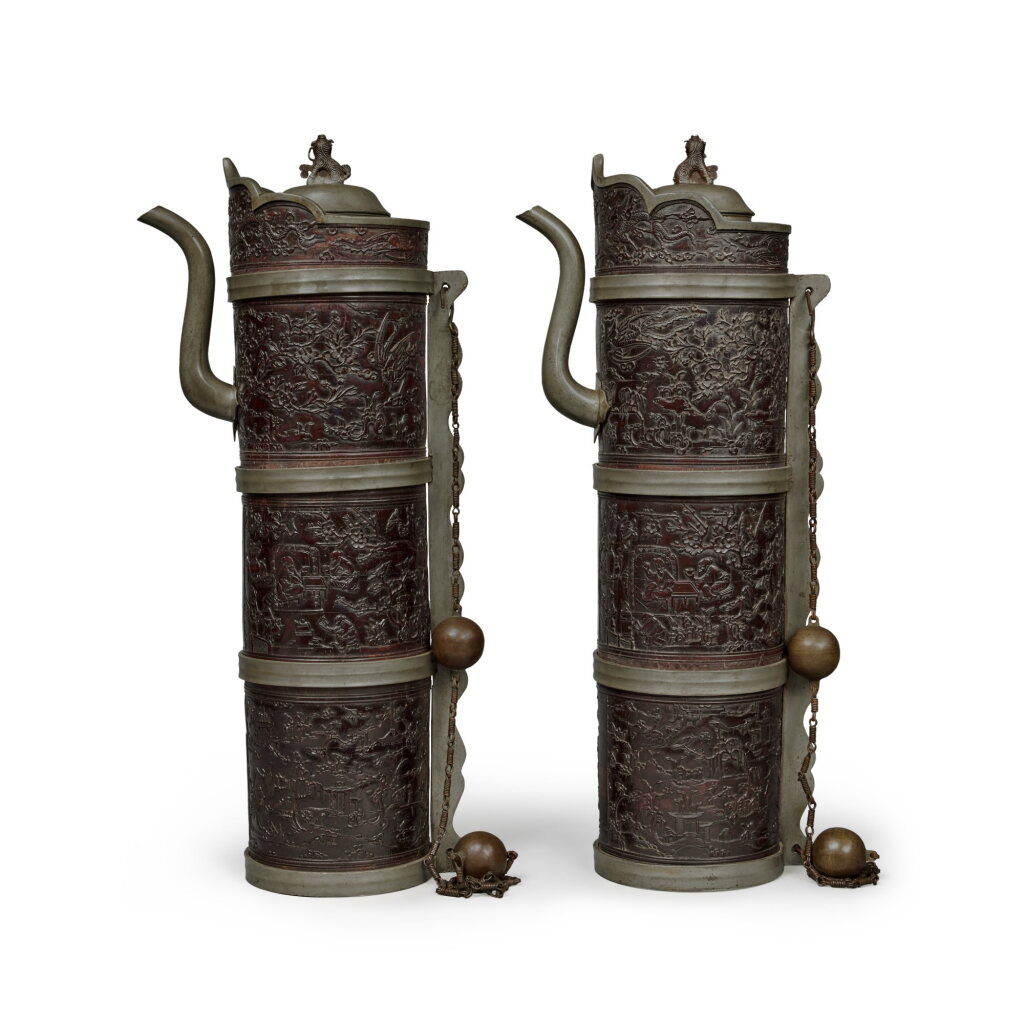
A rare pair of coconut shell pewter-mounted Tibetan-style ewers (Duomuhu), Qing dynasty, 18th century | 清十八世紀 鑲錫椰殼雕花鳥山水煎茶圖多穆壺一對
Auction Closed
September 21, 06:54 PM GMT
Estimate
50,000 - 70,000 USD
Lot Details
Description
A rare pair of coconut shell pewter-mounted Tibetan-style ewers (Duomuhu)
Qing dynasty, 18th century
清十八世紀 鑲錫椰殼雕花鳥山水煎茶圖多穆壺一對
each with a pewter liner and a linked metal chain suspending two hollow spheres (6)
Height 20⅛ in., 51.2 cm
The appearance of Tibetan ritual vessels in the Qing dynasty began during the reign of the Kangxi Emperor as an expression of his personal and political commitment to the patronage of Tibetan Buddhism. The Fifth Dalai Lama's visit in 1652 during the reign of Kangxi's father, Shunzhi (r. 1643-61), marked the first important state visit of a Tibetan prelate to the Qing court. The Kangxi Emperor's mother, also a devotee of Tibetan Buddhism, exerted much influence on him when he came to the throne and his reign is marked by his strong relations with the Khalkha chieftains and the first Jebtsundamba Hukutu Zaanabazar, the highest incarnation of Outer Mongolia. Kangxi's devotion towards Tibetan Buddhism was continued by his successors, particularly during the reign of his grandson, Qianlong, whose extravagant spending on Tibetan religious institutions and ceremonies is well-documented.
This pair of ewers is modeled after Tibetan prototypes and are known as duohumu, meaning 'bucket of snow'. Ewers of this type were originally used in lamaist monasteries for storing butter, milk, or wine. Originally made of wood with metal bands, the humble vessel was reinterpreted in various materials including porcelain, lacquer, rare metals, and cloisonné. The rich brown tones of the coconut shell veneer on the present forms recalls the form's wooden origins. The ewers decoration comprises four matching registers of carefully worked veneer depicting auspicious Chinese subject matter of dragons and phoenix, phoenix amid flowers, scholars in nature, and landscapes.
You May Also Like