
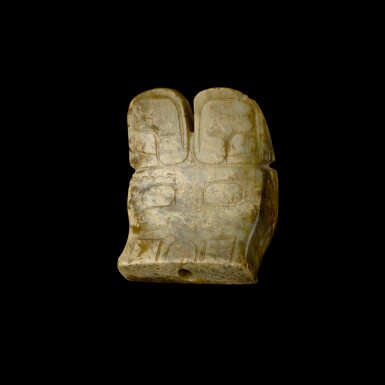
A jade 'animal mask' pendant, Shang - Western Zhou dynasty | 商至西周 獸面紋玉珮
Auction Closed
October 9, 07:30 AM GMT
Estimate
60,000 - 80,000 HKD
Lot Details
Description
A jade 'animal mask' pendant,
Shang - Western Zhou dynasty
商至西周 獸面紋玉珮
the curved animal head depicted with prominent bottle horns, incised with stylized facial features, perforated through the base to the plain convex back
2.9 by 2.2 by 1 cm
Collection of Mr and Mrs William and Charlotte McKim, Palm Beach, Florida.
Bluett & Sons Ltd, London, no. 173, label.
Sotheby's New York, 2nd November 1979, lot 31.
William 及 Charlotte McKim 伉儷收藏,棕櫚灘,佛羅里達州
Bluett & Sons Ltd,倫敦,標籤編號173
紐約蘇富比1979年11月2日,編號3
An Exhibition of Chinese Archaic Jades, Norton Gallery of Art, West Palm Beach, Florida, 1950.
Chinese Jade Carving, Hong Kong Museum of Art, Hong Kong, 1983.
British Museum, London, on loan, 1995.
《An Exhibition of Chinese Archaic Jades》,諾頓美術館,西棕櫚灘,佛羅里達州,1950年
《中國玉雕》,香港藝術館,香港,1983年
大英博物館,倫敦,借展,1995年
An Exhibition of Chinese Archaic Jades, arranged for Norton Gallery of Art, West Palm Beach, Florida, C.T. Loo, inc., New York, 1950, pl. XXII:12.
Ip Yee, Chinese Jade Carving, Hong Kong, 1983, cat. no. 35.
Jessica Rawson, Chinese Jade from the Neolithic to the Qing, London, 1995, pl. 12:18.
《An Exhibition of Chinese Archaic Jades, arranged for Norton Gallery of Art, West Palm Beach, Florida》,盧芹齋,紐
約,1950年,圖版XXII:12 葉義,《中國玉雕》,香港藝術館,香港,1983年,編號35 羅森,《Chinese Jade from the Neolithic to the Qing》,倫敦,1995年,頁272,圖版12:18
The production of small jade animal motif carvings blossomed in the late Shang period around the time of Fu Hao (c. 1200 BC). The bloom could have been inspired by Neolithic pieces, according to Jessica Rawson, as evident by the famous phoenix plaque from Shijiahe culture (c. 2500-2000 BC) unearthed in the tomb of Fu Hao, among numerous Shang dynasty jade animal carvings (The Complete Collection of Jades Unearthed in China, vol. 5: Henan, Beijing, 2005, pl. 30). The similarities in decoration between jade animal carvings and bronzes, especially those with exotic zoomorphic motifs from Dayangzhou in Jiangxi, however, suggest another possible connection (see Jessica Rawson, Chinese Jade: From the Neolithic to the Qing, London, 1995, pp. 205-208).
The facial features and the incised details of the present animal mask indicate a stronger relationship with Shang dynasty bronzes than with Neolithic precedents. Compare two related jade carvings excavated from Xiaotun, Anyang, and exhibited in King Wu Ding and Lady Hao: Art and Culture of the Late Shang Dynasty, Taipei, 2011, cat. no. IV-1, a celadon jade ornament for the handle of an arrow case, and cat. no. IV-1, a set of horse bridle ornaments including two jade animal masks. See also two jade ‘animal head’ carvings illustrated in Jessica Rawson, op.cit., nos 12:16-12:17. The former, probably reworked from a section of a cong, is similarly decorated with features reminiscent of Shang bronzes, but with protruding flanges on either side. See also a small jade carving of a bovine head from the tomb of Fu Hao, published in The Complete Collection of Jades Unearthed in China, op.cit., pl. 95.
You May Also Like


