
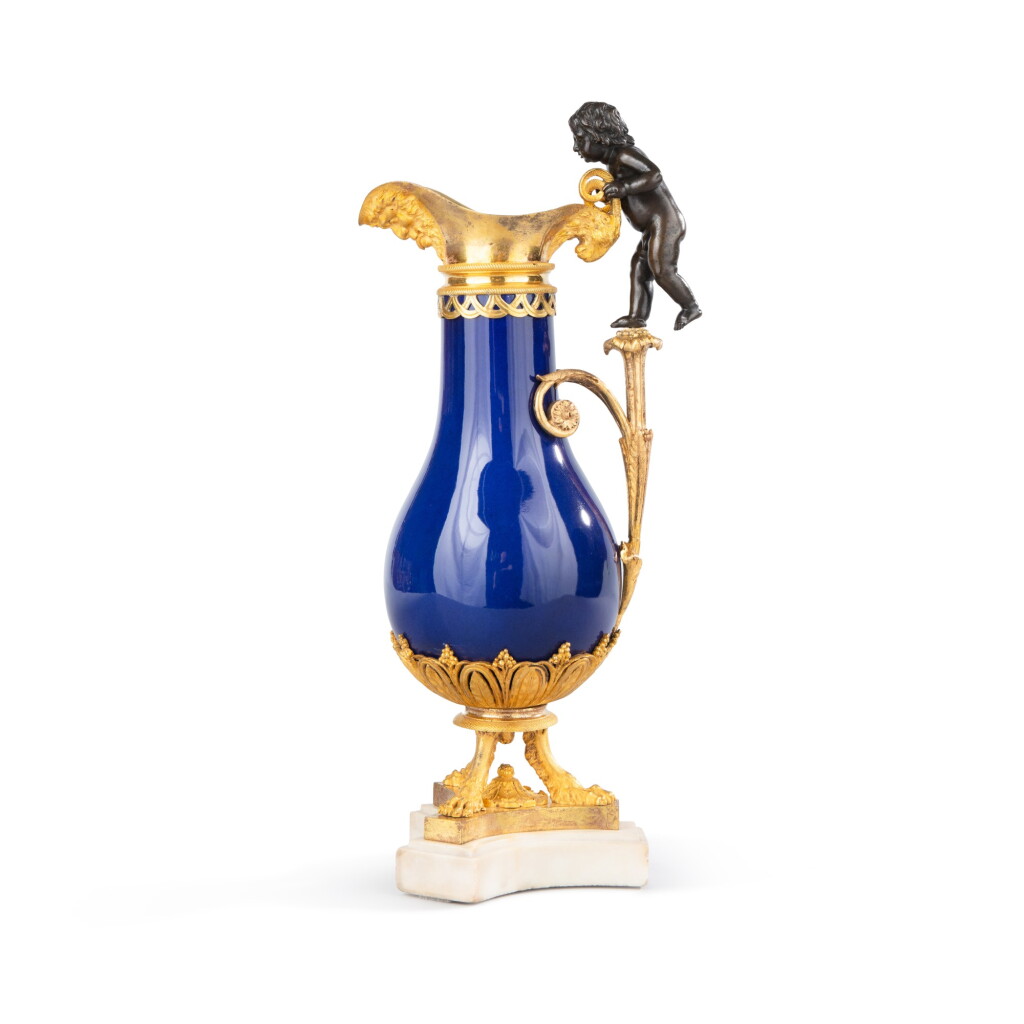
A gilt bronze-mounted Paris hard paste porcelain ewer, the porcelain made by the Locré Factory, 18th century, the mounts Louis XVI, circa 1785
Auction Closed
October 13, 06:27 PM GMT
Estimate
6,000 - 10,000 EUR
Lot Details
Description
A gilt bronze-mounted Paris hard paste porcelain ewer, the porcelain made by the Locré Factory, 18th century, the mounts Louis XVI, circa 1785
the baluster-shaped body surmounted by an open spout cast with a bearded grotesque mask and a horned ram's head at the junction with the handle, the handle headed by a standing putto holding onto the ram's horns, standing on a scrolling foliate and flower-head support, the stiff-leaf wrapped base above a tripartite support with lion paw feet on a stepped trefoil marble base with the blue underglaze crossed torches mark
height 15¾in.; 40 cm.
(1)
____________________________________________
Aiguière en porcelaine de Paris et bronze patiné et doré, la porcelaine de Locré, XVIIIe siècle, la monture d'époque Louis XVI, vers 1785
height 15¾in.; 40 cm.
(1)
The Grange, Lydd, Romney Marsh, Kent, England;
Richard Redding Antiques Ltd., London, 2008.
____________________________________________
The Grange, Lydd, Romney Marsh, Kent, Angleterre;
Richard Redding Antiques Ltd., Londres, 2008.
The design of the mounts can be compared to two works by Pierre Gouthière for the Duc d'Aumont. The moulded lip with a satyr mask and the handle with the perched figure looking in appear on a mounted celadon porcelain ewer that was lot 114 of the duke's 1782 auction and the tripod base appears on a pair of mounted blue china vases, lot 163. The drawings of these pieces are illustrated in C. Baulez, "Pierre Gouthière (1732-1813)" in Vergoldete Bronzen, vol. II, Munich, 1986, p.579, figs. 18 and 19).
Locré established a porcelain factory named 'Fabrique de la Courtille' in the rue Fontaine-au-Roi in 1773. The factory was soon very successful and productive, mainly producing imitations of German porcelain. The factory's mark consisted of crossed double swords, again inspired by those used at Meissen. After Ruffinger had joined Locre in 1790, a new hard paste porcelain manufacturing technique was conceived in the establishment. Related pairs of ewers were sold at Sotheby's Monaco, 1 July 1995, lot 77; Sotheby's London, 10 December 1993, lot 233 and Sotheby's London, 15 June 1990, lot 89.
You May Also Like


