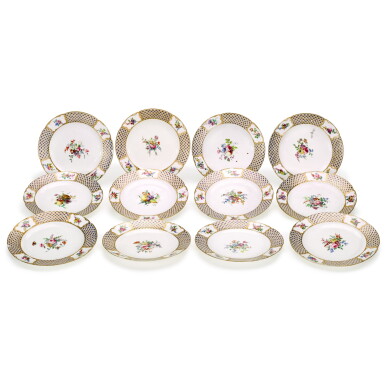
A Sèvres bleu mosaïque composite part dessert service, various dates, predominantly 1757-9 and 1762
Lot Closed
May 17, 11:38 AM GMT
Estimate
4,000 - 6,000 GBP
Lot Details
Description
A Sèvres bleu mosaïque composite part dessert service, various dates, predominantly 1757-9 and 1762
painted with bouquets of flowers, the borders reserved with further flowers sprays within gilt scroll cartouches, comprising: a pair of shell-shaped dishes, a pair of moulded saucer dishes and thirty-one plates; and a double preserve stand, (plateau à confiture), painted wiht flowers within a blue line border, various interlaced L's marks, various painter's marks
(36)
Please note that the W symbol has been removed from this lot. This lot will remain in New Bond Street after the sale.
The Wittlesbach pattern is an unofficial name derived from the resemblance between the blue and white border and the coat of arms of the Wittlesbach family and a service with this border given by Louis XV to Carl Theodore, Elector of the Palatine in 1760. However, the pattern is closely associated with Madame de Pompadour and her apartments at the Petit Château de Choisy. These origins are discussed by Rosalind Savill, Everyday Rococo Madame de Pompadour & Sèvres Porcelain, Norwich, 2021, Vol. 1, p. 558. The painted pattern highlighted the moulded border used on two compotiers, itself derived from the alt Brandenstein pattern borders on contemporary Meissen porcelain. Mme de Pompadour ordered two sets of plates in 1758 and 1762 described in her inventory as “mosaïques bleu, dessin de Choisy le Roy”. The author also illustrates a plate, probably from the 1758 order (date letter E) of eighteen plates in the collection at Stratfield Saye House, Hampshire (Savill, ibid., Vol. 2, Fig. 15.47).
You May Also Like