趙岡、陳鍾毅伉儷收藏書畫(編號3036-3048)│ Property From the Collection of Professor Kang and Jessica Chao (Lots 3036-3048)
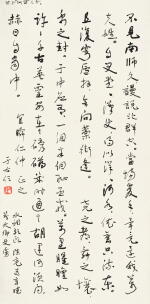
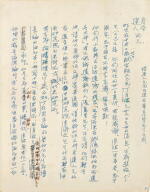
羅家倫 行書七絕 | Luo Jialun, Calligraphy in Xingshu
Auction Closed
April 30, 09:39 AM GMT
Estimate
40,000 - 80,000 HKD
Lot Details
Description
Property From the Collection of Professor Kang and Jessica Chao (Lots 3036-3048)
Luo Jialun
1897 - 1969
Calligraphy in Xingshu
ink on paper, hanging scroll
signed, with 1 seal of the artist
64.5 x 32.8 cm 25⅜x 12⅞in.
----------------------------------------------
趙岡、陳鍾毅伉儷收藏書畫(編號3036-3048)
羅家倫
1897-1969
行書七絕
水墨紙本 立軸
款識︰生憎刻意作詩人,豪興來時句有神;聊藉天山風雪夜,醉蘸濃墨寫天真。彥濱仁弟、鍾毅世妹儷正。羅家倫。
鈐印︰「羅家倫印」。
上款︰「彥濱、鍾毅」即趙岡、陳鍾毅伉儷。上世紀五十年代,羅家倫女兒久芳與趙氏伉儷同就讀於密西根大學,交情甚篤,並認趙氏女兒為義女。
64.5 x 32.8 cm 25⅜ x 12⅞ in.
Property From the Collection of Professor Kang and Jessica Chao (Lots 3036-3048)
The Collection of Professor Kang and Jessica Chao began in 1938 when Zhang Shanzi gifted Lot 3047, Tiger by the River to Kang Chao’s father, Zhao Ximeng (1899-1956). Ximeng was at the forefront of literature, poetry, art and politics from the 1920s to the early 1950s in China. During the Sino-Japanese war, he wrote patriotic articles in the Morning Light News and was a war correspondent for the Ta Kung Pao. In 1944, the famous Chinese artist Zhang Daqian, added the inscription and painted the grasses in the foreground during one of his visits to Ximeng while in Liaoning.
After his father’s death in 1956, Kang Chao inherited the Zhang Shanzi & Zhang Daqian painting, along with the Chao family legacy as a welcome oasis for visiting scholars, artists, writers and change-makers. By the 1980s, Kang Chao was acclaimed for his ground-breaking and bold analysis of China’s economic development, had co-founded the Chinese Institute for Economic Research in Taipei, and was one of the foremost Redologists in the world. He and Jessica were extraordinarily committed partners—in work as well as life. They collaborated on nearly 100 books and publications in both English and Chinese on Economics and the Hong Lou Meng.
As one of the few Chinese faculty members in the American Midwest, Kang and Jessica Chao continued the Chao tradition. They opened their home in Madison, Wisconsin to visiting scholars and artists from China, Taiwan, Hong Kong, Malaysia and beyond. These visitors appreciated being in a familiar environment, discussing topics ranging from art and politics to current events. Most of all they delighted in Jessica’s authentic Chinese cooking at a time when America was just beginning to understand true Chinese culture.
June 1980, Kang and Jessica kicked off the first International Conference on the Dream of the Red Chamber by hosting the opening dinner in their Madison home. The world’s leading redologists, Zhou Ruchang, Qi Gong, Dai Dunbong, Yu Pingbo and Feng Qiyong presented magnificent scrolls with personal dedications to our parents. Those who became close friends would use Kang's familiar name, "Yen-bing” (彥濱). The more formal visitors would use "Professor Kang Chao" (趙岡教授). By the time Kang retired from his professorship at the University of Wisconsin in the mid-90's, he and Jessica had a collection of nearly 100 scrolls of calligraphy and paintings.
In 2017, Kang and Jessica Chao donated their entire collection of rare Hong Lou Meng books and research materials, 40 banker boxes in all, to the Ricci Institute in San Francisco. Their goal was to encourage future generations of young scholars to enjoy the study of the Dream of the Red Chamber. Shortly thereafter, Jessica Chung-yee Chen Chao passed away on November 5, 2020. For Kang Chao, 2021 was a challenging year without his companion of 70 years. On October 23, 2021, he slipped away peacefully to join her.
To honor the legacy of their extraordinary teamwork and to their goal of promoting cross-cultural exchange by sharing the best of East and West cultures, partial proceeds from the sale of this Collection will go towards two projects. The first is to establish scholarships that strengthen cultural bridges between East Asia and the West. The second is to establish a much needed pipeline of Chinese-speaking Caregivers and Home Health Aides to serve our beloved Chinese elders.
You May Also Like