From the Library of Clayre and Jay Michael Haft
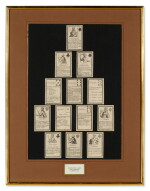
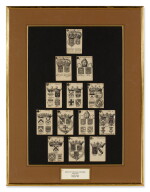
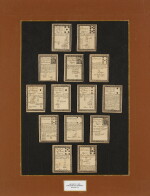
Higden, Ranulph | The first illustrated edition of the most influential chronicle in Britain
Lot Closed
December 16, 07:25 PM GMT
Estimate
12,000 - 18,000 USD
Lot Details
Description
From the Library of Clayre and Jay Michael Haft
Higden, Ranulph
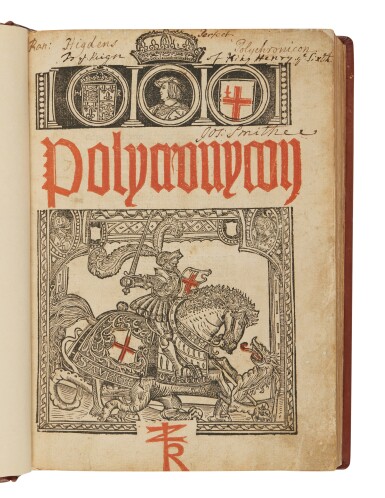
Polycronycon. Translated into English with additions by John Trevisa, edited with a continuation by William Caxton. Southwark: Peter Treveris, 16 May 1527
Folio (270 x 192 mm). Black letter, double-column, 44 lines to a page, title-page in red and black printed with five blocks comprising crown (cropped at top and bottom), medallion portrait of Henry VII with royal arms and arms of the City of London, xylographic title, large illustration of St George and the Dragon, John Reynes' printer's mark in red (McKerrow 55), colophon at the end within border of hunting scenes (McKerrow & Ferguson 12), full-page woodcut by Reynes on final page (an earlier version of the title-illustrations: McKerrow 61), full-page woodcut of English and French armies in battle on z6v (Hodnett 2491), woodcut musical notation illustrating diapason on n5r, further woodcut portraits of kings, queens, etc., with repetitions (6 blocks: Hodnett 2490, 2492-6), historiated and decorative initials; restoration to title-page, minor worming (some of which repaired), gatherings L and M with all instances of “pope” drawn over in red at an early date, similar highlighting continuing intermittently through gathering S, R4 with lower corner renewed, marginal repairs in last two leaves, occasional soiling and staining throughout. Modern paneled calf antique, all edges gilt.
Third edition, with annotations by an early reader—and the first illustrated edition—of the most influential chronicle in Britain of the fourteenth and fifteenth centuries. The Polychronicon, as originally written by the Benedictine monk Ranulph Higden, was a world history from Creation to 1360. Written in seven books, in imitation of the seven days of Genesis, it offered a clear and original picture of that history based on medieval tradition, with an added emphasis on antiquity (particularly the Roman world) and the relation of early British history to the wider context. As such it serves as a national history, with its focus on the Norman Conquest and subsequent English history. The Polychronicon went through a number of manuscript editions in Higden's lifetime, with the history continued by a number of writers in the second half of the fourteenth century, the most important of whom was John Malvern. The English translation of John Trevisa (ca. 1330-1412) was commissioned by Thomas, Lord Berkeley, and completed on 18 April 1387. The complete text was first printed by Caxton in 1482, with a second edition published by Wynkyn de Worde in 1495. With the exception of the woodcut of the musical notation on n5r, which first appeared in Wynkyn de Worde's 1495 edition (and was the earliest printed musical notation in an English book), all the woodcut illustrations appear here for the first time.
REFERENCE:
STC 13440; Pforzheimer 490; Grolier/Langland to Wither 121, Steele/English Music Printing no.10; ESTC S119426
PROVENANCE:
Alice James (16th-century ownership inscription on Hh5v). An accompanying October 1990 letter from British Library curator W. H. Kelliher transcribes the inscription that documented the receipt of the book upon the marriage of Alice James to Robert Mowle, 10 February 1577 (a photocopy recording their marriage license in Lemuel Chester’s London Marriage Licenses 1521-1869 is also included). The book is extensively annotated in an early hand, presumably that of Alice James. — Joseph Smithee? (19th-century signature and identification of authorship on title)
You May Also Like