
Property from the Collection of Richard Kent
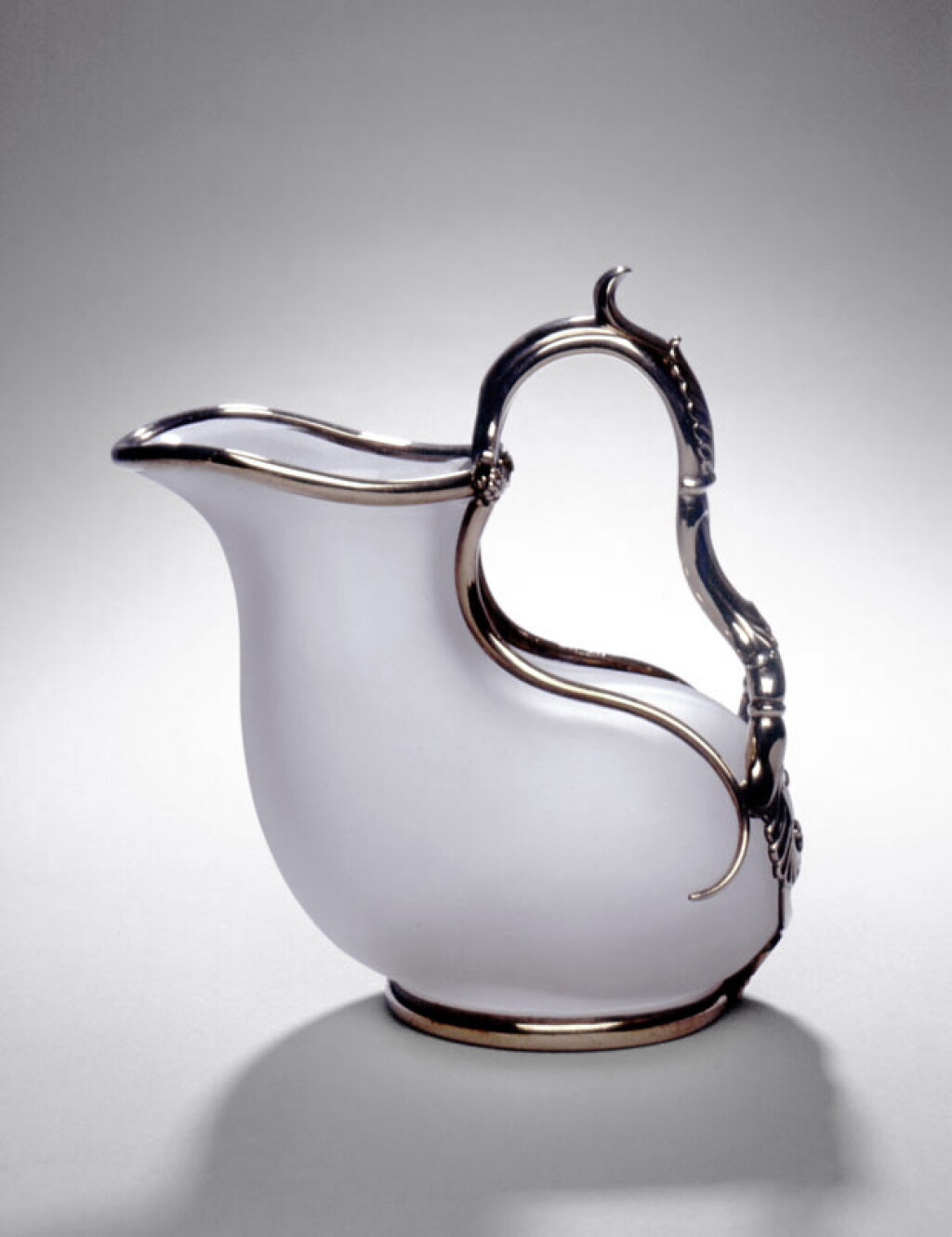
A William IV Silver-Gilt and Frosted Glass Askos-Form Ewer, Paul Storr, London, 1836
Lot Closed
October 18, 07:49 PM GMT
Estimate
6,000 - 9,000 USD
Lot Details
Description
Property from the Collection of Richard Kent
A William IV Silver-Gilt and Frosted Glass Askos-Form Ewer, Paul Storr, London, 1836
the swelling body with plain foot and neck rims, the foliated scroll handle with grape clusters where it meets the rim, forking at the base to rejoin at the foot rim, in fitted oak box, the green baize lined interior with paper label of "Storr & Mortimer 156 New Bond St., Factory 17 Harrison St., Gray's Inn Rd.," the front of the box inscribed on a brass plaque "Sir Richard Acton Bart."
height 8 1/4 in.
21 cm
Sir Richard Acton, Baronet (1801-1837)
David Orgell, Beverly Hills
Francis Raemaekers
Sir Ferdinand Richard Edward Dalberg-Acton, 7th Baronet (1801-1837) was the son of Sir John Acton, Prime Minister of Naples; he was named for the King of Naples. but was commonly known as Richard. He succeeded his father in 1811, and the ties to Italy remained strong, as Sir Richard built the Villa Pignatelli near Naples in 1826, with spectacular views of the sea and Mt. Vesuvius. In 1832 he married Marie Louise Pelina von Dalberg. He must have purchased this askos the year it was made, as in January of 1837 he attended a party at the Tuileries Palace in Paris with his friend Lord Augustus Loftus; the party was very hot, but they were then obliged to walk in the cold to find a carriage. Sir Richard caught a fever, and died January 30. The funeral was held at the church of St. Thomas Aquinas in Paris and attended by the Ambassadors of Russia, Austria, and Prussia; King Louis-Philippe, "who with the rest of his family had always honoured the Chevalier Acton with the most marked attention, send one of his aides-de-camp" (The Times, February 17, 1837). After his death, the Villa Pignatelli was bought by Baron Carl de Rothschild, head of the Naples branch.
This bellied design originated in ancient times with animal-skin vessels, which were then replicated in pottery. In the 18th century the classical prototypes were rediscovered and extensively published. The form became popular for modern wares from the 1830s to the 1850s and was made in silver-mounted glass as well as solid silver, by a variety of firms; it was even picked up in America by Samuel Kirk.
Many examples of this form in silver survive by Storr from the period 1835 to 1837. An 1836 Storr example with the same shaped frosted glass body, but with the mounts done as gilt naturalistic grapevine rather than following the classical prototype, was sold Bonham's, London, June 30, 2010, lot 314. The askos form of mounted glass jug was continued by Storr's successor firm, Hunt & Roskell, through at least 1851 (see Christie's, London, June 13, 2001, lot 26).
You May Also Like


