Leonard Baskin
Hephaestas
Lot Closed
December 15, 06:08 PM GMT
Estimate
10,000 - 15,000 USD
Lot Details
Description
Leonard Baskin
1922 - 2000
Hephaestas
bronze
height: 65 in.
165 cm.
Executed in 1963.
Borgenicht Gallery, New York
Acquired from the above on 1 November 1964 by the present owner
New York, Borgenicht Gallery, 1964
John Canaday, "Baskin and the Sooty God: In a New Exhibition, the American Sculptor Not Only Affirms His High Position, But Tops It," The New York Times, 9 February 1964
George Braziller, Baskin: Sculpture, Drawings & Prints, New York, 1970, no. 35, illustrated
Irma Jaffe, The Sculpture of Leonard Baskin, New York, 1980, no. 114, pp. 10, 34, 168, 170, 214, illustrated
Jacob Nyenhuis, Myth and the Creative Process: Michael Ayrton and the Myth of Daedalus, the Maze Maker, Detroit, 2003, p. 67
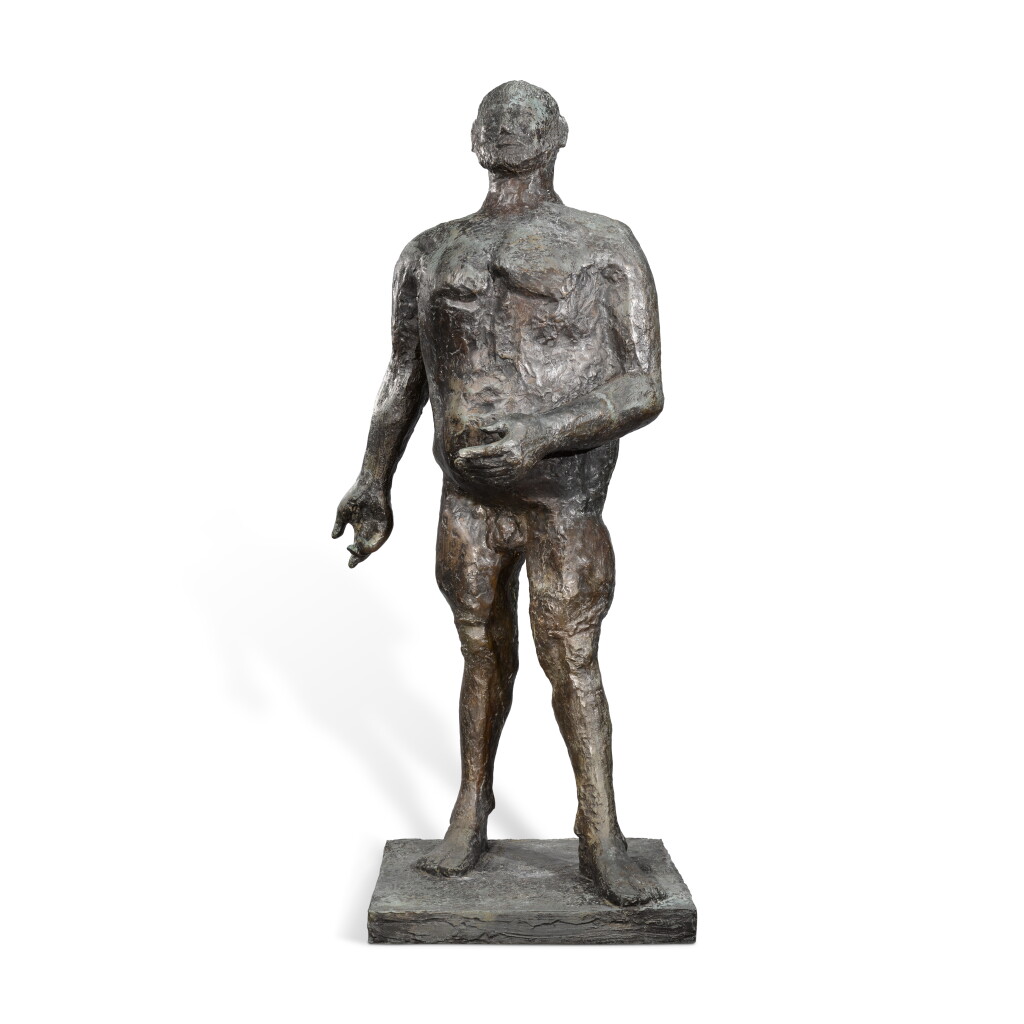
In Greek mythology, Hephaestus is banished from Olympus for his ugliness yet ultimately becomes the blacksmith of the gods and creates extraordinary beauty. He appears in Homer's Iliad, which Leonard Baskin illustrated for a deluxe edition in 1962 and which likely inspired his creation of this sculpture in 1963. In the present work, Hephaestus is not just a mythological figure, but is also an archetypal artist (perhaps a self-portrait of Baskin) and a symbol of beauty in the grotesque.
This sculpture was cast in 1963 in an edition of four. The first example from this edition has been in the collection of the Whitney Museum of American Art since 1964. The present example was the highlight of a 1964 exhibition of Baskin's work at the Borgenicht Gallery in New York. A review of the exhibition in The New York Times celebrates this audacious, "three-quarters life size" sculpture:
"It is the latest and most impressive development in Baskin's series of physically grotesque male nudes... Hephaestus, the lamed god of fire and blacksmith to other gods, stands with a great swollen growth of belly balanced over spindly legs, his monstrous torso surmounted by a battered, coarsely bearded head... This was the ugly god among the beautiful ones... To turn such a figure into a noble one without falling into sentimentality is the problem Baskin solves again and again... There are much fortitude, much pride of acceptance and even a high degree of good humor." (John Canaday, "Baskin and the Sooty God: In a New Exhibition, the American Sculptor Not Only Affirms His High Position, But Tops It," The New York Times, 9 February 1964)