Bill Viola
Witness
Lot Closed
July 19, 08:16 PM GMT
Estimate
50,000 - 70,000 USD
Lot Details
Description
Bill Viola
b. 1951
Witness
color video on LCD flat panels mounted on wall, in 3 parts
Each Screen: 16¼ by 13 by 2 in. (41.3 by 33 by 5.1 cm.)
Overall: 16¼ by 75 by 2 in. (41.3 by 190.5 by 5.1 cm.)
Executed in 2001, this work is number 4 from an edition of 5, plus 1 artist's proof.
This work is accompanied with a Certificate of Authenticity signed by the artist.
Anthony d’Offay, London
Acquired from the above by the present owner in 2001
London, Anthony d'Offay Gallery, Bill Viola: Five Angels for the Millennium and Other New Works, 2001
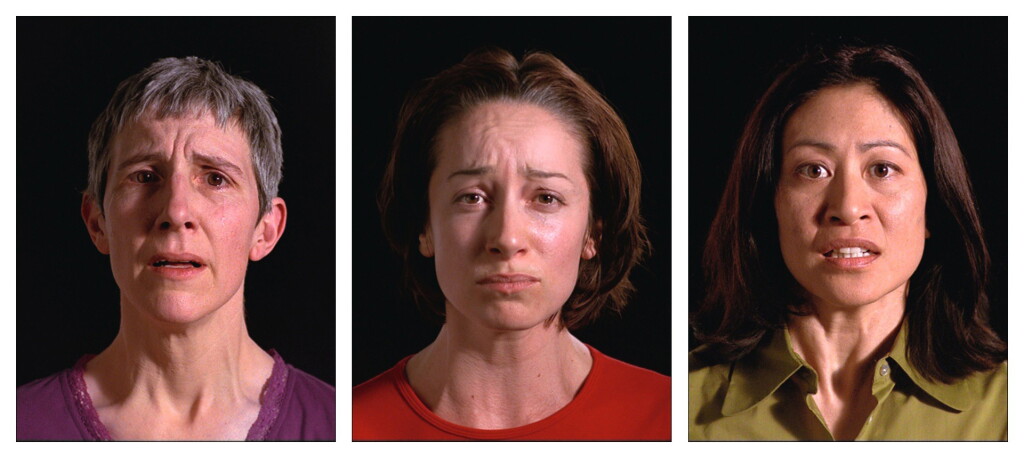
Universally acknowledged as one of the great pioneers of Video Art, Bill Viola uses the element of time provided by his medium to reinvestigate one of the fundamental themes of art history: human feeling and emotion. Renaissance artists across Europe were constantly trying to refine the painterly rendition of human feelings in all their complexity and fleetingness. With his innovative use of video, Viola picks up on this theme precisely where it had been halted centuries ago. In Witness, Viola renders with a great poignancy the palette of variations which stands between one archetypical emotion after the other.
As the artist stated "[In this work] three contemporary women maintain an intensive, locked gaze on the camera as they undergo a succession of strong emotional states. Joy, sorrow, anger and fear unfold on their faces in slow motion as continuous gradations of expression. The three moving-image portraits are presented as individually framed pictures mounted in a row on a wall. The women relentlessly staring eyes call out for the viewer to return their gaze. Their unbroken lines of sight cut across time and space to meet the viewer's eyes in a continuously shifting stream of emotional strength and vulnerability." (Bill Viola, Witness, 2001)
Although traditionally the video medium doesn't allow the viewer's gaze to settle on the subject, Viola's dexterous use of slow motion and state of the art digital rendering gives the beholder an unprecedented opportunity to scrutinize each stage of one's emotional changes. This new psychological insight triggers an almost contagious effect from the part of the beholder who slowly but surely entwines his feelings with the one represented in Witness, until a point where a mirror effect starts to come into play. As Peter Sellars noted "Witness is an elusive and irreducible piece which testifies directly to the interchangeability and interrelatedness of opposite moods and states the impossibility of sustaining "pure" emotion. You can feel your own mood shift as you watch three women open their eyes in calm and then look back at you with powerfully suggestive and even contagious emotional indicators. The piece is a rollercoaster ride through your own emotional landscape and brings home the confusion that we experience in the face of different versions, contradictory accounts and the divergent explanations of the world around us." (Exh. Cat., Los Angeles, The Getty Museum, Bodies of Light' in Bill Viola: The Passions 2003, p. 177)
You May Also Like