
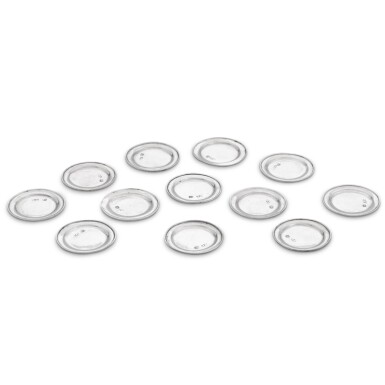
A rare set of twelve miniature George I silver plates, David Clayton, London, circa 1720
Lot Closed
November 8, 02:49 PM GMT
Estimate
3,000 - 5,000 GBP
Lot Details
Description
A rare set of twelve miniature George I silver plates, David Clayton, London, circa 1720
Plain form, with raised rims,
3.2cm., 1 ¼in. diamter
77g., 2 ½oz.
David Clayton, a London smallworker well known to collectors of miniature silver articles, was probably born in the mid 1670s. Through his father, also David Clayton, he was made free by patrimony of the Merchant Taylors’ Company on 10 September 1689. His first mark was entered at Goldsmiths’ Hall on 9 July 1697, when he gave his address as Cheapside, City of London.
David Clayton of the parish of St. Matthew, Friday Street, off Cheapside, assumed to be the same individual, was married at St. Ethelburga, Bishopsgate, on 8 October 1706 to Hannah Vincent of Newington, Middlesex. (Marriage allegation, London Metropolitan Archive, MS 10091/43)
Although Clayton was declared a bankrupt in 1711, when he was described as a jeweller, by June 1713 his creditors received a dividend on his estate. On 8 October that year he registered the duty paid for an apprentice, Edward, son of Edward Highmore, Citizen and Woodmonger. (National Archives, Kew, IR 1/2, fol. 125) By 14 December 1714 Clayton’s financial situation had recovered, so much so that he was able to place the following advertisement in The Daily Courant:
‘To all that love King George.
‘His most Excellent Majesty’s Head curiously Struck and Grav’d in Gold and Silver Seals, by David Clayton, Jeweller, at the Golden Unicorn in Butcher-hall-lane, Newgate-street, sold by the Goldsmiths and Toyshops in London and Westminster. Any Jeweller may have the Heads either in Gold or Silver unset, to set themselves, of the said David Clayton, as likewise Middle-Pieces for Watches, Stampt very fine.’
Clayton’s second mark was entered on 6 July 1720. Grimwade (London Goldsmiths, p. 467) suggests that John Clayton, whose mark, also found apparently exclusively on silver miniatures, was entered on 2 November 1736, may have been David’s son. John Clayton was declared bankrupt in January 1737. Whether David Clayton is connected with Anthony and John Clayton, Matthew Clayton and Ruth Clayton, all of whom are recorded by Grimwade, is open to speculation.
You May Also Like


