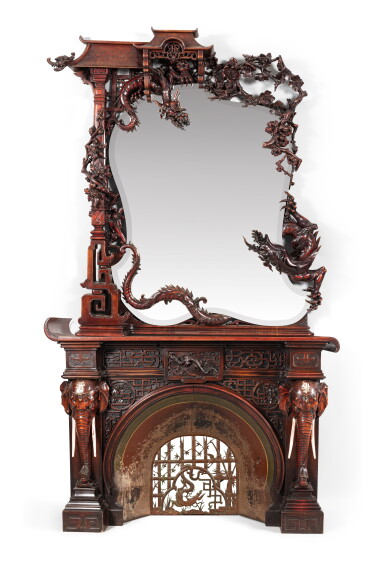
A carved wood chimney and mirror frame, second half 19th century | Cheminée et cadre de miroir en bois sculpté, seconde moitié du XIXeme siècle
Auction Closed
April 22, 02:09 PM GMT
Estimate
70,000 - 100,000 EUR
Lot Details
Description
A carved wood chimney and mirror frame, second half 19th century
the chimney with elephant heads inlaid with mother of pearl, the mirror decorated with dragoons, three branches and pagoda; the front fire in lacquered tôle; with a pierced brass grid decorated with dragoons; (traces of wear)
Chimney: Height 45⅔in; width 65¾in; prof 22 in; Mirror: Height 80⅓in; width 78¾ in; prof 10⅔in
_______________________________________
Cheminée et cadre de miroir en bois sculpté, seconde moitié du XIXeme siècle
la cheminée avec des montants en forme de têtes d’éléphant incrustées de nacre, surmontée d’un grand cadre sculpté de dragons, éléments d’architecture de pagode et branchages fleuris; l'avant foyer de forme circulaire en tôle peinte laquée; avec une grille ajourée en cuivre ornée de dragons masquant l’âtre; (usures)
Cheminée: Haut. 116 cm, larg. 167 cm, prof. 56 cm, Miroir: Haut. 204 cm, larg. 200 cm, prof. 27 cm
The Musée des Arts Décoratifs in Paris holds a mirror with dragons (inv. 2002.57.1) whose aesthetic is very similar to this impressive composition of a mantelpiece topped with a mirror frame. The museum's mirror is attributed to Gabriel Viardot (1830-1906), and consists of two dragons clashing with each other, hanging on the walls of an asymmetrical mirror. He inherited the family cabinetmaking business and specialised in animal and plant woodcarving. In the second half of the 19th century, the taste for the fantastic animals of the Renaissance and the attraction of the Far East allowed him to express this theme with talent. Known for his "Anglo-Chinese" furniture, this mantelpiece and mirror are very much in keeping with his work.
--------------------------------------------------------------
Le musée des Arts décoratifs à Paris conserve un miroir aux dragons (inv. 2002.57.1) dont l’esthétique est très proche de cette impressionnante composition de cheminée surmontée d’un cadre de miroir. Le miroir du musée est attribué à Gabriel Viardot (1830-1906), il se compose de deux dragons qui s’affrontent, accrochés aux parois d’un miroir asymétrique. Héritier de la manufacture d’ébénisterie familiale, il se spécialisa dans la sculpture sur bois animalière et végétale. Dans la seconde moitié du XIXe siècle le goût pour les animaux fantastiques de la Renaissance et l’attrait de l’Extrême-Orient lui permirent d’exprimer avec talent cette thématique. Connu pour son mobilier « anglo-chinois », cette cheminée et miroir s’apparente tout à fait à son corpus.
You May Also Like