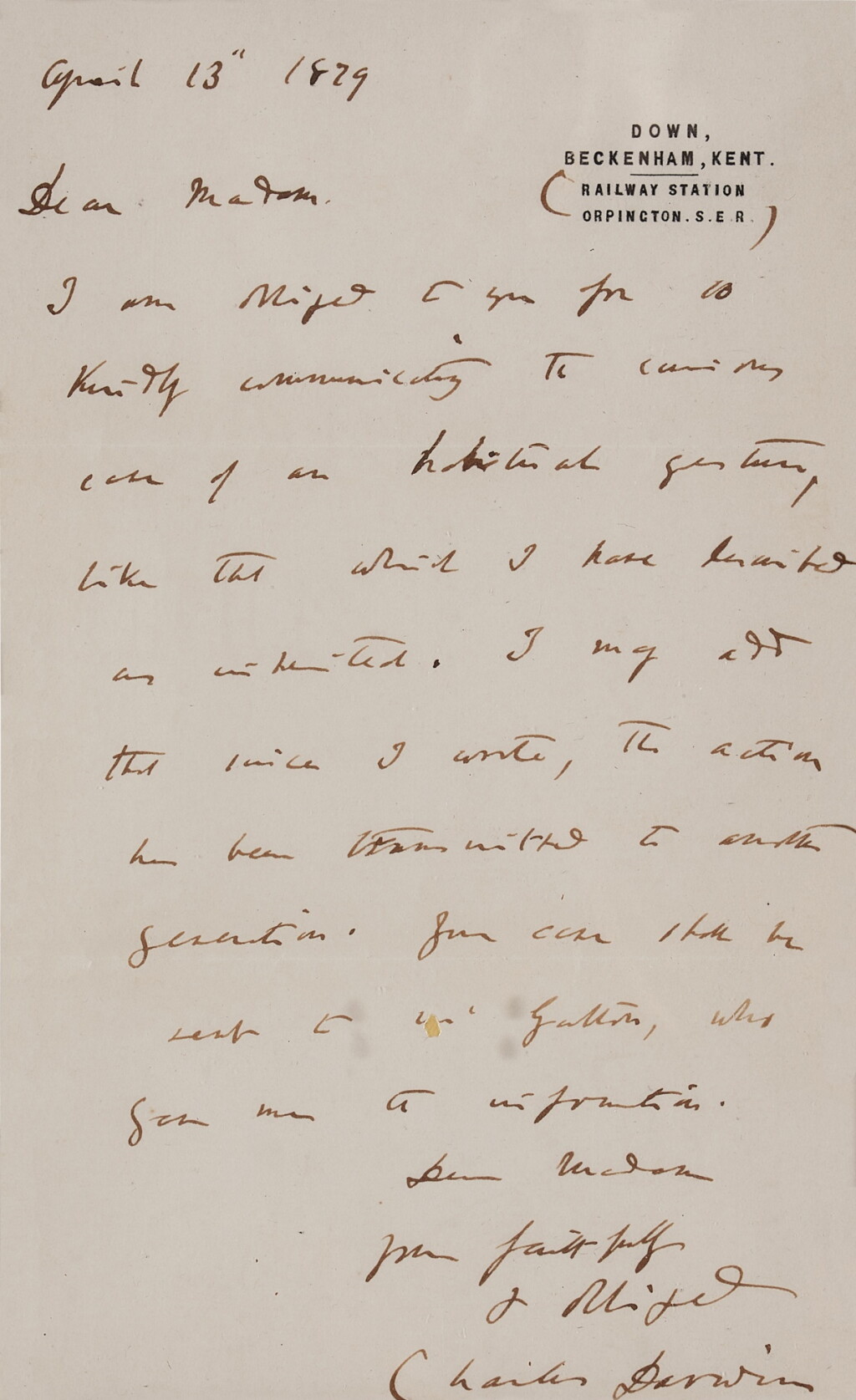
Darwin, Charles | A letter regarding a bizarre inherited behavior
Lot Closed
December 9, 08:36 PM GMT
Estimate
12,000 - 18,000 USD
Lot Details
Description
Darwin, Charles
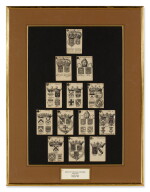
Autograph letter signed in full ("Charles Darwin") to [Fanny Kellogg], Down, Beckenham, Kent, 13 April 1879
One page (to sight: 190 x 116 mm), in black ink on Darwin's stationary, signed ("Charles Darwin"); old folds. Matted, framed, and glazed in Plexiglass; not examined out of frame.
A letter by Darwin, related to the hereditary transmission of a peculiar behavior.
In this letter Darwin thanks Fanny Kellogg for “communicating the curious case of an habitual gesture, like that which I have described as inherited. I may add that since I wrote, the action has been transmitted to another generation. Your case shall be sent to Mr. Galton, who gave me the information.”
The Mr. Galton he refers to is of course his half-cousin, Sir Francis Galton, one of the leading men of science of his day. Galton was keenly interested in the inheritance of human qualities and abilities, so it is no surprise that Darwin would have referred this case to him.
Darwin had discussed the heritability of habitual gestures in The Expression of the Emotions in Man and Animals (1872). There he cites at length a remarkable case related to him by his cousin, Francis Galton. Galton, a distinguished scientist in his own right, was keenly interested in behavioral inheritance, and the two naturalists often shared their findings and theories. Darwin quotes Galton in The Expression of the Emotions:
“A gentleman of considerable position was found by his wife to have the curious trick, when he lay fast asleep on his back in bed, of raising his right arm slowly in front of his face, up to his forehead, and then dropping it with a jerk, so that the wrist fell heavily on the bridge of his nose. The trick did not occur every night, but occasionally, and was independent of any ascertained cause. Sometimes it was repeated incessantly for an hour or more. The gentleman’s nose was prominent, and its bridge often became sore from the blows which it received. At one time an awkward sore was produced, that was long in healing, on account of the recurrence, night after night, of the blows which first caused it. His wife had to remove the button from the wrist of his night-gown as it made severe scratches, and some means were attempted of tying his arm."
"Many years after his death, his son married a lady who had never heard of the family incident. She, however, observed precisely the same peculiarity in her husband; but his nose, from not being particularly prominent, has never as yet suffered from the blows. The trick does not occur when he is half-asleep, as, for example, when dozing in his arm-chair, but the moment he is fast asleep it is apt to begin. It is, as with his father, intermittent; sometimes ceasing for many nights, and sometimes almost incessant during a part of every night. One of his children, a girl, has inherited the same trick. ...”
The present letter demonstrates the lengths to which Darwin went in gathering data and examples for his writings. His published books reached a wide audience, producing additional correspondence with yet more evidence for his theories.
The letter is also particularly noteworthy for being signed in full “Charles Darwin,” instead of the more usual abbreviated “Ch. Darwin” (see lot 1025).
REFERENCE:
Darwin Correspondence Project, “Letter no. 11992”
You May Also Like