
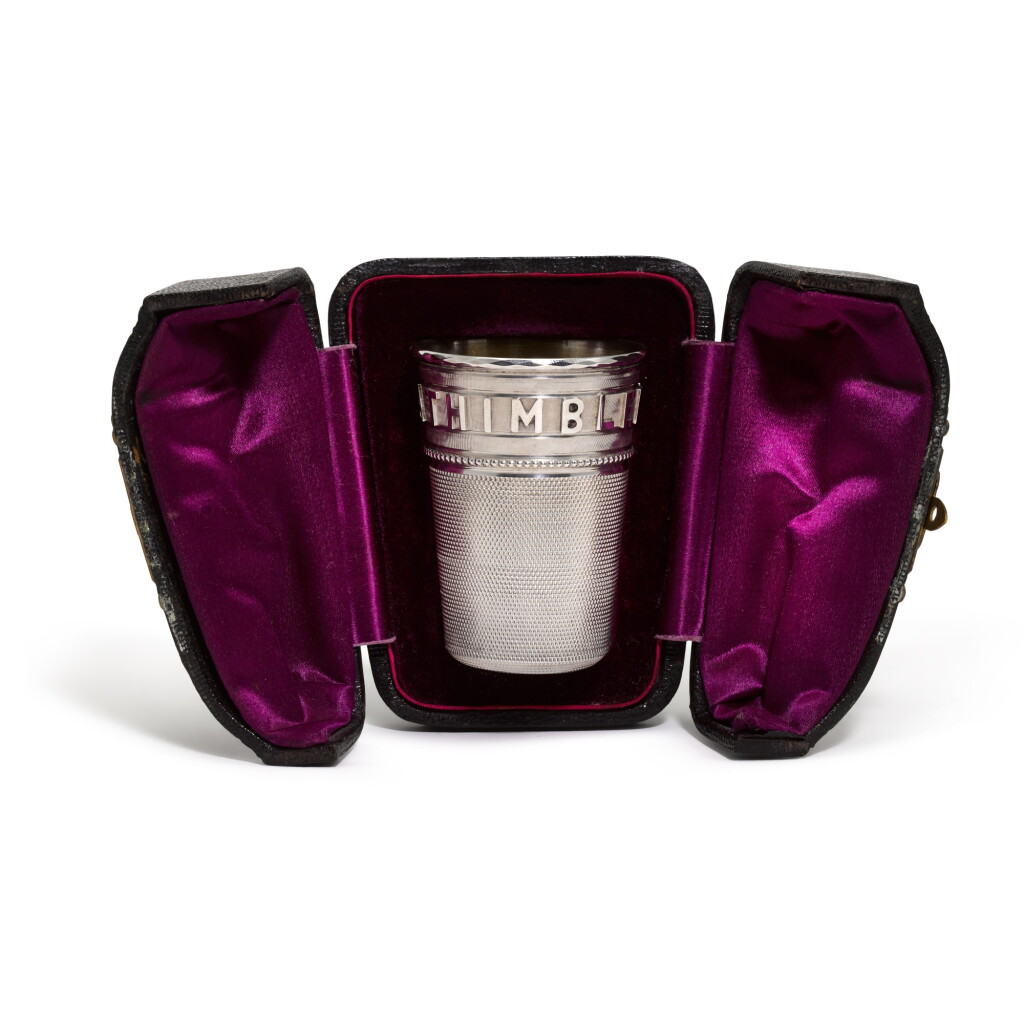
A novelty Victorian cased silver shot glass, Horton & Allday, Birmingham, 1890
Lot Closed
December 19, 03:33 PM GMT
Estimate
500 - 700 GBP
Lot Details
Description
A novelty Victorian cased silver shot glass, Horton & Allday, Birmingham, 1890
Modelled as an oversize thimble, applied with the words 'Just a Thimbleful', in original case,
6cm., 2 ¼in. high
Horton & Allday, manufacturing jewellers of 195 Warstone Lane, Birmingham, was established in 1881.1 The partners were Alfred George Horton and Harry Allday. The partnership was terminated on 7 September 1885 upon the death of Horton, after which Horton & Allday was carried on by Allday on his own account.2 The firm continued to flourish for many years, being represented at a number of trade fairs, including the British Industries Fair of 1920 when they exhibited small silverware, grandfather, bracket chime and other clocks, strikers and various other types of timepieces.
The dramatic details of Horton’s decline in health and death were widely reported:
‘Mr. Alfred George Horton was . . . chief partner in the firm of Horton and Allday, jewellers, Warston [sic] lane, Birmingham, and was thirty-two years of age. He was a widower, his wife having died about eighteen months ago, leaving him one child. For some time past it appears his business had not been prospering as he could have wished, and this fact, preying on a frame naturally delicate, no doubt largely aided in undermining his health, and it is to be feared, his reason. . . . As time flew by, and his business prospects did not improve, Mr. Horton began to think that he would at last have to go to the workhouse, a sufficient enough indication of the gloomy thoughts which were then filling his mind. . . .
‘Mr. Horton was a martyr to physical weakness. About five months ago he sustained a stroke of paralysis, which greatly prostrated him. . . . After the paralytic stroke Mr. Horton appeared quite a different man [and] it need not be much a matter of wonder, therefore, that not long after the severe illness . . . he should have made an attempt upon his life. . . .
‘Some months after the death of Horton’s wife, his victim, Lilian Walker, came to live with the household [of his mother] at No. 34, Frederick-road [and] a cordial friendship sprang up between her and Horton. . . .
‘Horton soon showed an extraordinary fondness for Mrs. Walker, who, we may mention, was 27 years of age and of rather prepossessing appearance. . . . At last a crisis came in the shape of a letter from Mrs. Walker’s husband in America, announcing his return. There is little doubt that his communication, which was known to Horton, contributed still further to embitter and unhinge his mind. He seemed to have conceived the idea that if Mrs. Walker could never be his wife, she should never live as the wife of another. . . .’3
‘[On 7 September 1885 Horton] returned home [from work] at 6-0 in the evening and requested his mother to warm him beef-tea. Mrs. Walker was in her room, and Horton went up to sit with her. His mother got him the beef-tea and took it up-stairs. She had hardly returned to the kitchen when she was alarmed by the report of two pistol-shots. Returning she found the woman lying prostrate, while her son, who had a revolver in his right hand, was standing by the door, bleeding from the mouth, having discharged the weapon at his own head. Mrs. Horton cried, “Oh, what’s the matter?” Her son simply gasped, “Lil, mother,” and fell down insensible. Dr. Hoare was fetched in, but both man and women were dead. . . .’4
1. ‘The Birmingham, Smethwick and District Commercial List,’ The Birmingham, Black Country and Sheffield and Rotherham Commercial List, London, 1884-1885.
2. The London Gazette, London, 14 May 1886, p. 2357b
3. Birmingham and Aston Chronicle, Aston, Saturday, 12 September 1885, p. 3d-f
4. The Leeds Times, Leeds, Saturday, 12 September 1885, p. 7c
You May Also Like


