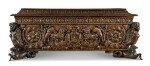

An Italian carved and parcel-gilt walnut cassone
Lot Closed
April 29, 01:38 PM GMT
Estimate
12,000 - 18,000 GBP
Lot Details
Description
An Italian carved and parcel-gilt walnut cassone
with elaborately carved decoration of animals and foliage, centered by the armorial of the Castelli family, on hippocampus feet
60.5cm. high, 185cm. wide, 56cm. deep; 1ft. 11¾in., 6ft.¾in., 1ft. 10in.
The form and decoration of the present cassone derives both from ancient marble sarcophagi and also contemporary Renaissance tombs. The versatility of the chest made it a popular bridal present from the 13th century onwards. Up until the 16th century, even the most luxurious palaces had very few items of furniture, but contemporary inventories record that cassoni were the only pieces of furniture of which affluent people had many examples of due to their utilitarian function. They were, however, not constructed by a lowly carpenter but a craftsman belonging to a guild specialising in their specific production.
When the cassone was given as a wedding present it was usually given in pairs, with the coat-of-arms of the bride and that of the groom on the respective panels. Thanks to the artistic ability of Italian craftsmen during the Renaissance, the chests were adorned with sculpture representing historical, mythological or naturalistic subjects. Supporting figures held medallions or wreaths and corner figures were often employed and the acanthus leaf was the most commonly employed motif.
A similar cassone was sold Sotheby’s, London, Important Furniture, Silver & Ceramics, 8 December 2009, lot 2 (£73,250). Other comparable examples dating from Renaissance are illustrated in R.W. Symonds, Italian Furniture, 1949, p.90, fig.234 for an example in the Collection of Ugo Jandolo in Rome and p. 93, fig. 242 for an example from the Orsoline di Calvi Monastery in the National Museum of Perugia.
Further examples are a pair of cassoni with the armorials of Strozzi and Carnesecchi sold at Sotheby's, London, Treasures, 6 July 2011, lot 5. A drawing from the third quarter of the 16th century not only relates to the aforementioned example but also to the present cassone as it features bold acanthus scrolls (fig.1. illustrated in Daniëlle O.Kisluk-Grosheide et al, European Furniture in the Metropolitan Museum of Art, Highlights of the Collection, New York, 2006, p. 22, fig. 10).