
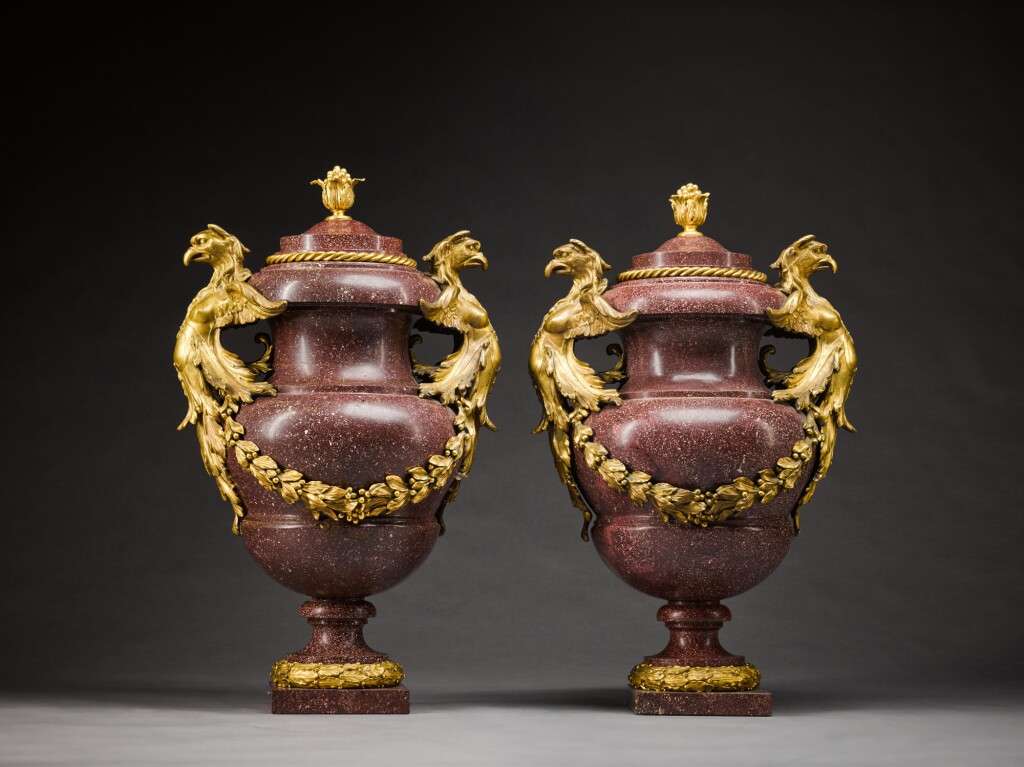
A pair of French gilt-bronze mounted porphyry vases, second half 19th century
Lot Closed
April 29, 02:48 PM GMT
Estimate
30,000 - 50,000 GBP
Lot Details
Description
A pair of French gilt-bronze mounted porphyry vases,
second half 19th century
each cover with a berried knop, with eagle headed handles joined by berried laurel garlands, the circular foot fitted with a laurel wreath
72cm. high, 45cm. wide; 2ft. 4¼in., 1ft. 5¾in.
This pair of vases with distinct handles in the form of griffins reflect the long tradition and fashion of French craftsmen to ornament with finely cast and chased mounts precious stones like porphyry, a material embodied with great symbolism largely reclaimed in the 18th and 19th centuries from Ancient Roman monuments.
The enthusiasm for mounted stone is much similar to that of mounted porcelain which originally commenced with the various ‘Compagnie des Indes' which from 17th century onwards, traded with the Orient in all manner of luxurious Oriental ware and which so inspired the Parisian marchands-merciers, who were driven to supply their illustrious clientele with the latest fashion and novelties such as gilt-bronze-mounted objects. As soon as the porcelain ware or the stones arrived in France, the materials were cut, carved before being applied with gilt-bronze mounts. These pieces remained the pinnacle of fashion for much of the second half of 18th century up to the late 19th century.
The design for the handles of the present vases, with a pair of griffins, was popularized from the late 17th century in France by Claude Ballin (1615-1678) who created handles from figures of putti, satyrs and animals for his vases at Versailles. A drawing dating from the late 17th century shows an ovoid vase with collar and base decorated with griffins forming handles (illustrated, P. Malgouyres, Porphyre, Paris, 2003, p.145, fig. 68). Interestingly, the particular motif of the winged griffin/chimera were used in the 19th century by the bronze founder Ferdinand Barbedienne and even by the faïencier Prosper Jouneau.