Tsimshian or Gitxsan Frontlet Headdress
Lot Closed
April 8, 05:13 PM GMT
Estimate
20,000 - 30,000 USD
Lot Details
Description
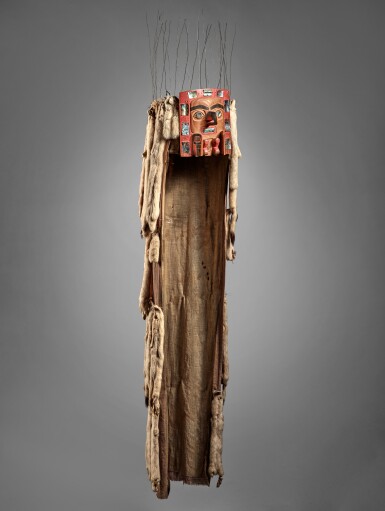
Tsimshian or Gitxsan Frontlet Headdress
amhalait
Height (frontlet mask): 7 in (17.8 cm); Length (including train): 51 in (129.5 cm)
Charles Wallace Zollman, Indianapolis
Butterfield and Butterfield, San Francisco, November 17, 1999, lot 9136, consigned by the above
Jeffrey R. Myers, New York, acquired after the above auction
Abraham Rosman and Paula Rubel, New York, acquired from the above on July 13, 2006
Joanne MacDonald, Gitwangak Village Life: a Museum Collection, Ottawa, 1984, cover, p. 18, fig. 3, and p. 19, fig. 4
McLennan and Duffek, The Transforming Image: Painted Arts of Northwest Coast First Nations, Seattle, 2007, p. 157, fig. a
Bill Holm writes that “from the farthest northwestern reach of Tlingit country at Yakutat Bay, southward along the coast to the middle of Vancouver Island, dancing chiefs wore crowns as elegant as rich material and sculptor’s skill could make. Traditions of the tribes assign various places of origin to the dancing headdress, but, whichever is correct, it must have been somewhere in the north. […] The features of the headdress are the same wherever it is worn: a cylindrical frame - often made of strips of whale baleen and covered with cloth - from the back of which hangs a long panel covered with rows of white ermine skins; an upstanding circlet of the long, springy whiskers of the Steller’s sea lion; and a spectacular plaque carved of hardwood, painted and inlaid with abalone shell on the forehead. This plaque, or frontlet, is carved to represent a crest or a mythical character. The figure in the center is surrounded by a flange that is usually covered with inset plates of brilliantly iridescent abalone shell. Inlays of the same shell flash from the eyes, teeth, and joints.” (Holm, The Box of Daylight: Northwest Coast Indian Art, Seattle, 1983, p. 19).
“The dance must have traveled from tribe to tribe with the headdress as its use spread over the coast. The dancer appears with blanket and apron and often a raven rattle […]. Knees slightly bent and legs spread, he jumps on both feet to the time of the song beat – short jumps, feet hardly off the floor, making the ermine rows covering his back jump in turn. The blanket was spread by the wearer's arms or elbows. The crown of sea lion whiskers holds a loose fluff of eagle down when the dancing begins. The whiskers rustle and clatter as the dancer bobs and tosses his head, shaking white wisps of down through the whisker barrier to swirl around his dancing figure. The white down means peace, or welcome, to the guests at a potlatch. Chiefs dance to greet canoes invited from far villages. Canoe-borne visitors dance in turn, and the swirling down from their headdresses drifts shoreward on the wind and over the host and his tribe on the beach. […] In its rich composite of material, form, and movement, no Northwest Coast object expresses the ideas of rank and heredity, supernatural power, drama, and aesthetics so well as the dancing headdress. (ibid.)
In a letter to a former owner about this object, Bill Holm commented that “the frontlet and headdress I believe to be at least nineteenth century and probably Tsimshian in origin […]” (Holm letter to Zollman, quoted in Butterfield & Butterfield auction catalogue, November 17, 1999, p. 18). The Tsimshian and Gitxsan call this form of crown or frontlet headdress amhalai’t. The Steller sea lion whiskers that typically appear at the top of the headdress are replaced here by strips of metal wire which echo their form. Holm’s letter notes that “The wire ‘sealion whiskers’ are not unique, I know of […] other old headdresses with them.” (ibid.).
At some point in its history this frontlet headdress lost its association with the chief to whom it once belonged. However, when a group of ten Northwest Coast photographs appeared at auction in the spring of 2002, Jeffrey Myers immediately recognised that this important object was the frontlet headdress worn by a chief in two images. Together with the stamp “Department of Mines and Geological Survey, Photographic Division”, the back of each photograph bore a handwritten inscription. One photo is inscribed “Chief Larhaitz”, whilst the other is inscribed “Chief Lagaxnits of Gitwanga, near his totem pole”. In a letter to Jeffrey Myers, Bill Holm noted that these are “both attempts to spell Laxnitz”. The man pictured is Jim Lax n’itsx, a Gitxsan chief “whose name as the head of the Larhsail (Laxsail) phratry [kinship group] was ‘Hlengwah’.” (Holm, personal letter to Jeffrey Myers, June 16, 2002). Hlengwah means “earthquake”, whilst Lax n’itsx signifies “looks to both sides” (MacDonald, Gitwangak Village Life: a Museum Collection, Ottawa, 1984, p. 35). Jim Lax n’itsx was “promoted to the rank of chief about 1870 [...]”, when he was still a young man (MacDonald, The Totem Poles and Monuments of Gitwangak Village, Ottawa, 1984, p. 95). He is photographed wearing the frontlet headdress in several photographs. The earliest image, which shows Hlengwah with his son, was taken circa 1900 (MacDonald, The Totem Poles and Monuments of Gitwangak Village, Ottawa, 1984, p. 26, fig. 15), whilst the last picture was taken on July 31, 1927 (ibid., p. 30, fig. 18). In 1924 the American artist W. Langdon Kihn painted a striking portrait of Chief Hlengwah, dressed in his full regalia and wearing the frontlet headdress (McCord Museum, Montreal, inv. no. M927.102). He is similarly depicted in a 1926 charcoal and chalk drawing by the Canadian artist Edwin Headley Holgate (Musée national des beaux-arts du Québec, Quebec City (inv. no. 1935.01).
You May Also Like