Club with Marine Ivory Inlays, Tonga
Lot Closed
April 8, 04:13 PM GMT
Estimate
20,000 - 30,000 USD
Lot Details
Description
Club with Marine Ivory Inlays
Tonga
apa 'apai
length: 28 ⅞ in (73.3 cm)
Sperm whale (Physeter macrocephalus) teeth
Bud C. Holland, Chicago
Abraham Rosman and Paula Rubel, New York, acquired from the above on November 24, 1993
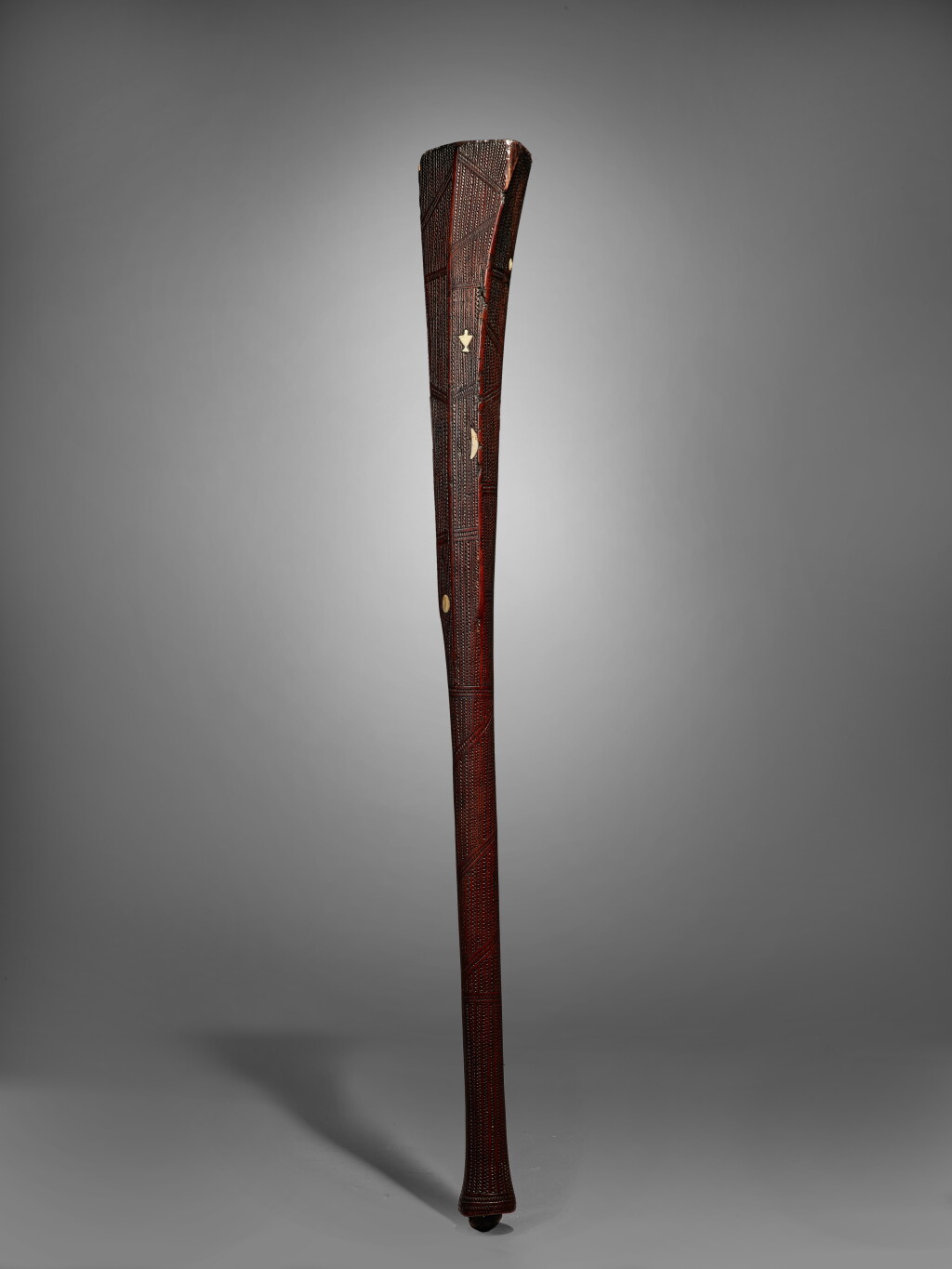
Carved from fine-grained, black-veined toa wood (Casuarina equisetifolia) which has developed a silky, softly worn patina, this refined and elegant club is an example of a form known in Tonga as apa‘apai, a name that “seems to connote the Tongan concept of deference – fakaapa‘apa‘i.” (Mills, “‘Akau Tau: Contextualising Tongan War-Clubs”, The Journal of the Polynesian Society, Vol. 118, No. 1, 2009, p. 24). The present apa‘apai has a lithe and supple quality, and its seemingly simple shape belies a form which, in the hand, is highly sculptural. All but the very top and bottom surfaces of the club are covered in a collage of intricate, finely incised fields of decoration, known as tata, which seem to wrap around the club as if enveloped in some richly decorated textile. Wrapping had great metaphysical importance in Tongan culture. There is a possible connection between the decorative motifs, or kupesi, of tata on clubs such as this and the kupesi that served as protective surface marking in other forms of wrapping, such as tattooing, barkcloth, and matting. As Mills notes, tata may be seen as a form of wrapping the surface of a club, insulating, containing, and indicating mana, or spiritual power (Mills, Tufunga Tongi ‘Akau: Tongan Club Carvers and Their Arts, unpublished PhD thesis, 2008, p. 381).
The surface of the present club is inlaid with five segments of cut sperm whale teeth, or lei. These teeth had enormous prestige in Fiji and Tonga, and they were the preserve of the ‘eiki, or chiefly class, who marshalled this precious resource with great care. William Mariner, who lived in Tonga as a young man at the beginning of the 19th century, recounts an incident from the life of his protector, the great chief Finau ‘Ulukalala II, or Finau Fangupo, which illustrates the value and ‘eiki status of whale teeth. Having heard that a whale had been beached off a small island inhabited solely by a commoner and his wife, Finau Fangupo “immediately sailed for this place, and finding the teeth taken from the whale, questioned the man [… who] defended his innocence on the plea that teeth would be of no use to him since every chief who could afford to give their value would question his right to them, and take them from him […] for the same reason, he could not wear them. Not satisfied with this plea […Finau Fangupo] ordered him to be immediately dispatched with a club” (Mariner and Martin, An Account of the Natives of the Tonga Islands, London, 1817, Vol. I, pp. 313-314).
The inlays were made by tufunga fono lei, craftsmen who specialised in cutting and carving precious whale teeth into a range of prestige objects. A club could be inlaid with fono lei at various points in its life. Some inlays were placed at the moment of the club’s creation, “piped around” by the tufunga tata, who created the carved tata, whilst others, as is the case here, were added later and “cut through and obscure” the tata (Mills, Tufunga Tongi ‘Akau: Tongan Club Carvers and Their Arts, unpublished PhD thesis, 2008, Vol. 1, p. 63). As the precious quality of whale teeth suggests, the embellishment of clubs with fono lei was historically the preserve of the ‘eiki. Furthermore, Mariner notes that “they only ornament those clubs which are considered good on account of their form […or] which have done much execution […]” Mariner and Martin, An Account of the Natives of the Tonga Islands, London, 1818, Vol. II, p. 266).
Here a radiating star, or sun, is set into the top of the head, whilst the body of the club is adorned with an abstract depiction of a bird, a crescent moon, and three circles. These inlays all carry their own meaning. With its abstract beak, wings, and broad tail-feathers, the bird appears to be caught soaring in flight. It represents a pigeon, or lupe (Ducula pacifica), a bird that was the prerogative of the ‘eiki. Pigeon snaring was historically a popular pursuit amongst the ‘eiki, and it was also a metaphor for conquest. Depicted as a slender crescent, the moon, or mahina, was associated with Hina, the Tongan goddess of beauty. The three circles of ivory may depict Venus, or tapukitea; in tata, such circles are usually carved next to the crescent moon, but in inlaid clubs such as this, the circle often appears on its own, the evening star shining out against the dark patina of the wood.
You May Also Like