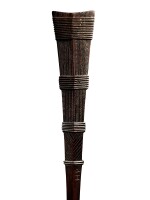
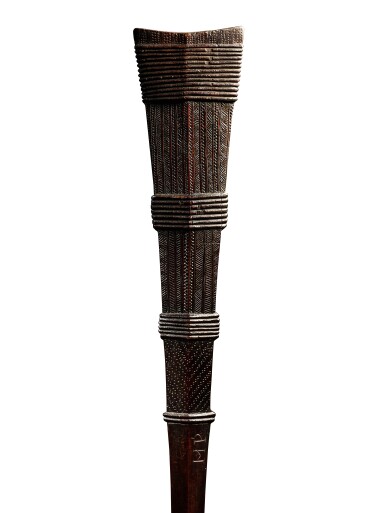
Club, Tonga or possibly Samoa
Lot Closed
April 8, 04:15 PM GMT
Estimate
10,000 - 15,000 USD
Lot Details
Description
Club
Tonga or possibly Samoa
apa 'apai or uatogi
Length: 50 ¼ in (127.6 cm)
The shaft with two incised inscriptions: "M [or H] P" and "1773"
Rainer Werner Bock, Maui
Abraham Rosman and Paula Rubel, New York, acquired from the above on May 4, 2016
One side of the handle of this intriguing club is incised with the date “1773”, the other with initials that can be read as either “M. P.” or “H. P.”. The Rosman Rubels acquired it in the belief that the initials were those of Henry Pryor (1736 – ?), an Able Seaman on HMS Adventure, the companion vessel to HMS Resolution during Cook’s second voyage (1772 – 1775). Pryor was the only man on the voyage with initials to correspond to the “H. P.”; no man bore the initials “M. P.”. It is unclear whether the inscriptions are genuine or if they are opportunistic additions made at a later date. Cook voyage objects with documentation of any sort are scarce, and it would be surprising if a humble Able Seaman (even if he “had his letters”) were the only member of the crew to have the foresight to inscribe the year and his initials on a souvenir of the voyage.
Stylistic similarity to clubs documented as having been collected in Tonga during Cook’s second and third voyages is not, on its own, sufficient to confirm a Cook voyage attribution, but it is interesting to note certain similarities between such clubs and the present example. Kaeppler remarks that “Tongan clubs were the most numerous type of artifacts collected on Cook’s voyages […]” (Kaeppler, “Artificial Curiosities”: An Exposition of Native Manufactures Collected on the Three Pacific Voyages of Captain James Cook, R.N., Honolulu, 1978, p. 238), and the documented examples encompass a wide variety of types, including several of the same ribbed apa‘apai form as the present club. These apa‘apai vary from the lavishly carved, such as the club now in the Weltmuseum, Vienna (inv. no. 32) to simpler examples, such as one in the Royal Albert Memorial Museum, Exeter (acc. no. E1205). The latter is perhaps the closest in style to the present club; the two are of very similar shape and outline and are uncarved below the lowest rib, or collar, although the decoration of the head is noticeably different.
The decoration of the present club may be its most distinctive feature, particularly two zones that appear to be of Samoan design (Cook did not visit Samoa but, as Mills notes, “there are Fijian and Samoan clubs collected by [Europeans] in Tonga well before 1800.” Mills, Tufunga Tongi ‘Akau: Tongan Club Carvers and Their Arts, unpublished PhD thesis, 2008, p. 397). The Samoan designs are the patterns of shallow dots, some roughly circular and some roughly triangular, gouged into the surface of the wood above the topmost ribbed collar and in a chevron-like pattern immediately above the bottom-most collar. Discussing apa’apai (known in Samoa as uatogi, or in some texts lapalapa), Mills notes that “it is not always easy to differentiate between Samoan and Tongan clubs of this type, but […] collar distribution and the style of surface incision are the best guides.” (Mills, “‘Akau Tau: Contextualising Tongan War-Clubs”, Journal of the Polynesian Society, Vol. 118, No. 1, March, 2009, p. 24). The remaining incised decoration is composed of two large zones of tata, the form of engraved carving found on many Tongan clubs. Amongst documented Cook voyage clubs there is no example that exactly parallels the Samoan style design of the present club. Somewhat similar – but more deeply gouged and circular – marks can be seen on a Cook voyage club, of pakipaki type, in the Royal Albert Memorial Museum, Exeter (acc. no. E1217), and on a tautau, or food hook, now in the Museum of New Zealand Te Papa Tongarewa, Wellington (reg. no. FE000330. This object also appears to have come from one of Cook’s voyages; see Kaeppler, “Cook Voyage Provenance of the ‘Artificial Curiosities’ of Bullock's Museum”, Man, N.S., Vol. 9, No. 1, March, 1974, p. 79). Expanding the field beyond Cook voyage objects reveals other old clubs that are more closely comparable; these include a club, from either Samoa or Rotuma, in the Museum of Archaeology and Anthropology at the University of Cambridge (acc. no. 1918.213.75). It is adorned with similar triangular depressions, as is a Samoan club of the same type (but an entirely different shape) once in the collection of W. O. Oldman and now in the Museum of New Zealand Te Papa Tongarewa, Wellington (reg. no. OL000215.S/8).