
Henri-Pierre Danloux
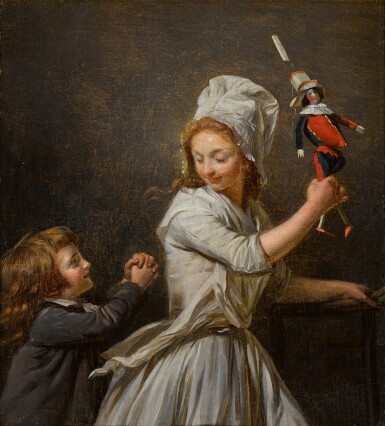
A young boy pleading with his older sister for the return of his Polichinelle puppet
Lot Closed
December 16, 02:59 PM GMT
Estimate
20,000 - 30,000 GBP
Lot Details
Description
Henri-Pierre Danloux
Paris 1753 - 1809
A young boy pleading with his older sister for the return of his Polichinelle puppet
signed lower right: H Danloux
oil on canvas
unframed: 19.2 x 17.3 cm.; 7 6/8 x 6¾ in.;
framed: 26.2 x 24.5 cm.; 10⅜ x 9⅝ in.
Probably by whom sold, Paris, Galerie Lebrun, 30–31 January 1792, lot 108;
Where acquired by Auguste-Gabriel Godefroy (1728–1814), Paris;
His sale, Paris, Boileau, 2 April 1794, lot 114, for 235 livres to Naudou;
Binney Collection, Boston, early 19th century;
Anonymous sale, Paris, Sotheby's, 23 June 2011, lot 82, for €78,750.
This dynamic composition, in which a young boy begs his older sister to give him a doll, is one of the finest examples of Henri-Pierre Danloux's ability to capture the playful innocence of youth. The strong and lively composition, leading the eye from lower left to upper right is complemented by Danloux's technical ability, notably in the fine execution of the delicate features of the children, particularly in the face of the girl and the young boy's glossy brown hair. The soft and careful application of paint in these areas is at odds with the expressive strokes used for the girl's dress, which adds vitality and movement to the scene. Danloux uses a limited palette for the figures, while the doll, the subject of the painting, is depicted in bold primary colours. Danloux's use of soft light, his painting style and the subject matter reveals the resounding influence of the genre scenes of the seventeenth-century Dutch Masters on eighteenth-century painters in France.
In 1792, Danloux was forced to flee Paris for England to escape from the perils of the French Revolution. According to Portalis, before leaving, he sold two paintings from his collection, which his wife reports 'ont été bien vendues'; one was La Petite Couturière and its pendant was a work titled Le Petit Polichinelle, presumably the present painting.1 In 1793, shortly after Danloux's arrival in England and just three years after producing this painting, he exhibited The Masters Foster at the Royal Academy. This success of the double portrait earned him a great reputation and he went on to receive a number of important commissions from British Patrons, including the Duke of Buccleuch.
1 Portalis 1910, p. 50; Portalis records that these two paintings were sold at Mme Paupe's sale, Paris, Galerie Lebrun, 30–31 January 1792. The catalogue for this sale lists lot 108 as 'Plusieurs tableaux par M. Donloux, qui feront divisés', probably a reference to this painting.