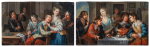
Circle of Gerard van Opstal (1594 or 1604-1668), Flemish, first half of the 17th century
Autumn and Winter
Lot Closed
July 12, 12:11 PM GMT
Estimate
12,000 - 18,000 EUR
Lot Details
Description
Circle of Gerard van Opstal (1594 or 1604-1668), Flemish, first half of the 17th century
Autumn and Winter
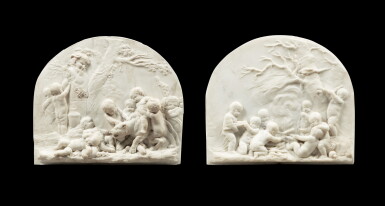
A pair of semi-circular marble reliefs
Autumn depicting Bacchic putti, one riding a panther and with a term at the back; Winter depicting putti around a fire and gathering wood
38.5 x 44 cm.; 15 3/16 x 17 5/16 in.
(2)
________________________________________________________
Entourage de Gerard van Opstal (1594 ou 1604-1668), Flandres, première moitié du XVIIe siècle
Automne et Hiver
Paire de reliefs en marbre semi-circulaires
L'Automne représentant une bacchanale d'enfants, avec un putto sur une panthère ; L'Hiver avec des putti autour d'un feu
38.5 x 44 cm.; 15 3/16 x 17 5/16 in.
(2)
With Étienne Delaunoy, Amsterdam, until 1941;
Collection W.J.R. Dreesmann, Amsterdam;
With A. Staal, Antiquair, Amsterdam, by whom sold 16th March 1962;
Collection Professor Dr Drs Anton C.R. Dreesmann, Laren, inv. no. E1;
Collection Mrs Marianne L. Dreesmann-van der Spek, Laren, inv. no. E005;
Thence by inheritance to the present owners.
__________________________________________________________________________
Collection Étienne Delaunoy, Amsterdam, jusqu'en 1941;
Collection W.J.R. Dreesmann, Amsterdam;
A. Staal, Antiquaire, Amsterdam, vendu le 16 mars 1962;
Collection Professeur Dr Drs Anton C.R. Dreesmann, Laren, inv. n° E1;
Collection Mrs Marianne L. Dreesmann-van der Spek, Laren, inv. n° E005;
Par descendance jusqu’aux propriétaires actuels.
Related Literature :
La Sculpture au siècle de Rubens, dans les Pays-Bas méridionaux et la principauté de Liège, exh. cat 1977, pp. 250-254.
M. Boudon-Machuel, François Duquesnoy (1597-1643), Paris, 2005, pp. 276-280.
P. Malgouyres, ‘La collection d’ivoires de Louis XIV : l’acquisition du fonds d’atelier de Gérard van Opstal vers 1604-1668)’, La Revue des musées de France, Paris, 2007, pp. 46-54.
P. Fréart de Chantelou, Journal de voyage du Cavalier Bernin en France, Paris, ed. 2001, pp. 259-260.
----------------------------------------------------------------------------------------------
Références bibliographiques :
La Sculpture au siècle de Rubens, dans les Pays-Bas méridionaux et la principauté de Liège, cat. exp. 1977, pp. 250-254.
M. Boudon-Machuel, François Duquesnoy (1597-1643), Paris, 2005, pp. 276-280.
P. Malgouyres, « La collection d’ivoires de Louis XIV : l’acquisition du fonds d’atelier de Gérard van Opstal vers 1604-1668) », La Revue des musées de France, Paris, 2007, pp. 46-54.
P. Fréart de Chantelou, Journal de voyage du Cavalier Bernin en France, Paris, ed. 2001, pp. 259-260.
Probably belonging to an ensemble of four works depicting the Seasons, this pair of marble reliefs illustrates Autumn with a Children’s Bacchanal, featuring a drunken young Bacchus riding a panther, while Winter is portrayed by a group of putti busy lighting a fire.
The sculptor’s great skill is apparent in these works, especially in the allegory of Autumn, where the detail and depth of the relief are remarkable. The bacchanal suggests the influence of motifs made popular by François Duquesnoy (1597-1643), and in particular the present relief has echoes of his Bacchanal of Putti with a Goat (c. 1525), a bronze version of which is in the Petit Palais (Dutuit collection, inv. no. SDUT 1329). In this celebrated scene inspired by antiquity, eight erotes tease and mistreat a goat, regarded as the enemy of the vine. Duquesnoy’s model made a huge impression on European sculpture and decorative arts up to the end of the eighteenth century. The theme was picked up, with variations, by many sculptors: here the goat is replaced by a panther, the wild animal associated with Bacchus.
More specifically, the virtuosity in the carving of the marble and the themes depicted suggest that the sculptor of these reliefs was an artist in the circle of Gérard van Opstal (c. 1604-1668). In particular, Autumn recalls an ivory attributed to van Opstal, illustrating A Procession of Putti with the Infant Bacchus Riding a Panther, shown in 2015 at TEFAF (Tomasso Brothers, Leeds, now private Belgian Collection). Trained in the studio of Nicolas Diodone in Brussels, van Opstal was active in the first half of the seventeenth century in Antwerp and then in Paris. Here, as an Academician, he encouraged the spread of the style and models developed by François Duquesnoy. His reliefs, especially on ivory, were admired by many of his contemporaries, including Bernini, who visited his studio while he was in France in 1667. On this occasion, the Roman sculptor apparently praised the quality and originality of van Opstal’s compositions, ‘saying that he knew of no one in Paris who was capable of making such things’.(P. Fréart de Chantelou, op. cit.). After his death in 1668, Louis XIV acquired the stock in his studio – mainly bacchic ivory reliefs – and these are now in the Louvre.
----------------------------------------------------------------------------------------------
Appartenant vraisemblablement à un ensemble de quatre œuvres dédiées aux Saisons, cette paire de reliefs en marbre personnifient l'Automne par une Bacchanale d'Enfants, où un jeune Bacchus ivre chevauche une panthère, tandis que l’Hiver est dépeint par des putti s’affairant à attiser un feu.
L’auteur de ces œuvres fait preuve d’une grande habileté, particulièrement perceptible dans l’allégorie de l’Automne, où la minutie et la profondeur du relief sont remarquables. On discerne dans cette bacchanale l’influence des motifs popularisés par François Duquesnoy (1597-1643), surtout sa Bacchanale d’enfants avec une chèvre (vers 1525) dont notre relief semble l’écho, et dont un exemplaire en bronze est conservé au Petit Palais (collection Dutuit, inv. no. SDUT 1329). Dans cette célèbre scène inspirée de l’Antique, huit amours jouent et maltraitent une chèvre, considérée comme ennemie de la vigne. Le modèle de Duquesnoy connaît un immense retentissement dans la sculpture et les arts décoratifs européens jusqu’à la fin du XVIIIe siècle. Le thème est repris et varié par de nombreux sculpteurs, notamment ici où une panthère se substitue à la chèvre, animal sauvage et compagne de Bacchus.
Plus spécifiquement, ce sont la virtuosité dans la sculpture du marbre, ainsi que les thématiques représentées qui nous permettent de supposer que l’auteur de ces reliefs soit un artiste de l’entourage de Gérard van Opstal (c. 1604-1668). Notre Automne évoque plus spécifiquement un ivoire attribué à van Opstal, illustrant une Procession de putti avec Bacchus enfants chevauchant une panthère, présenté en 2015 à la TEFAF (Tomasso Brothers, collection privée Belge). Formé dans l’atelier de Nicolas Diodone à Bruxelles, van Opstal est actif dans la première moitié du XVIIe siècle à Anvers, puis à Paris où en tant qu’Académicien il permet la propagation du style et des modèles mis au point par François Duquesnoy. Ses reliefs, notamment sur ivoire, lui valent l’estime de bon nombre de ses contemporains, comme Bernin qui visite en 1667 sont atelier lors de son séjour en France. A cette occasion, le sculpteur romain aurait loué la qualité et l’originalité de ses compositions « disant qu’il ne savait personne dans Paris capable de faire de telles choses » (P. Fréart de Chantelou, op. cit.). Suite à sa disparition en 1668, Louis XIV acquière le fonds d’atelier de van Opstal composés essentiellement de reliefs bachiques en ivoire, aujourd’hui conservés au Louvre.
You May Also Like