Probably Bohemian or Flemish, mid 18th century
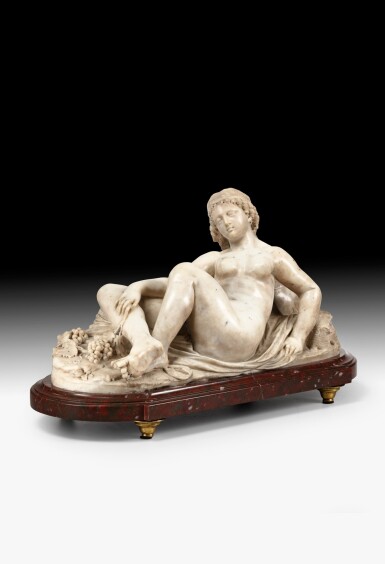
Reclining Nymph
Auction Closed
June 15, 02:40 PM GMT
Estimate
25,000 - 30,000 EUR
Lot Details
Description
Probably Bohemian or Flemish, mid 18th century
Reclining Nymph
white marble, on an oval red griotte marble base with gilt bronze feet
monogrammed W. on the terrace
40 x 60 cm ; 15¾ by 23⅔ in.
__________________________________________________________________________
Probablement Bohême ou Flandres, milieu du XVIIIe siècle
Nymphe allongée sur un drapé
marbre blanc, sur un socle ovale rouge griotte posé sur des pieds en bronze doré
monogrammée W. sur la terrasse
40 x 60 cm ; 15¾ by 23⅔ in.
Didier Aaron Gallery, Paris, 1992
Jerrold Perenchio's Collection, California
__________________________________________________________________________
Galerie Didier Aaron, Paris, 1992
Collection de Jerrold Perenchio, Californie
Lying back in a position that recalls Titian's Danaë, this charming nymph is recognisable as a portrayal of one of Bacchus's companions. Her orientalised hairstyle and sensual pose, as well as the vine branches, amphora and lion skin lying on the ground, evoke the elaborate universe of the Bacchanalia.
The style is at an interface between a variety of influences, making its attribution complex. While the face suggests the work of a Flemish artist, the mythological and courtly nature of the scene is more reminiscent of eighteenth century French art. However, the presence of the monogram W, as well as the particularly elaborate treatment of the ground, lead us to believe that this charming marble could be by Lazar Widman (1697–1769). Originally from Pilsen in Bohemia, this sculptor was mainly known for his small-scale mythological works, in alabaster and marble, distinguished by dynamic compositions and by the meticulous treatment of their settings. The present Nymph can be compared to two alabasters by Widman depicting Cronus and Latona (LACMA, inv. no. M.80.90 and M.78.86), as well as to a group of Wrestlers in the Schwarzenberg Palace in Prague. His works are distinguished by a perceptible Flemish influence in the facial features and the treatment of the body, as well as by ornate settings decorated with plant forms, similar to those on the ground of the present Nymph.
__________________________________________________________________________
Délicatement allongée dans une position qui rappelle celle des Danaé de Titien, on peut reconnaître dans cette charmante nymphe le portrait d’une compagne de Bacchus. En effet, sa coiffure orientalisante, son attitude sensuelle, ainsi que les pampres de vigne, l’amphore et la peau de lion qui jonchent le sol évoquent le riche univers des Bacchanales.
Son traitement stylistique se trouve au carrefour de diverses influences qui rendent son attribution complexe. Tandis que le visage évoque le travail d’un artiste flamand, la nature mythologique et galante de la scène rappelle davantage l’art français du XVIIIe siècle. Toutefois, la présence du monogramme W, ainsi que le travail particulièrement élaboré de la terrasse nous permettent de supposer que l’artiste de ce charmant marbre pourrait être Lazar Widman (1697-1769). Originaire de Pilsen en Bohème, ce sculpteur est principalement connu pour ses œuvres mythologiques de format modeste, en albâtre et en marbre, qui se démarquent par leurs compositions dynamiques, ainsi que par un traitement minutieux des terrasses. Ainsi, notre Nymphe peut être rapprochée de deux albâtres de Widman représentant Cronos et Latone (LACMA, inv. no. M.80.90 et M.78.86), ainsi que d’un groupe de Lutteurs conservé au palais de Schwarzenberg à Prague. On décèle dans ses œuvres une influence flamande dans la physionomie et le traitement des corps, doublée de foisonnantes terrasses ornées de rinceaux végétaux qui résonnent avec notre nymphe.
You May Also Like