
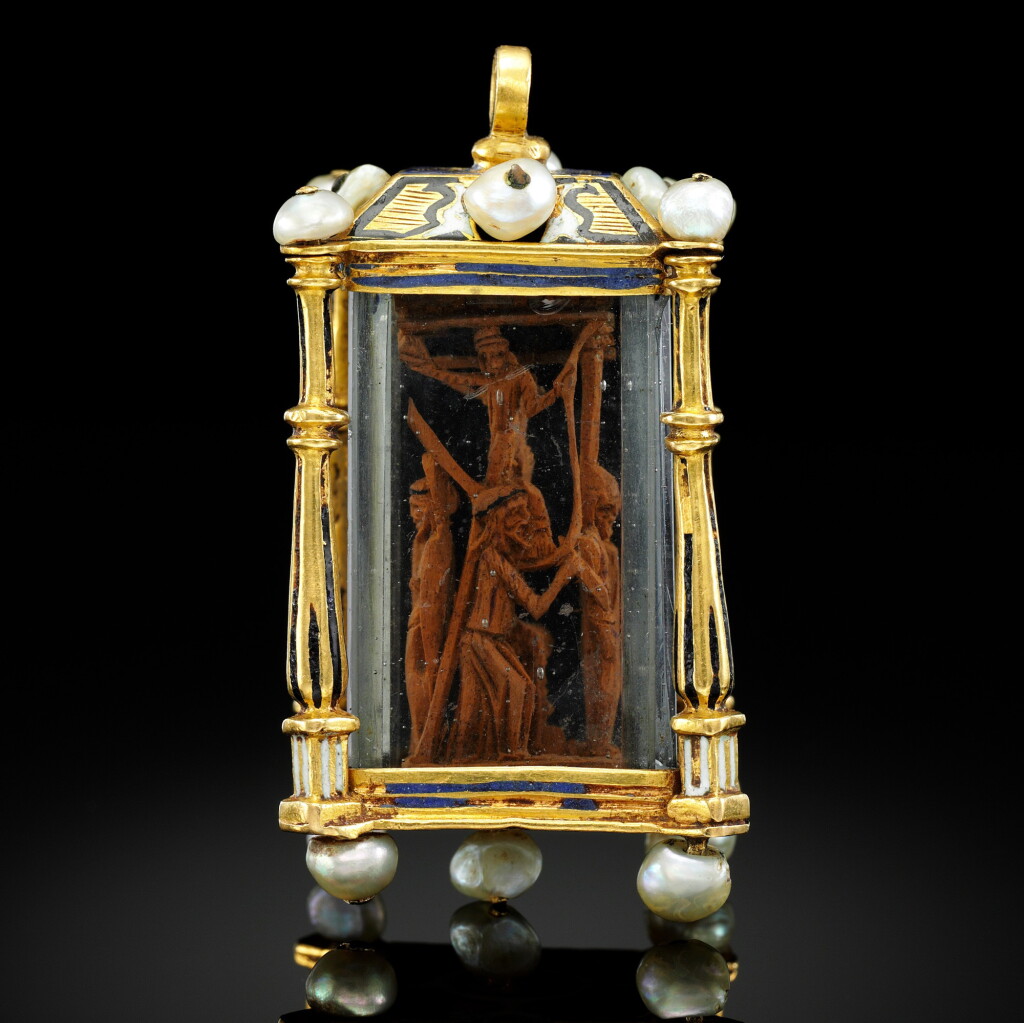
Spanish and Mexican, circa 1600 | Tabernacle Jewel in the form of a Lantern with micro carvings depicting scenes from the Passion of Christ: Christ carrying the Cross; the Flagellation; the Crucifixion; and the Resurrection
Lot Closed
July 15, 12:03 PM GMT
Estimate
3,000 - 5,000 GBP
Lot Details
Description
Spanish and Mexican, circa 1600
Tabernacle Jewel in the form of a Lantern with micro carvings depicting scenes from the Passion of Christ: Christ carrying the Cross; the Flagellation; the Crucifixion; and the Resurrection
enamelled gold, pearl, boxwood and rock crystal or glass
45mm., 1 3/4 in.
The recently published article by Ilona Katzew and Rachel Kaplan (op. cit. 2021), provides highly convincing evidence for a Mexican origin for these types of gold mounted ‘temple’ pendants containing minute boxwood carvings. Their analysis is principally supported by their examination of a Mexican chalice, dated to c.1575-8 in the Los Angeles County Museum, marked for Mexico, and containing similar carvings against a background of hummingbird feathers. The similarly conceived Mexican Pax offered in Christie’s, Exceptional Sale, London, 8 July 2021, lot 16, gives added weight to their study.
They suggest that the production of these microcarvings was likely introduced into Mexico by Flemish Franciscan missionaries, probably originally inspired by Flemish boxwood prayer nuts, in order to ‘continue the spiritual conversion initiated by the conquest and create a paradise on earth, far removed from the corruption that had suffused contemporary European society’. Franciscan missionary Friar Gero ́nimo de Mendieta (1525–1604), in his descriptions of the School of San Jose ́ de los Naturales noted (Katzew/Kaplan, op. cit., p.9):
It can be generally understood that for almost all the fine and strange works that are made in any trade or art in the Indies (at least in New Spain), it is the Indians who practise and make them, because the Spanish masters of these trades rarely do more than give work to the Indians and tell them how they want it done. And they execute it so perfectly, that it cannot be improved.
The Spanish chronicler Antonio de Herrera y Tordesillas (1549–1625) similarly remarked on the skill of indigenous artists and their ability as carvers which seems particularly relevant for these lantern pendants (Katzew/Kaplan, op. cit., p.12):
They work crystal very finely and make large and small glass cases (beriles), in which they place very small carved wood images, where in a space the size of a fingernail, they carve images of Christ on the Cross flanked by Saint John and Our Lady, with the Magdalene at his feet. The reverse includes additional figures of the same wood so that the glass case is two- sided; and if these were not a daily sight, they would seem to be an impossible thing.
Three similar types of pendant are in the Louvre, Paris. The Louvre pendant (inv. 0A2316) is particularly close to the offered example, with the similarly enamelled baluster columns, strap work and pearl embellishments. A further example is in the Waddesdon Bequest (see Hugh Tait, op. cit., p.231-6). Several examples are also in the Wernher Collection, exhibited at Ranger House, Greenwich, described by Diana Scarisbrick (op. cit.), as reflecting '...on a small scale the Counter-Reformation piety which Murillo and Zurbaran expressed so fervently in painting. Lanterns, symbolic of the word of God, enclose delicate boxwood carvings of scenes from the Old and New Testaments, some perhaps carved in Mexico'.
RELATED LITERATURE
I. Katzew and R. Kaplan, ‘Like the Flame of Fire’: A New Look at the “Hearst” Chalice, Latin American and Latin Visual Culture, Vol 3, Issue I, January 2021, pp. 4-29; El arte de la plata y de las joyas en la España de Carlos V: Palacio Municipal de Exposiciones "Kiosco Alfonso", La Coruña, 6 de Julio / 17 de septiembre de 2000, p264-5; H. Tait, Catalogue of the Waddesdon Bequest in the British Museum, London, 1986, pp. 231-6; D. Scarisbrick, 'Jewellery in the Wernher Collection, Apollo Magazine, May 2002, pp. 49-50; D. Thornton, A Rothschild Renaissance: Treasures from the Waddesdon Bequest, London, 2015, pp. 220-223
You May Also Like


