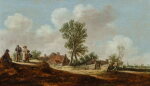
The Property of a Gentleman
Workshop of Marten van Cleve the Elder
A peasant Wedding Dance
Lot Closed
July 8, 01:26 PM GMT
Estimate
50,000 - 70,000 GBP
Lot Details
Description
The Property of a Gentleman
Workshop of Marten van Cleve the Elder
Antwerp circa 1527 - before 24 November 1581
A peasant Wedding Dance
oil on oak panel, the reverse with the brand of the City of Antwerp and the panel maker's mark of Guilliam Aertsen (fl. 1617 - after 1638)
unframed: 73 x 105.5 cm.; 28½ x 41¼ in.
framed: 95.5 x 127.5 cm.; 37⅝ x 50¼ in.
From whom acquired in 1899 by a private collector;
Thence by descent to his grandchildren;
By whom sold, London, Sotheby's, 3 July 1985, lot 38 (as Pieter Brueghel the Younger);
Where acquired by the present owner.
C. Currie and D. Allart, 'Copies after the Wedding Dance in the open air probably after a lost painting by Pieter Bruegel the Elder', in The Brueg[h]el Phenomenon, Brussels 2012, vol. II, p. 613, n. 60;
K. Ertz and C. Nitze-Ertz, Marten van Cleve 1524-1581, Kritischer Katalog der Gemälde und Zeichnungen, Lingen 2014, p. 206, cat. no. 167.
The conception of this well-known composition is traditionally thought to be derived from a design by Pieter Bruegel the Elder, known through an engraving by Pieter van der Heyden (c. 1525–1569), published after 1570 by Hieronymous Cock.2 As Georges Marlier first observed in 1969 and as Christina Currie and Dominique Allart have more recently argued, all later painters of the famous composition had access to either this print or else another, presumably lost, painting or drawing which it records, which they then adapted to their own style and preferred format. The similarity between first Marten van Cleve’s interpretations and the later versions by Jan Brueghel the Elder,3 and their relationship to the many examples painted by his younger brother Pieter Brueghel the Younger and his workshop,4 suggests that some, if not all, of them had seen this lost work. The only surviving painting of this subject ascribed to Pieter Bruegel the Elder himself, now in the Detroit Institute of Arts,5 is however of too dissimilar a design to have served as such a model.
We can probably assume that Pieter van der Heyden’s engraving was based on this model, which was itself most likely a detailed preparatory drawing or cartoon, as this was Bruegel the Elder’s normal method of working with engravers. The engraving is correspondingly marked ‘Brueghel invenit’ rather than ‘Brueghel pinxit’, the form that would normally indicate a painted prototype. It is quite reasonable to suppose that at least one such cartoon must have been inherited by the Breughel family workshop, for the many smaller (but identical) scale versions of the Wedding Dance design produced there undoubtedly used tracings made from such a model. It is interesting to note, however, that the colour schemes used in the versions painted by Van Cleve and Jan Brueghel the Elder are closely related to each other, but quite different to those employed by Pieter Brueghel the Younger, as indeed are their dimensions. They are also far closer in design to the van der Heyden engraving than any other versions or copies. There are, however, elements that are common to the first two that are absent from both the latter (the couple in the outhouse in the background for example) and the Detroit painting which suggest that both painters had seen a common original of Pieter Bruegel the Elder different from the Detroit panel or that – more probably – Jan was following Van Cleve’s adaptation, and that it was Van Cleve who had worked from the lost original itself, whether a painting or drawing, or the engraving after it.
Taken together these factors strongly suggests an Antwerp workshop, perhaps that once run by Van Cleve himself, must have had access to a lost prototype. However, the attribution to Van Cleve himself, considered by Christina Currie and published by Klaus Ertz, must now be discounted following the discovery of the brand of the Antwerp panel makers Guild on the reverse of the panel. In addition to this there is the mark of the individual panel maker himself, now identified as Guilliam Aertsen, who was active from 1617 to after 1638. These marks indicate that the panel was not constructed until after November 1617 when the requirements for these marks came into force in Antwerp. This is clearly too late for Martin van Cleve, who died in 1581.6 It is not at all uncommon to find panels which would stylistically be dated to the 16th century that were produced in the early 17th century.
While this dating would fit perfectly well for the known activity of Pieter Brueghel the Younger, who died in 1637 or 1638, and to whose hand this panel was once attributed, other stylistic and technical factors go against such a conclusion. The preparatory under-drawing on the panel, which can be seen with infra-red reflectography, shows a distinctive hand, which cannot be paralleled among the known examples of either Brueghel or his workshop, nor among any other versions of this composition for which we have infra-red images. The style of the under-drawing shows an individual hand who cannot yet be identified, whose style is different from that of the Brueghel workshop and much closer to that of the Van Cleve atelier. With regard to the actual execution of the painting itself, as all recent scholars have pointed out, stylistic details of the facial types or the inclusion of the dog, again show much stronger parallels with those found in the work of Marten van Cleve than those from the Brueghel workshop. Three other complete versions of this design by or attributed to Van Cleve and on panels of very similar size are known: one, also once considered the work of the Younger Brueghel, was sold London, Christie’s, 8 December 2004, lot 13, and later with Johnny van Haeften, London; a second was sold London Christie’s, 6 December 2007 lot 24; and a third, from an Italian private collection, was more recently sold London, Christie’s, 7 December 2017, lot 20. Importantly all of these use the same cartoon or tracing in the preparation of the panels and their painting, which indicates that they form a coherent group within a wider workshop practice. Unfortunately, no dendrochronological or infra-red evidence is available for any of these panels which might indicate whether any of them date from within Marten van Cleve’s lifetime, but their common origin must clearly lie in his workshop.
1 According to Ertz and Nitze-Ertz 2014.
2 https://www.dia.org/art/collection/object/peasant-wedding-dance-108963
3 The best of these is the copper now in the Musée des Beaux-Arts in Bordeaux, reproduced in Currie and Allart 2012, p. 604, fig. 411.
4 Ertz 2000, nos, 916–1015, lists one hundred examples, thirty-one of which he attributed to the hand of the master himself.
6 This dating is further supported by a recent dendrochronological examination undertaken by Ian Tyers in November 2018. His analysis of three of the four planks that make up the panel shows that the latest of these was from a tree felled in 1609, which, allowing for eight years seasoning for the timber before use, provides a terminus post quem of c. 1617 for the panel.
You May Also Like