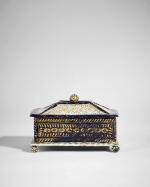
Embriachi Workshops | Italian, probably Venice, circa 1420-1440 | Hexagonal Casket with Scenes from the Life of Paris
Lot Closed
December 7, 03:15 PM GMT
Estimate
15,000 - 20,000 GBP
Lot Details
Description
Embriachi Workshops
Italian, probably Venice, circa 1420-1440
Hexagonal Casket with Scenes from the Life of Paris
bone and certosina (bone, horn and wood inlay), on a wood core
with a metal key
39 by 29cm., 15⅜ by 11½in.
Private collection, Spain
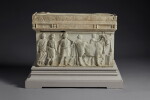
Hexagonal and octagonal caskets of the present type originated in the workshop led by Baldassare Ubriachi, whose name inspired the umbrella term of 'Embriachi', which has long been used to describe objects now thought to have been made in related workshops. The bone panels adorning this impressive casket illustrate four scenes from the life of Paris, a narrative which appears on numerous caskets from Ubriachi's workshop (for example two in the Victoria and Albert Museum, inv. nos. A27-1952 and A.19-1952): The infant Paris being handed to attendants of Queen Hecuba; the infant about to be stabbed due to the prophecy of the destruction of Troy; the shepherd Agelaus handing the infant to his wife; and the three goddesses on whom the adult Paris passes judgement. In contrast to Ubriachi examples, however, instead of further scenes from the narrative, the remaining plaques show more generic motifs of shepherds with herds of bulls. Stylistically the figurative panels on the present casket relate to works formerly categorised as the 'Second Susanna Workshop', which may represent either a later phase of the Ubriachi workshop's activity or the production of local imitators; see one such casket in the V&A Museum (inv. no. 4718-1859).
RELATED LITERATURE
P. Williamson and G. Davies, Medieval Ivory Carvings. 1200-1550. Part II, cat. Victoria and Albert Museum, London, 2014, nos. 265, 266 and 280
RELATED LITERATURE
P. Williamson and G. Davies, Medieval Ivory Carvings. 1200-1550. Part II, cat. Victoria and Albert Museum, London, 2014, nos. 265, 266 and 280
You May Also Like